Erythrulose: The First Sugar Baked in an Interstellar Furnace ✛ ✦
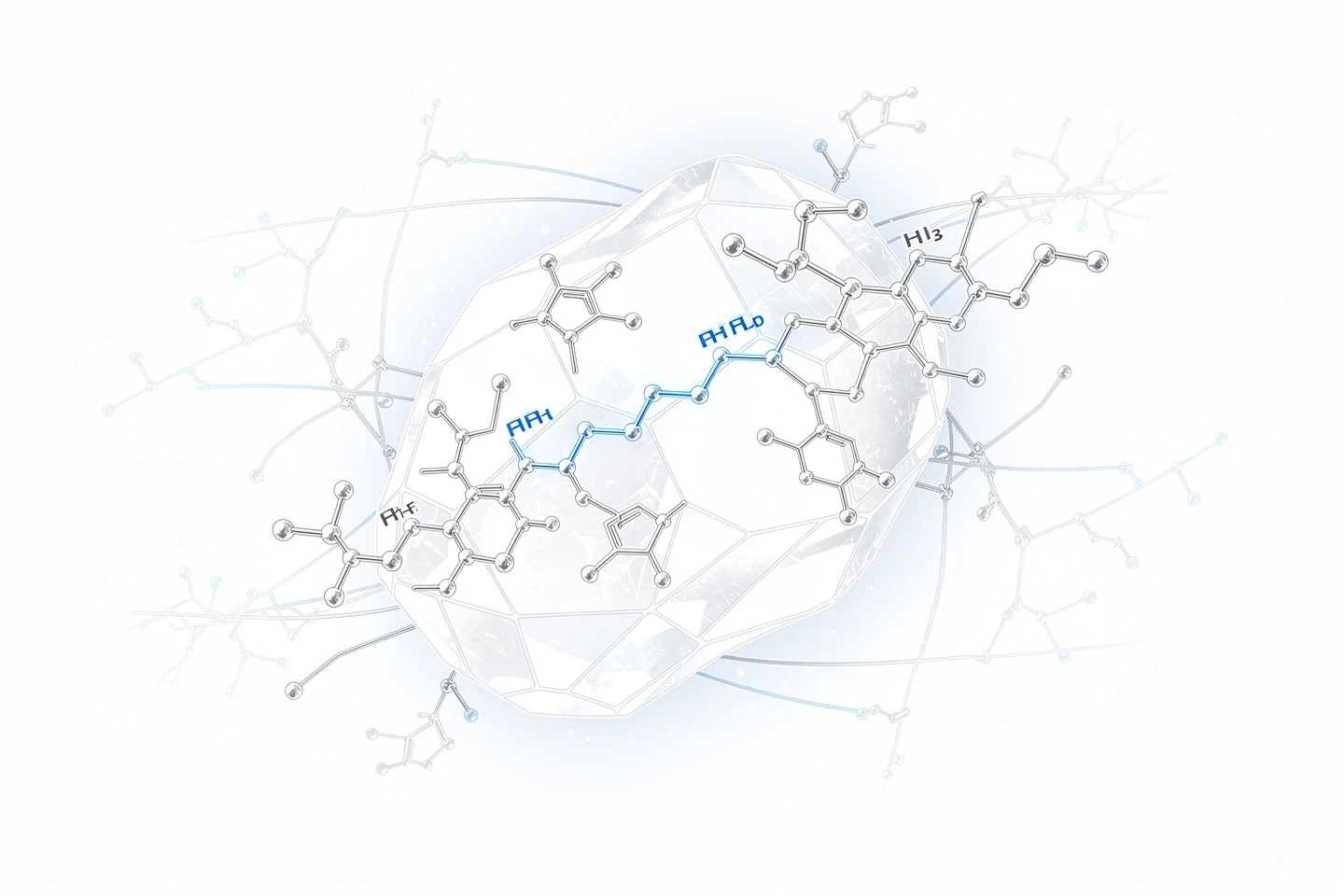
In the heart of the Milky Way, in the cloud G+0.693, astronomers caught a sweet signal — emission lines of erythrulose, a simple sugar with four carbon atoms and four oxygen atoms. To hear this molecular whisper, ultrasensitive radio spectroscopy on the Yebes and IRAM telescopes stared into the coldest furnace of the Galaxy for hours, accumulating photons. The legacy of Charles Townes and the precision of spectral analysis, pioneered by Joseph von Fraunhofer, helped decode the chemical barcode of the cloud. The new sugar’s abundance is only 6.4×10⁻¹⁰ relative to molecular hydrogen, but that’s tens of times higher than its three-carbon cousins.
The cloud G+0.693 acts like a pastry shop without heat or hurry. Here, at 11 kelvins, thermal motion almost freezes, and on cosmic dust grains coated with water and other ices, a subtle dance of radicals unfolds. Under cosmic ray impacts, molecules of glycolaldehyde and ethylene glycol neatly stitch into a four-carbon skeleton. This is not a bubbling broth, but rather ice engraving: no solvents, no high temperatures — only quantum mechanics and time.
The significance of the find goes far beyond astrochemical catalogs. Erythrulose can isomerize into aldoses, becoming a precursor to nucleic acids — for example, threose nucleic acid, a simpler analog of RNA. The interstellar cloud turns out to be not just a warehouse, but a genuine factory of prebiotic building blocks. Smashing into asteroids and comets, these sugars travel across the Galaxy and, under the right conditions, seed young exoplanets. The hypothesis of Fred Hoyle about the cosmic seeding of organics takes visible shape, and perhaps messengers like erythrulose once reached the primeval Earth.
Next up: the hunt for ribose and glucose with even more sensitive millimeter- and submillimeter-wave interferometers. Astrochemists plan to probe protoplanetary disks, where sugar dust may become part of planets and spawn new biospheres. The cold kitchen of the cosmos keeps revealing recipes, and our own biochemistry, it seems, began at an alien table. Curiously, to detect these spectral lines, telescopes had to accumulate the signal for hours — much like skin soaking up tanning cream, drop by drop, gaining a tint. In both cases, patience is needed for the molecular pattern to emerge.
Erythrulose is the active ingredient in self-tanners, giving skin a bronze tint. Now we know this substance floats in the cloud G+0.693, 27,000 light-years away from us.
In 'The Black Cloud,' Fred Hoyle imagined interstellar clouds as almost intelligent beings. Today we find sugars in them, real building blocks of biochemistry, and the fiction gains factual footing: clouds can indeed spread a prebiotic 'seed' throughout the Galaxy.