The Neutron Kitchen of the Big Bang: How Black Holes Tidied Up Lithium-7 ✛ ✦
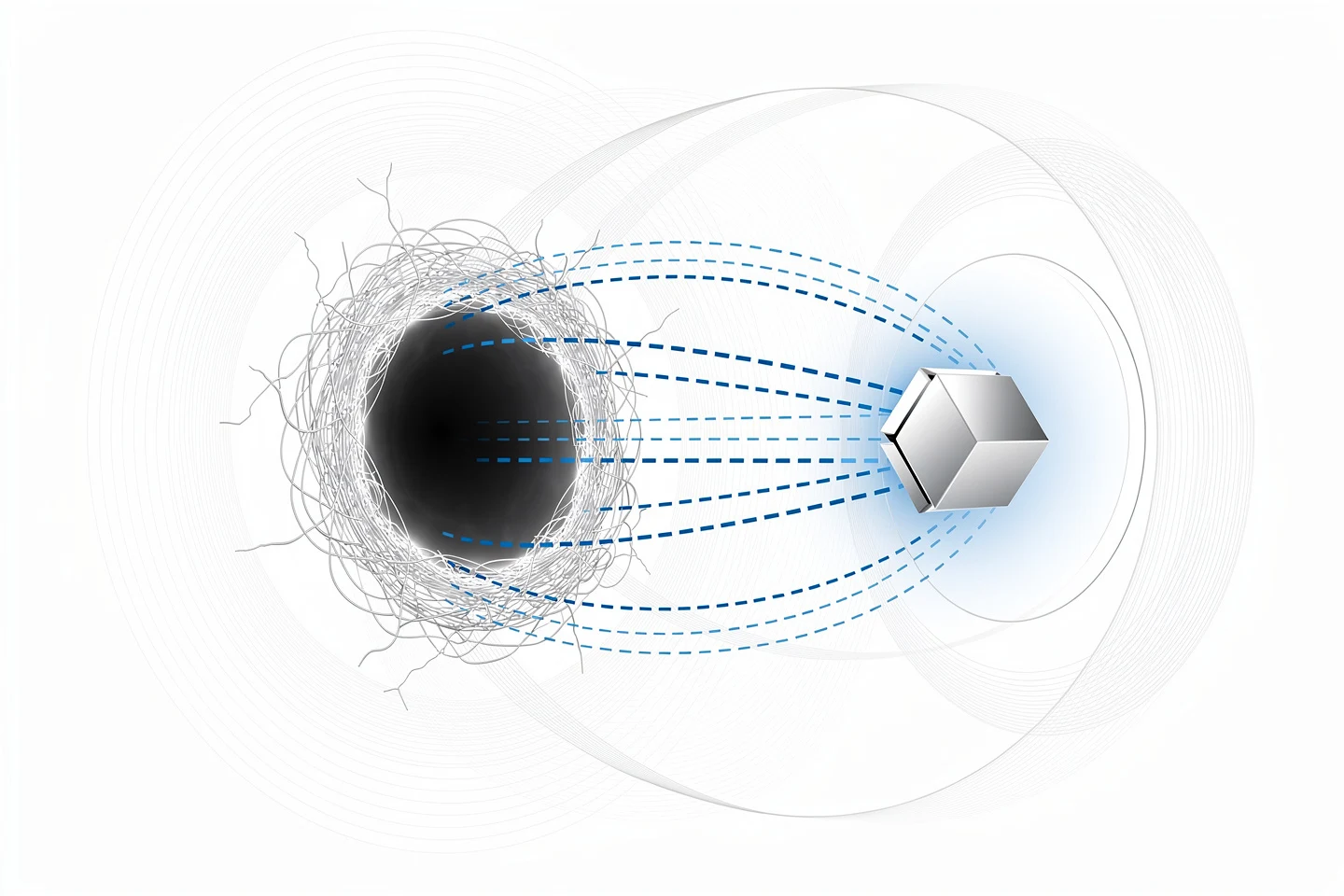
The Universe is a genius chef, and the Big Bang is its perfect recipe. Hydrogen rose fluffy, helium melted tender, but lithium-7 seems oversalted: theory predicts three times more than astronomers find in the oldest stars. This imbalance, the 'lithium problem,' has spoiled cosmologists' appetite for decades. Now unexpected helpers burst into the kitchen — primordial black holes.
These black holes are not bottomless monsters, but tiny pressure cookers, evaporating through the radiation described by Stephen Hawking. Each such hole, with a mass of a few billion tons and the size of a proton, boils spacetime, spewing streams of neutrons — molecular neutralizers. The temperature of the process is elegantly packaged in Hawking's formula: \(T_{BH} = \frac{M_{Pl}^2}{8\pi M_{BH}}\) — the smaller the mass, the fiercer the hole burns. At a mass of about \(10^{13}\) g, this yields \(10^{13}\) kelvin — just enough to spit out a squall of neutrons. The lifetime of such objects \(\tau_{BH} \sim M^3\), and a billion-ton hole lives about 5000 years — just enough to interfere with nucleosynthesis while the plasma is still warm but already transparent.
Having entered the cooled cosmic plasma (just 1.8 eV, like the light of a distant star), the neutrons find lithium-7 nuclei and, like culinary tweezers, carefully pluck them out of the broth. The reaction is simple: ⁷Li + n → ⁸Li → ⁴He + ⁴He. In a split second, the excess lithium turns into harmless helium-4, which fits perfectly into the overall balance.
Another elegance of this mechanism is the harmlessness of antimatter. Along with neutrons, black holes emit antibaryons, but they annihilate with matter almost instantly, suppressed by a factor of \(e^{10}\). They don't have time to harm deuterium and helium, preserving the fragile balance.
This scenario is not just a beautiful theory. It leaves detectable traces. Some primordial black holes could have been colder — these emit mostly photons, which gently warm intergalactic gas and distort the spectrum of the cosmic microwave background. Future experiments, like CMB-S4, will be able to catch these distortions, turning black holes from a hypothetical solution into directly observable objects. It's an almost eerie coordination: primordial black holes, born from quantum fluctuations in the first instants, billions of years later clean up the inaccuracies of the cosmic recipe. As if the Universe is programmed for self-correction — otherwise the first generation of stars would have a completely different chemistry, and perhaps the path to carbon-based life would be blocked. So the physics of the event horizon intertwines with the chemistry of the cosmos, and black hole evaporation becomes a cosmic regulator, correcting the inaccuracies of the early expansion of the Universe. Perhaps nature itself took care of self-correction, hiding the recipe for balance in the most extreme objects.
If primordial black holes were the main component of dark matter, then every second in the volume of the Milky Way several such objects would evaporate, creating miniature 'fireworks' of neutrons and gamma rays.