Evaporating Primordial Black Holes and the Mystery of Lithium-7 Deficit ✛ ✦
Context
The standard Big Bang scenario brilliantly describes the formation of light elements—hydrogen, deuterium, helium-3 and helium-4—whose predicted abundances match observations perfectly at a baryon-to-photon ratio η≈6×10⁻¹⁰. However, lithium-7 breaks this harmony: its calculated abundance is about three times higher than measured in the atmospheres of ancient stars (primordial nucleosynthesis yields ⁷Li/H≈5×10⁻¹⁰, while the observed value is ~1.6×10⁻¹⁰). This discrepancy, known as the "lithium problem," could not be explained by nuclear physics or modifications to cosmological parameters without destroying the agreement for other elements.
Methods
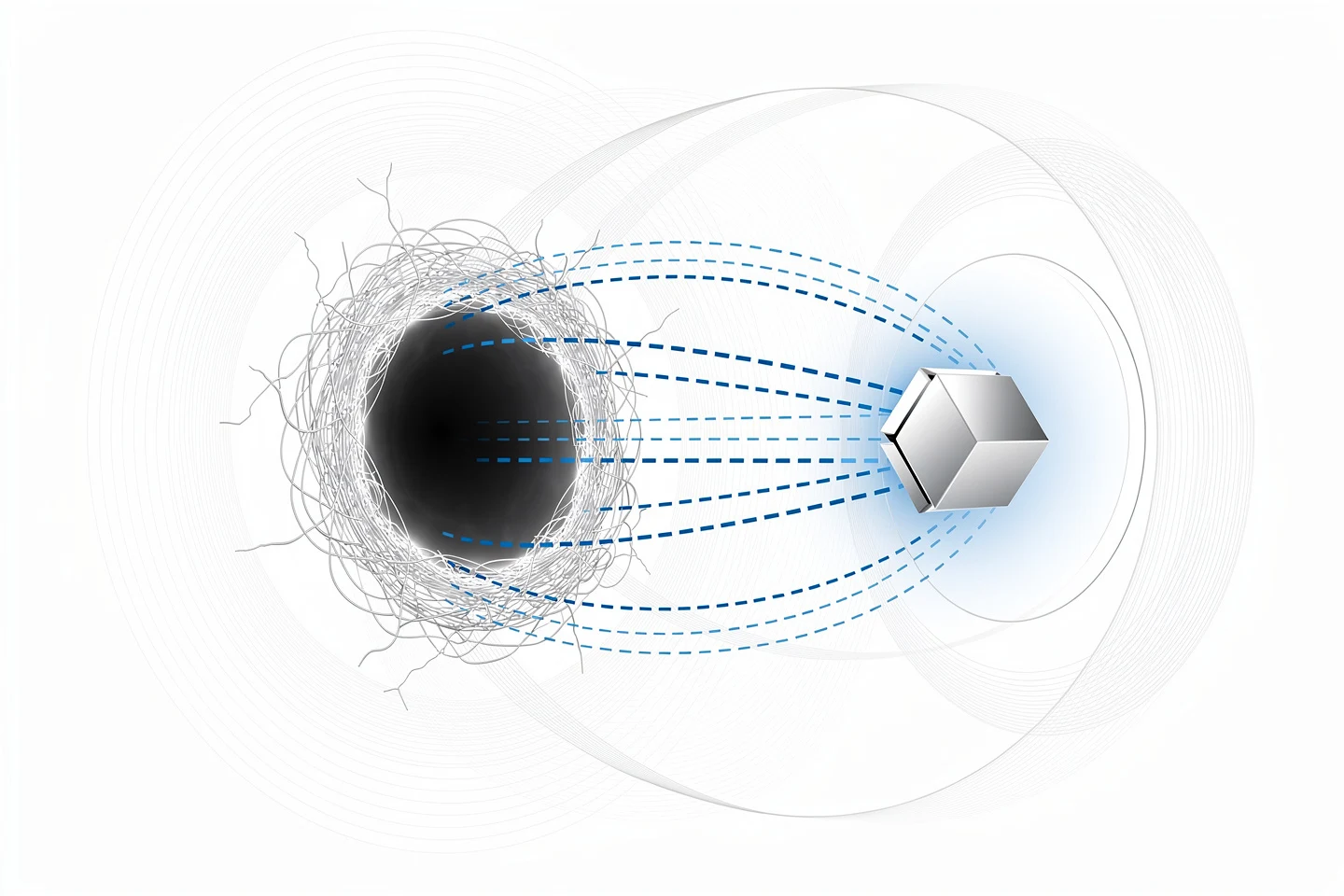
The researchers considered a population of primordial black holes (PBHs) born in the early universe from the collapse of overdense regions. According to the Hawking mechanism, a black hole radiates like a black body with a temperature inversely proportional to its mass. For "hot" PBHs with a temperature of ~1 GeV (mass around 10¹³ g), evaporation actively produces nucleons—neutrons and protons. These neutrons, entering the already cooled cosmic plasma at ~1.8 eV (in the era just before hydrogen recombination), can be captured by ⁷Li nuclei, triggering reaction chains ⁷Li + n → ⁸Li + γ or ⁷Li + n → ⁸Be + γ. The resulting ⁸Li and ⁸Be are unstable and within fractions of a second decay into two ⁴He nuclei. Numerical modeling, based on known neutron capture cross sections for lithium and PBH lifetimes, showed that at a reasonable black hole density, the amount of destroyed lithium is sufficient to compensate for the excess.
Results
Key result: at an allowable PBH density that does not disturb the abundance of helium-4 and deuterium, the lithium-7 concentration is suppressed by a factor of e ≈ 2.7. This almost exactly eliminates the discrepancy between theory and observations. Importantly, antibaryons, also emitted during evaporation, efficiently annihilate with the baryon background: calculations give a suppression factor of e⁻¹⁰, so they do not have time to destroy the precious relic nuclei of ⁴He and D. Additionally, "cold" PBHs (temperature ≤ 100 MeV) that emit photons instead of nucleons were considered; such photons, scattering off electrons, can contribute to the reionization of the cosmic microwave background and distort its spectrum at low frequencies.
Implications
The proposed mechanism for the first time naturally connects black hole physics with the chemical evolution of the early universe. It does not require introducing new particles or exotic physics beyond the Standard Model and general relativity; it merely assumes the existence of a population of PBHs with suitable masses. This strengthens the status of PBHs as a universal tool for solving cosmological puzzles — from dark matter to sources of gravitational waves. Moreover, the result highlights that processes near the event horizon can leave observable imprints on the large-scale structure of the cosmos.
Future development
The topic could develop in several directions. First, more precise measurements of the ⁷Li + n reaction cross section in the astrophysical energy range are needed. Second, the predicted distortions in the cosmic microwave background (both spectral and anisotropies) could be tested by new observational missions, such as future CMB-S4 class satellites. Third, the "cold" black hole scenario deserves detailed kinetic modeling that accounts for photon transport and thermalization in the expanding plasma, to reliably calculate the contribution to reionization and constrain PBH parameters.
Impact
This work will impact cosmology, particle astrophysics, and observational astronomy. It stimulates the search for correlations between anomalies in light element abundances and signals from primordial black holes, including gravitational waves and gamma-ray bursts.
Next steps
Immediate next steps include analyzing data from the James Webb Space Telescope and ground-based surveys for spectral distortions in the cosmic microwave background, as well as laboratory experiments to refine nuclear cross sections for lithium.
Key open problems
The research intimately connects the lithium problem with the dark matter mystery (if PBHs make up part of it) and the nature of singularities in quantum gravity. It also raises the question of how primordial black holes are distributed in mass and what their total density is — one of the key unresolved questions in modern physics.
The knowledge machine's view
This section is addressed to the author of the paper and their colleagues. Neighbouring works were found by meaning-based search across our archive, not by word overlap. We do not review: we show the field around the work.
What the work does
The paper examines the mechanism of suppressing primordial lithium-7 via neutrons produced during the evaporation of primordial black holes with masses around 10^13 g. Numerical simulations that account for neutron capture cross sections on lithium show that, at an allowed PBH density, the 7Li abundance decreases by a factor of e, which nearly eliminates the discrepancy between theory and observations. It is also noted that antibaryons do not destroy deuterium or helium-4, and cold PBHs could affect reionization.
Where its strength is
The idea of using evaporating PBHs as a neutron source for nonstandard nucleosynthesis elegantly connects black hole physics with the chemical evolution of the early Universe without introducing new physics. The calculation shows that the effect can be quantitatively significant and compatible with constraints on other light elements.
Where it could go next
- It might be interesting to compare the proposed scenario with alternative solutions to the lithium problem, such as models involving new particles, as in the work on a two-particle recipe for the right lithium, to understand which observational consequences distinguish them.based on: A Two-Particle Recipe for the Right Lithium arXiv:2604.01324
- A related study examines how primordial black holes could have affected the expansion rate of the Universe through energy injection; it would be curious to check whether your scenario imposes additional constraints on PBH parameters due to their influence on the cosmological background.based on: Cosmic Hot Tap: How Primordial Black Holes Rewrite the Speed of the Universe arXiv:2607.18528v1
- There is a paper in the archive on the formation of primordial black holes; perhaps one could consider which specific formation mechanisms for PBHs with the required mass and density are compatible with your scenario, to close the picture from generation to nucleosynthesis.based on: How the First Black Holes Are Born arXiv:2606.30641
Worth trying
- Test how uncertainties in the Hawking radiation spectrum for PBHs with masses around 10^13 g affect neutron yields and the resulting lithium suppression.
- Consider the impact of injected neutrons on beryllium and boron production to identify additional observational signatures.
- Assess whether PBH density fluctuations could lead to spatially inhomogeneous lithium suppression, which would be reflected in the dispersion of abundances in old stars.
Why this may matter
If the proposed mechanism is confirmed, it would provide further evidence for the existence of primordial black holes and allow the lithium problem to be used as an indirect probe of early Universe physics.
Nearby works in our archive
- Symphony of Nucleosynthesis: How a Sudden Tempo Saved Deuteriumsimilarity 0.67
- A Two-Particle Recipe for the Right Lithiumsimilarity 0.65
- Black Holes That Didn't Evaporatesimilarity 0.64
- Why is there less lithium than the Big Bang promised?similarity 0.63
- Cosmic Hot Tap: How Primordial Black Holes Rewrite the Speed of the Universesimilarity 0.63
- How the First Black Holes Are Bornsimilarity 0.62
The closest work in the archive sits at 0.67 by meaning — the usual level for our corpus.
Original abstract
as written by the authors arXiv:2606.03316v2
A reduction mechanism of the theoretically predicted excessive abundance of $$^7$$Li via baryons evaporated by primordial black holes is suggested. It is shown that the fraction of $$^7$$Li with respect to the number density of baryons can be diminished down to the observed value via the process of $$^7$$Li transformation by neutron capture. The created in this process $$^8$$Li or $$^8$$Be quickly decay into a pair of $$^4$$He nuclei.
If primordial black holes were the main component of dark matter, then every second within the volume of the Milky Way, a few such objects would evaporate, creating miniature "fireworks" of neutrons and gamma rays.
Key numbers
- Lithium-7 deficit: Observed concentration is ~3 times less than theoretical
- Hydrogen recombination temperature: 0.27 eV
- Lifetime of a black hole with mass 10^13 g: 1.6×10¹¹ seconds (~5000 years)
- Baryon-to-photon ratio η: 6×10⁻¹⁰
- Suppression efficiency of antibaryons: Factor e^{-10}, rendering them harmless