How Black Holes Get Their Gas: Webb's Discovery ✛ ✎ ✦
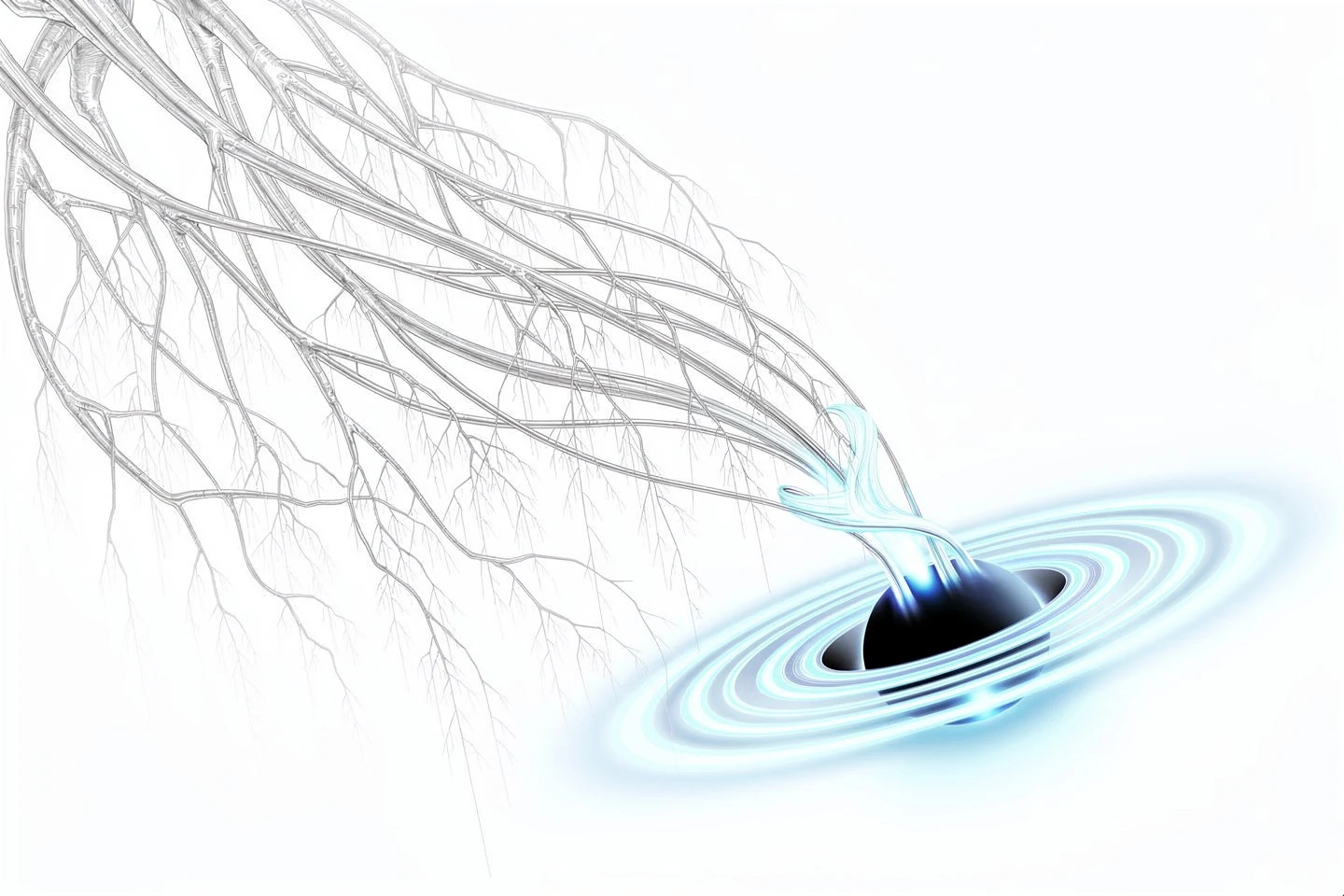
Way back when, Edwin Hubble showed that galaxies are distant islands of stars. Now we know that supermassive black holes lurk at their centers — cosmic drainpipes sucking in gas. The mystery remained: how exactly does the gas find its way to the drain, like water circling a sink?
The Webb telescope, with its ability to peer through dust, set its sights on galaxy NGC 4696. Just 400 light-years from the black hole, it spotted a rotating disk of gas. A bright filament of hydrogen extends from it, like a pipe feeding a hot stream straight into the funnel. Spectroscopy (parsing light into colors) clocked the speeds: different parts of the disk race at speeds differing by 600 km/s. In one second, that gas covers about the distance from San Francisco to Los Angeles.
This picture backs up models that include dark matter (whose gravitational pull on galaxies was calculated by Vera Rubin) and infall dynamics described by Subrahmanyan Chandrasekhar. So it turns out black holes don't feed haphazardly: they dine via a tidy system of filaments and disks: a cosmic water-supply network.
The infrared light Webb captures allowed us to see gas structures the size of our Solar System, even though the galaxy is 43 million light-years away.
It's reminiscent of Fred Hoyle's novel The Black Cloud: there, clouds also steer matter into the right channel themselves.