What a Giant Planet Was Baked From express
WASP-121 b is not just a hot ball. It's a world where iron vaporizes and the sky glows with its own heat. A fresh look at it has revealed what 'ingredients' went into making it.
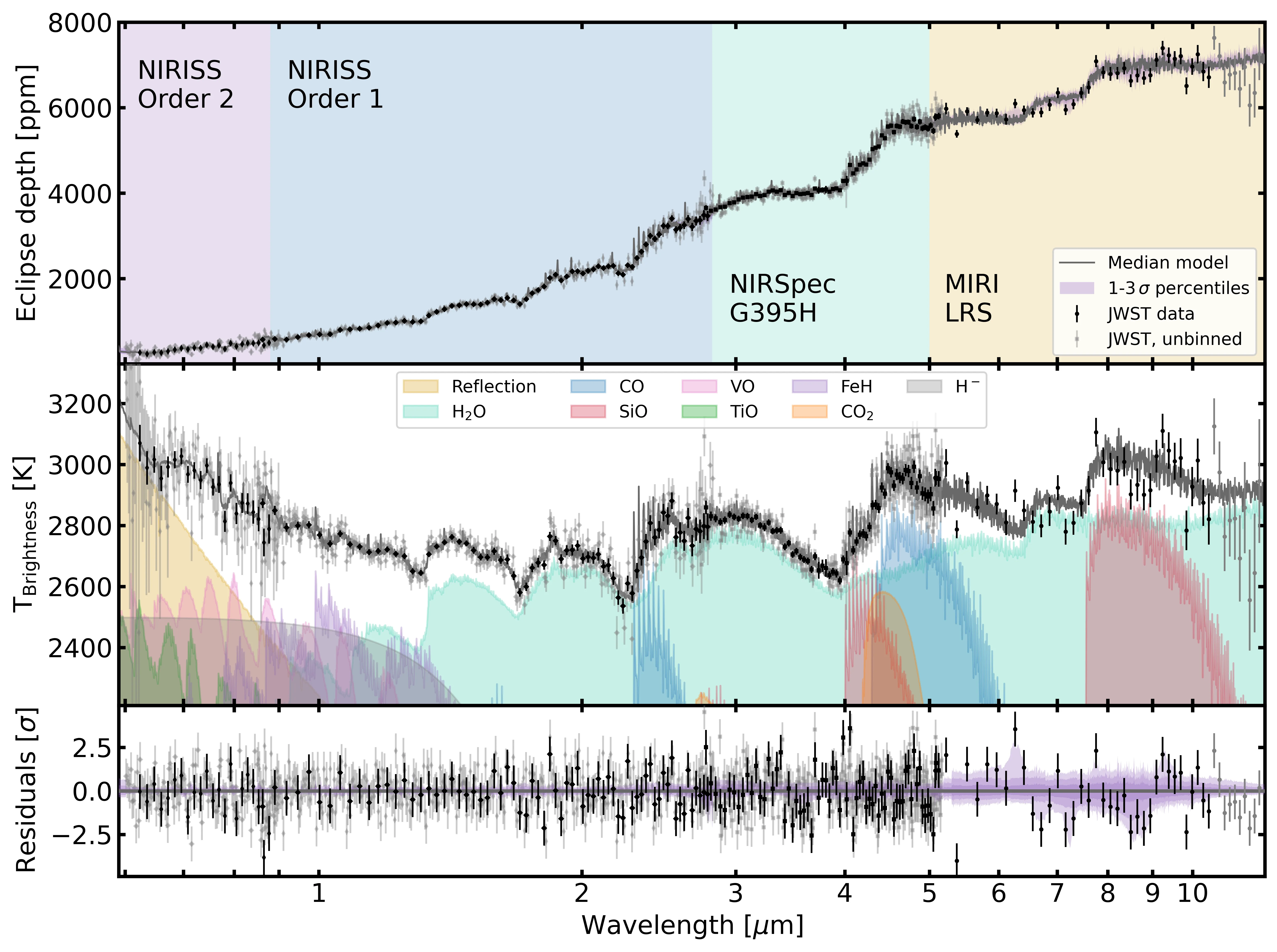
Scientists combined new data from three of Webb's instruments and added ground-based measurements of the host star's composition. The result is a complete picture: the planet's air contains both light gases (water, carbon monoxide) and heavy elements (silicon, iron). But the most intriguing part is the ratio. Silicon relative to oxygen and carbon turned out to be more than three times higher than in the star. Such a 'recipe' couldn't have come from a single source. It seems that in its youth, the planet gathered material from different zones of the protoplanetary disk — some as solid bodies, some as gas. Then it experienced a jolt that tilted its orbit nearly 90 degrees relative to the star's rotation axis. Modeling suggests this could have been a close encounter with another planet or a long dance with a distant stellar companion.
Original abstract
as written by the authors arXiv:2606.21855
One path to understand how planets form is to link their present-day atmospheric composition to predictions from planet formation models. For the hottest planets, the abundances of refractory species can provide a useful formation tracer, complementing the traditionally used C/O and overall metallicity. Here we investigate the refractory abundance in the atmosphere of the ultra-hot Jupiter WASP-121 b, combining new JWST MIRI/LRS observations with archival NIRSpec/G395H and NIRISS/SOSS data to obtain a panchromatic dayside emission spectrum from 0.6 to 12 $$\mu$$m. Our retrieval analysis detects the refractory tracer SiO gas at high confidence, in addition to previously detected volatile species. The atmosphere is enriched in volatile and refractory species, with enhanced refractory-to-volatile ratios of Si/O=$$3.54^{+0.86}_{-0.69}$$x stellar and Si/C=$$3.05^{+1.12}_{-0.80}$$x stellar, relative to new stellar abundance constraints from ESPRESSO data. In addition, we confirm the depletion of TiO and the need for an additional source of reflected light opacity with a geometric albedo of $$0.22\pm0.03$$. The retrieved dayside temperature profile has a strong inversion layer, with a more complex structure than standard parameterizations can accommodate, and an eclipse map analysis indicates a small eastward hotspot offset of $$4.8^{+2.7\circ}_{-2.8}$$. Comparing our results with models of planet formation, we find that the measured enrichment pattern was shaped by accretion from multiple reservoirs, either through a mixture of solid and gas accretion interior to the water ice line or through continued solid accretion during inward migration from farther out in the disk. Finally, we model the planet's dynamical history and find that it could reach its current high-obliquity orbit as a consequence of a post-formation dynamical event, such as planet-planet scattering or von Zeipel-Lidov-Kozai cycles.
The daytime temperature on WASP-121 b reaches 3000 degrees Celsius — enough to melt steel, and metal vapors float in its atmosphere.
A similar world is described in Arthur C. Clarke's novel 'Rendezvous with Rama'—except there, a scorching object comes to us from interstellar space.