An Interstellar Visitor Wrapped in Amorphous Glass Dust express
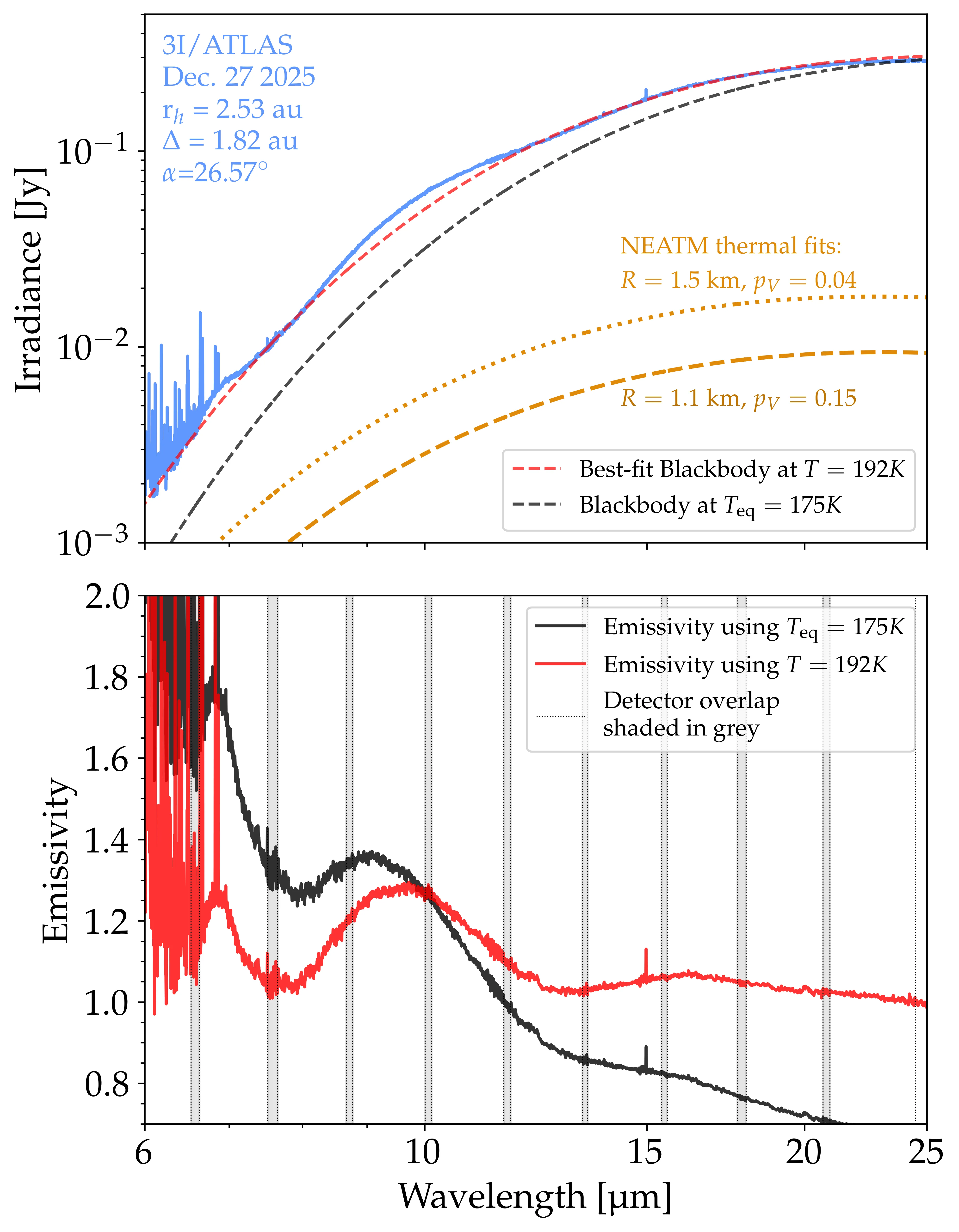
In 2019, an unusual visitor, comet 3I/ATLAS, zoomed into the Solar System. It came from another star, and for the first time, astronomers were able to see what its dusty tail is made of. The MIRI instrument on the James Webb Space Telescope caught a characteristic emission peak at a wavelength of 10 microns. Such a signal is familiar from interstellar dust and from the distant disks around young stars where planets are just being born.
That peak revealed the dust's composition. Comets in our system are usually rich in crystalline silicates — tiny grains with an ordered structure, like sand grains shaped by nature. 3I/ATLAS is different: its dust is almost entirely amorphous silicates — shapeless, like solidified glass. It resembles the raw material of the interstellar medium more than the mixed-up stuff that makes up our comets.
Why is that? Perhaps 3I/ATLAS was born on the outskirts of its system, where material never passed through the furnace of temperatures near the star. There were no conditions for crystallization. Alternatively, over a billion years of wandering, cosmic rays might have shattered the crystals, turning them into an amorphous state. But the authors doubt this: the object is losing mass too quickly, and its dust spectrum differs from what is seen in "aged" comets of the Solar System.
The telescope captured a signal that came to us from a wanderer that never knew our Sun. Its dust is a frozen story of another world, and now we are learning to read it.
The dust grains in the coma of 3I/ATLAS resemble not beach sand but tiny shards of volcanic glass: they were never crystals.
In Arthur C. Clarke's novel "Rendezvous with Rama," humanity encounters an interstellar object, but its true nature turns out to be far more artificial than our icy wanderer.