The Hourglass of an Ancient Galaxy: JWST Spots Maturity That Arrived Too Soon ✛ ✎
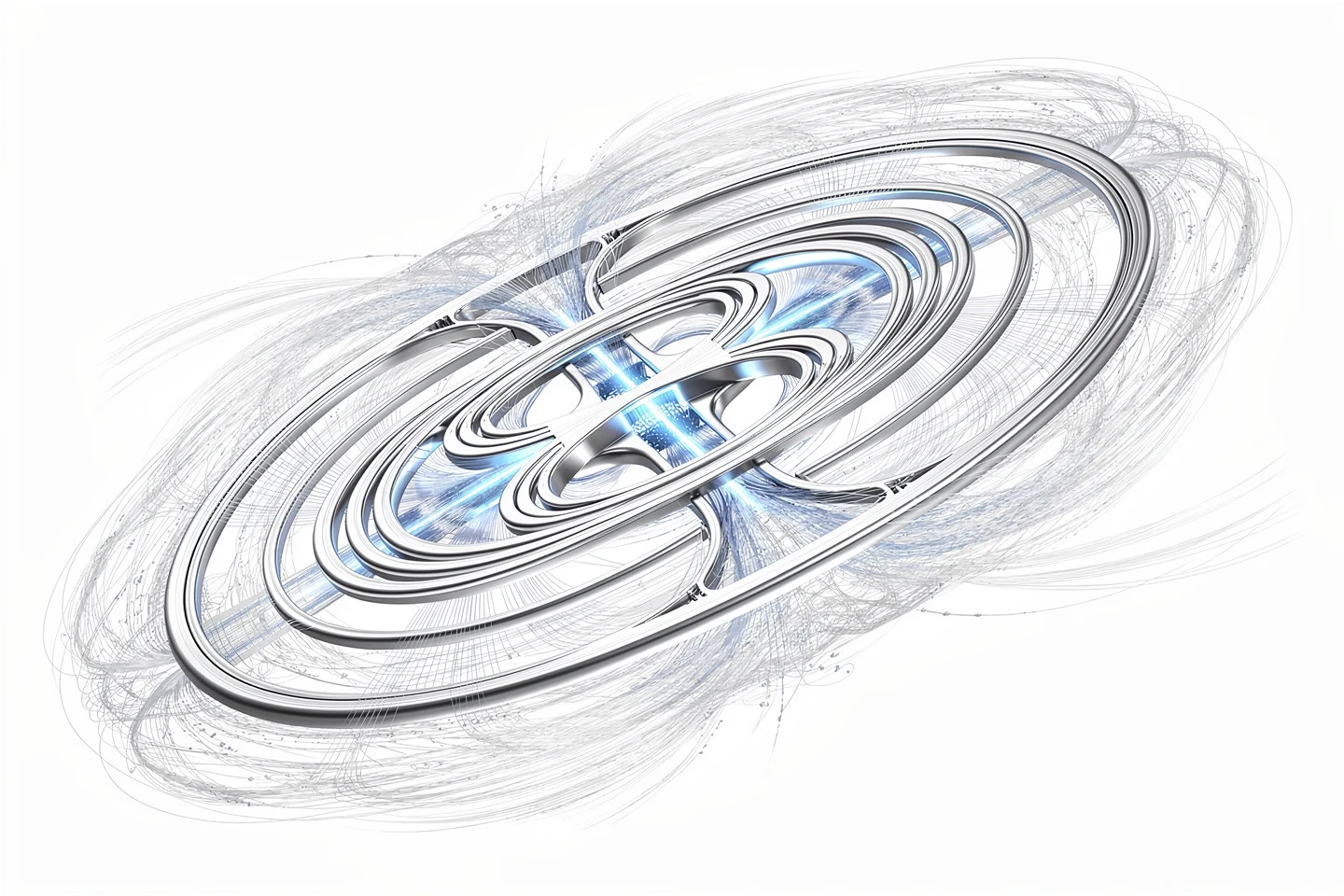
When we peer deep into space, we see the past. Edwin Hubble’s law turns redshift into a time machine: light from galaxy UDS 12999 traveled to us for 7.6 billion years — more than half the age of the Universe. What appeared before the lenses of JWST surprised even seasoned theorists: it wasn't a shapeless heap of stars, but a sleek disk system, as if straight off a modern astronomical “catwalk”. It already sported a galactic bar, a dense core, and, the key feature, an elegant X-shaped bulge. It’s as if someone set an evolutionary hourglass running, with sand of hydrogen and dark matter, and it measured out maturity in just a few billion years.
The secret to its rapid maturation lies in the bridge — the bar. This elongated structure of stars and gas acts as a giant transport corridor. Like the neck of an hourglass, the bar funnels matter from the disk’s outskirts into the center. There, in a tight ring about 800 parsecs across, a nuclear stellar disk is born — akin to a plug of compressed sand. But the bar does not stay the same: as it accumulates mass, it becomes unstable and “buckles” vertically, forming the characteristic X-shaped profile seen edge-on. It’s this structure — stretched to 4.5 kiloparsecs: that was captured by JWST and Hubble in eight infrared filters. Modeling showed that the four arms of the X-bulge are symmetrical, like butterfly wings, and are populated by stars that ceased forming about 270 million years ago — true fossils of that turbulent era.
This discovery shatters previous timescales. The total time to form the disk, bar, and X-bulge fell within an interval of 3.8 to 5.4 billion years; a stellar mass of 77 billion solar masses was assembled at a breakneck pace — up to 50 solar masses per year at its peak. This means that already 6.2 billion years after the Big Bang, some galaxies were running the full cycle of secular evolution. Theorists, recalling the pioneering work of Vera Rubin on galaxy rotation and the predictions of dark energy orchestrating expansion, face a tight constraint: in the inner regions, the baryonic component must dominate, enhancing gravitational instability and accelerating dynamics.
The next step is to search for such “early hourglasses” at even higher redshifts. High-resolution spectroscopy with the NIRSpec instrument will allow us to measure stellar kinematics and confirm the bar’s age. Joint efforts by JWST, future giant telescopes, and supercomputer simulations will help clarify how dark matter conducts this cosmic ballet. Perhaps the timeline of galaxy evolution will be rewritten, and we will see that mature structures are born almost immediately after the Big Bang, as if the Universe was in a hurry to populate its expanses with orderly systems. From the primeval atom hypothesis of Georges Lemaître to modern simulations, the story of galaxies is being written anew.
Stars in the X-shaped bulge move along orbits resembling an hourglass: they rise and fall, creating vertical streams that give the structure its “X” shape when seen edge-on.