Cosmic Carving: Birth of a Bloated Neptune from a Jupiter ✛ ✎
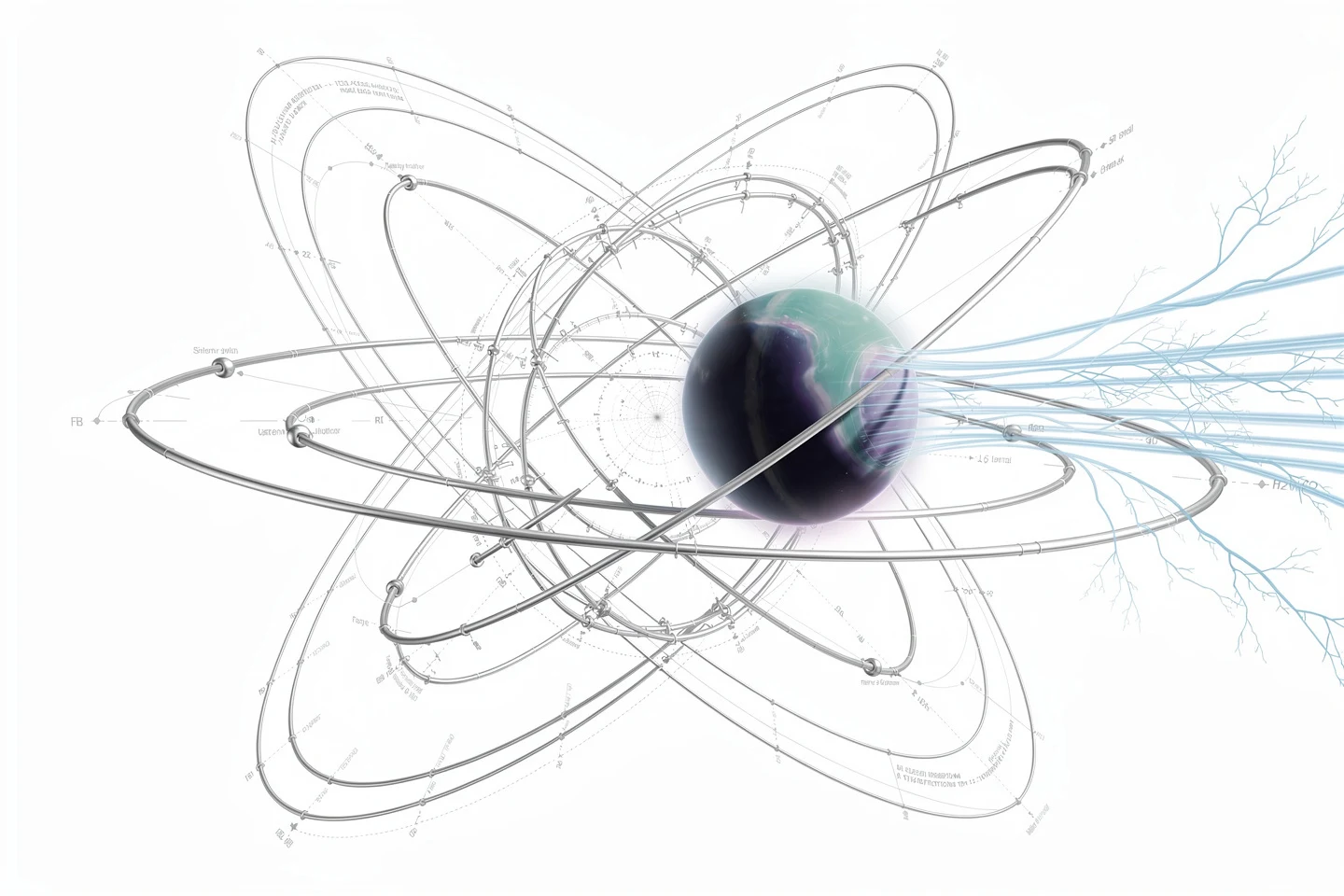
A ball, almost weightless for its size, circles its star every four days. Planet TOI-2195 A b is a real riddle: by mass it's slightly heavier than Neptune, yet bloated to Jovian volumes. If there were an ocean big enough, this exoplanet would float on its surface like a giant inflatable ball. This odd world moves on a steeply inclined, nearly polar orbit — as if hurled into the system at an angle. Where did such a fluffy giant come from?
The answer lies in brutal gravitational sculpting. Imagine a block of marble — a distant, cold Jupiter tens of astronomical units from its star. Then the chisel comes into play: the gravity of a distant companion star, which via the Kozai–Lidov mechanism rocks the orbit, stretching it into an extreme ellipse. At pericenter, the planet comes so close to the star that it crosses its Roche limit — the distance at which the parent star's tidal forces tear away its outer layers. This critical threshold is described by a simple formula: \[ r_t = R_p \left(\frac{M_\star + m_p}{m_p}\right)^{1/3} \] Here \( R_p \) is the planet's radius, \( M_\star \) and \( m_p \) are the masses of the star and planet. Once past this barrier, the planet began bleeding its hydrogen-helium atmosphere, losing up to 90% of its original mass. From the monumental Jupiter, only a core remained with a bloated, superheated envelope — a hot Neptune born in agony.
This metamorphosis is no isolated oddity. Many hot Neptunes may be 'gutted' giants, which explains their similarity to hot Jupiters in metallicity and orbital architecture. At the core of it all are the transit method, perfected by William Borucki in the Kepler mission, and high-resolution spectroscopy, standing on the shoulders of pioneer Cecilia Payne-Gaposchkin. These tools allowed not only weighing the planet but also catching the faint signal of the Rossiter–McLaughlin effect, betraying its polar plunge. Evolutionary models showed that tidal heating sharply raised the entropy of its interior, and the planet is still slowly cooling, puffing thermal radiation.
Ahead lie observations with JWST that will probe the atmosphere's composition: is there water, methane, traces of evaporated metals? It's like peering into slices of cosmic carving to see how many layers were peeled away. Statistics on many such 'transitional forms' will one day connect the evolutionary line from Jupiter embryos to rocky worlds.
TOI-2195 A b's radius is almost equal to Jupiter's, while its mass is only 1.5 times that of Neptune. If placed in water, it would float like a giant balloon.