Simple

Black Holes Remember More Than You'd Think ⚡ экспресс

Original: "Black Hole Memory Burden and its Signatures in Gravitational Waves from Mergers"
A black hole stores more information than its victim.
Abstract

Imagine: a black hole, like a giant sack of secrets, changes the ripples in space — gravitational waves — depending on how many mysteries are hidden inside it. Scientists have discovered that this 'sack' can hold far more information than the star that gave birth to it had. And the most secrets are in black holes born from particle collisions. Could this be the key to unraveling the universe's past?

Links in the knowledge graph 1

A black hole works like a stretched string: every grain of matter that falls in doesn’t vanish but adds tension, like a finger pressing the string harder against the fretboard. That’s how its information accumulates. But the most striking fact is that even a microscopic hole from particle collisions can pull tighter than a giant star—like a spider’s thread ringing higher than a ship’s rope.

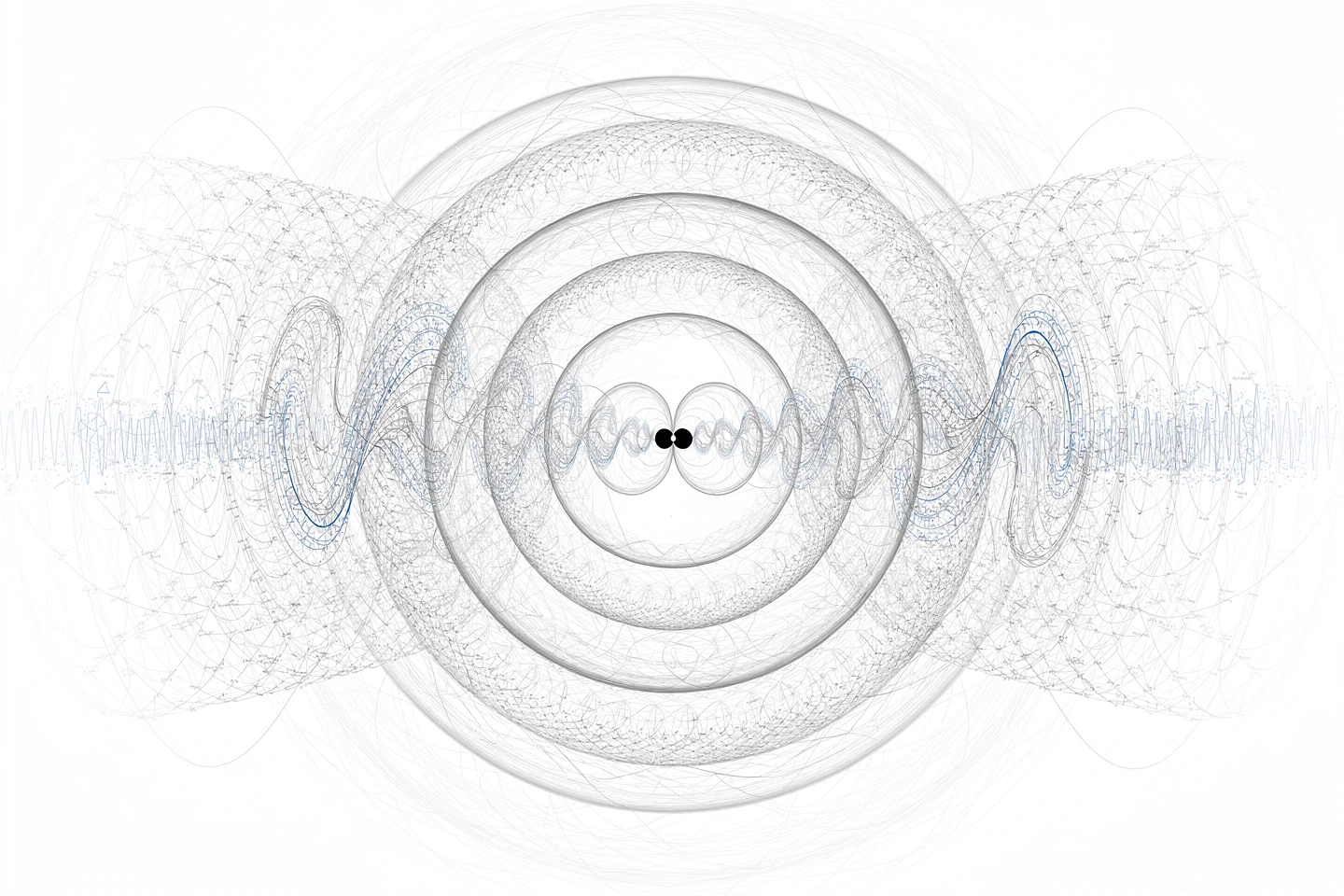
When two black holes merge, their 'strings' intertwine and start vibrating, emitting gravitational waves—ripples in spacetime itself. The tone of these waves depends directly on the overall tension: the more memory the holes carry, the higher the frequency. By catching such a shift, sensitive detectors can reconstruct the pair’s birth story—from a supernova explosion or from a collision of elementary particles.

The insight that a black hole stores information came from Bekenstein and Hawking, and ’t Hooft showed that this memory is etched directly into the quantum fabric of reality. Today, gravitational-wave observations offer a chance to test their ideas directly.

🎯 Even a microscopic black hole from particle collisions can store more information than a massive star.

🎬 In the movie 'Interstellar', a black hole stores information that saves humanity—an idea echoing real research on how black holes process data.

Scientists
Stephen HawkingJacob BekensteinAlbert EinsteinFritz ZwickyVera RubinBernhard Riemann
Tags
black hole gravitational waves entropy supernova
Laws
second law of thermodynamicsHawking radiationgravitational lensingBekenstein-Hawking entropyEinstein field equationsBoltzmann distribution
Original: arXiv:2607.03560 · CC BY 4.0 · bridge42worlds