Gravitational Waves as a Mirror of Black Holes' Information Memory ✛ ✦
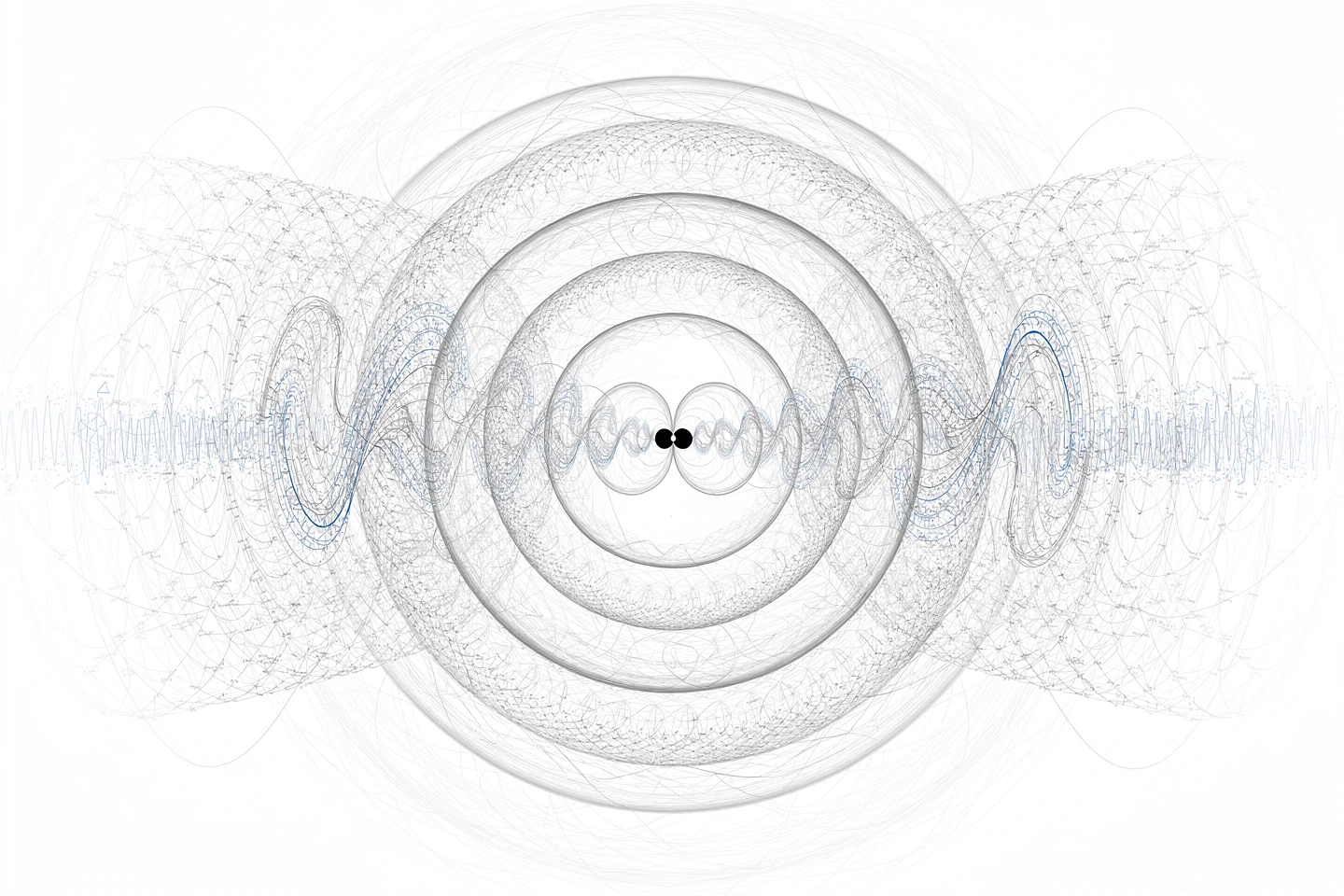
Context
Traditionally, the enormous Bekenstein–Hawking entropy of black holes was seen merely as a measure of information storage capacity, not affecting the dynamics of objects that John Wheeler dubbed 'black holes.' But the memory burden effect radically changes this picture: Bekenstein and Hawking showed that a black hole has a colossal number of microstates, and it now emerges that which specific microstates are realized can alter the hole's response when disturbed. This is especially important for black hole mergers, which generate gravitational waves picked up by LIGO. Just as the weight of a backpack shapes a hiker's gait, the information load changes how a black hole responds to external nudges.
Methods
The effect is modeled using a master mode and memory modes. The master mode, describing the black hole metric, interacts with a large number of memory modes that carry information. At a critical occupancy of the master mode, the energy gaps of the memory modes vanish, leading to a degeneracy of microstates. The parameter μ (storage efficiency) and the critical exponent p determine how strongly a perturbation shifts the resonant frequency. The analysis uses a Hamiltonian where, near the critical point, the gaps behave as (1 - n₀/$N_c$)^p, and information from the collapsing source — say, a supernova at the final stage of stellar evolution — is encoded in the excitation pattern of these modes. This employs a quantum-information approach, including entanglement among the modes, capturing subtle correlations beyond classical physics.
Results
The main result is a formula for the relative frequency shift of spectroscopic lines in the gravitational-wave 'ringdown' (quasinormal modes): |Δf/f| ≈ μ⁻¹ |δg|^{2(p-1)}. Here δg is the metric perturbation amplitude. The shift direction depends on the parity of p: for odd p, the frequency redshifts, for even p, it blueshifts. For black holes born from two-particle collisions, the memory is nearly maximal: μ⁻¹ ∼ 1/√S. For stellar collapse, μ⁻¹ spans a vast range — from 10⁻¹² (if all source details are copied) to 10⁶⁶ (if only uncorrelated features count). This means the observable signal could be absent or overwhelming. Analysis of event GW250114 already places constraints on p.
Implications
These results turn gravitational waves into a tool for probing information storage mechanisms in black holes. For the first time, it becomes possible to distinguish dark matter in the form of primordial black holes — if they carry the maximum memory burden, their mergers will show a characteristic frequency shift. Conversely, black holes of stellar origin might be 'almost empty.' Thus, gravitational-wave astronomy becomes a laboratory for quantum gravity.
Future development
Future work calls for more detailed modeling of the nonlinear merger stage, when metric perturbations are large. The memory burden effect might alter not just the frequency but the very shape of the signal, requiring a revision of event detection templates. Research is also needed on how to 'lighten' a black hole's memory through external influence — like unloading an overstuffed information backpack.
Impact
The results will impact not only gravitational-wave physics but also cosmology (the nature of dark matter), astrophysics (stellar collapse mechanisms), and quantum field theory.
Next steps
The next step is to refine the μ parameter for astrophysical black holes through more realistic modeling of information encoding, and to search for memory burden signatures in LIGO and Virgo data.
Key open problems
The memory burden effect is directly tied to the black hole information paradox: if information influences dynamics, its role in the evaporation process becomes tangible, and its loss is no longer a mere mathematical abstraction. Moreover, it challenges the traditional 'bald' model and demands a microscopic theory of quantum gravity.
The knowledge machine's view
This section is addressed to the author of the paper and their colleagues. Neighbouring works were found by meaning-based search across our archive, not by word overlap. We do not review: we show the field around the work.
What the work does
The study demonstrates how the memory burden effect influences the gravitational-wave response of black holes. The authors construct a model of the dominant mode interacting with memory modes and derive a formula for the frequency shift of quasinormal modes as a function of perturbation amplitude and information storage parameters. Using the event GW250114 as an example, constraints are placed on the critical exponent p.
Where its strength is
This work provides a concrete observational signature of information memory—a shift in spectroscopic lines that can be searched for in LIGO data. It turns the abstract idea of black hole microstates into a testable quantity.
Where it could go next
- It might be interesting to see how the memory burden effect manifests in mergers of primordial black holes, which are considered dark matter candidates. There is a nearby analysis that examines the impact of such objects on cosmological evolution, and transferring the proposed method to this class of sources could provide a new way to identify them.based on: Cosmic Hot Tap: How Primordial Black Holes Rewrite the Speed of the Universe arXiv:2607.18528v1
- The archive contains a rapid review of a paper suggesting that black holes remember everything and that this alters their oscillations. It may contain additional details about memory models that could be compared with your approach to refine the parameter range for μ and p.based on: Black Holes Remember Everything: Memory Burden Alters Their Oscillations arXiv:2509.22540
- The idea that gravitational waves leave a permanent imprint on spacetime resonates with your analysis of memory modes. It would be interesting to explore how nonlinear memory effects, discussed in a neighboring paper, might influence the frequency shift under strong perturbations.based on: Gravitational Waves Leave an Eternal Imprint arXiv:2605.27500
Worth trying
- Check whether the frequency shift formula holds when nonlinear corrections from gravitational memory are included, using the approach from paper 2605.27500.
- Estimate how the constraints on p from GW250114 would change if primordial black holes with different parameters are considered, as in the analysis 2607.18528v1.
- Compare the predictions of your model with the results of the rapid review 2509.22540 for the case of maximal memory to identify common patterns.
Why this may matter
If the memory burden effect is confirmed observationally, it would open a new channel for probing the quantum nature of black holes and allow distinguishing between different formation scenarios, including primordial black holes as a dark matter component.
Nearby works in our archive
- Cosmic Hot Tap: How Primordial Black Holes Rewrite the Speed of the Universesimilarity 0.68
- Black Holes Remember Everything: Memory Burden Alters Their Oscillationssimilarity 0.68
- Gravitational Waves Leave an Eternal Imprintsimilarity 0.68
- The Universe's Memory of Gravitational Wavessimilarity 0.68
- The Spectral Butterfly Effect in Thick Branessimilarity 0.66
- Black Hole Collisions: A Hum That Echoes Across the Universesimilarity 0.65
The closest work in the archive sits at 0.68 by meaning — the usual level for our corpus.
Original abstract
as written by the authors arXiv:2607.03560
Swift memory burden (MB) implies that the information stored in a black hole (BH) can modify its classical dynamics when the BH is perturbed. This influences the gravitational waves (GWs) emitted during BH mergers. In this paper, we investigate how the BH memory load is determined by the features of the collapsing source. We show that the memory load can vastly exceed the information content of its progenitor. An extreme example is a BH formed in a two-particle collision, which exhibits maximal MB. We then derive bounds for BHs formed through stellar collapse and examine the impact of swift MB on BH quasinormal modes, quantifying the MB-induced frequency shift of GWs. These findings imply that GW observations probe the fundamental mechanisms of BH information storage as well as their formation history.
A black hole of 30 solar masses has an entropy of about 10⁸⁰ — more than the total number of particles in the observable universe. If each microstate were a book, this hole would hold a library that makes all of humanity's libraries look like a speck of dust.
Key numbers
- Entropy of a 30 M⊙ black hole: ~10⁸⁰
- μ parameter for stellar collapse (full copying): ~10⁻¹²
- μ parameter for stellar collapse (uncorrelated features only): ~10⁶⁶
- Critical exponent p: integer > 1
- Fraction of semiclassical evaporation before stabilization: ~S^{-1/2(p-1)}