The Black Hole's Information Backpack: How Memory Shifts the Tone of Gravitational Ringing ✛ ✦
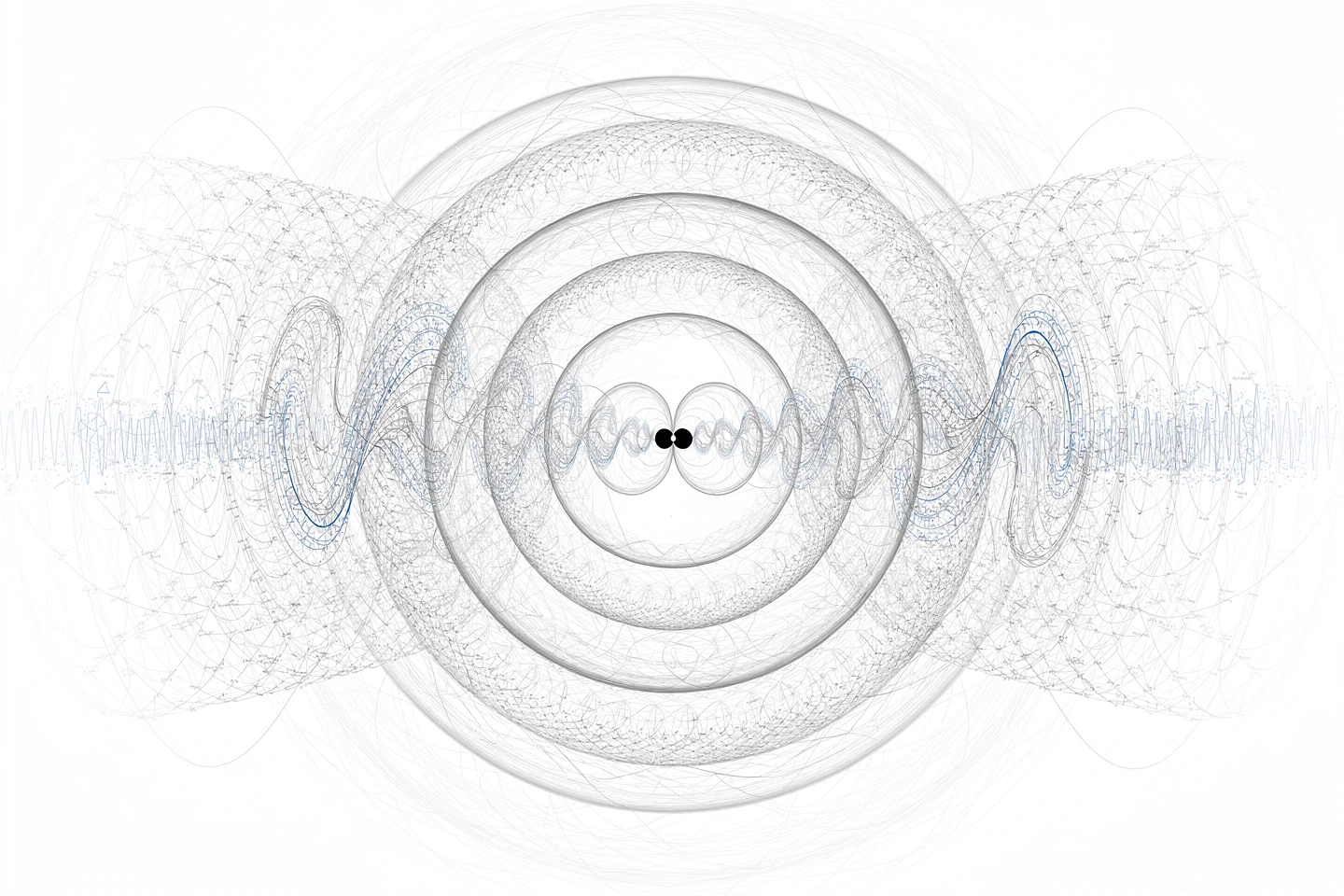
Traditionally a black hole was described by three parameters — mass, charge, and angular momentum. This concise description, polished to an aphorism by John Wheeler: 'Black holes have no hair.' However, quantum theory insists on immense internal complexity: the Bekenstein–Hawking entropy points to a colossal number of microstates — a kind of library of information. The new memory burden effect claims that this 'information cargo' is not passive: it can alter the black hole's behavior during a merger. The entire recorded history starts to play a role, like a backpack full of books that changes a traveler's gait.
Imagine a black hole as a weary traveler. Without a load, his stride is light and predictable — that's what classical general relativity gives. But load him with an informational backpack — and every movement gains individuality. So it is during a black hole merger: the newborn hole experiences a disturbance. Its 'ringing' — quasi-normal modes — is heard in gravitational waves. But the frequency of this ringing shifts due to the backpack's weight. The memory burden effect turns the ringing into a spectroscopic portrait of the past: as if through a chain of handshakes, information from a collapsing supernova or particle collisions seeps into the hole and makes it resonate differently.
A key parameter is the memory efficiency μ, indicating how thoroughly the source 'packed' the information backpack. Memory modes, like sheets in a folder, store quantum data, and their entanglement determines how heavy this legacy is. When the loading of the leading mode reaches a critical value, the energy gaps of memory modes vanish — and the backpack presses maximally. The frequency shift is described by a simple formula: |Δf/f| ≃ μ⁻¹ |δg|^{2(p-1)}. Here δg is the amplitude of the gravitational perturbation, and the exponent p (an integer) determines how sharply the gaps close at critical filling. For odd p, the frequency drifts to the red (the backpack pulls down), for even p — to the blue (as if a lightened load gives a boost). But the most striking part is the scale μ⁻¹. For black holes from dark matter — primordial ones, merged from dark sector particles — memory is near-maximal: μ⁻¹ ∼ 1/√S. For stellar collapses, the spread is gigantic: from 10⁻¹² (if the hole copied every detail of the progenitor star) to an astronomical 10⁶⁶ (if only broad features are accounted for). So the observational signal can either scream of memory or stay silent.
Already, LIGO data on event GW250114 allows constraints on the exponent p, turning gravitational-wave spectroscopy into a probe of quantum gravity. In the future, we will be able to distinguish the origin of black holes: a primordial dark matter hole will sing a different song than the product of a stellar collapse. Moreover, the stabilization of a hole after semi-classical Hawking radiation evaporation depends on memory burden — the backpack prevents the hole from easily evaporating, like ballast keeping it in the macroscopic world. Further modeling of the nonlinear merger phase promises to clarify how to unload this information backpack, and perhaps lead to paradoxical effects where the past literally changes the future dynamics of spacetime. We stand on the brink of reading cosmic diaries written with a gravitational pen.
A black hole with the mass of 30 suns has an entropy of about 10⁸⁰ — that's greater than the total number of particles in the observable universe. If you imagine each microstate as a book, that hole would contain a library that makes all of Earth's libraries look like a speck of dust.