Memory of a Superconducting Pair express
Superconductivity is often pictured as a frozen dance of electrons: they pair up and move without resistance, like figure skaters on perfect ice. But in high-temperature superconductors, that ice turns out to be not so smooth. Karl Schwarzschild once showed how matter warps spacetime; here, the pair field itself warps its 'memory' of past states.
In the new work, the superconducting pair field Δ is no longer just a number in an equation. It interacts with local fields arising from special points on the Fermi surface — the antinodes. These points act like a mirrored corridor: they select only certain wavelengths of oscillations, creating a spectral cavity (a resonator for electronic waves). As a result, the pair's response to a kick decays not smoothly but along a bell-shaped curve — a Gaussian. The lifetime of this memory is about $τ_g$ — a characteristic scale that can be measured.
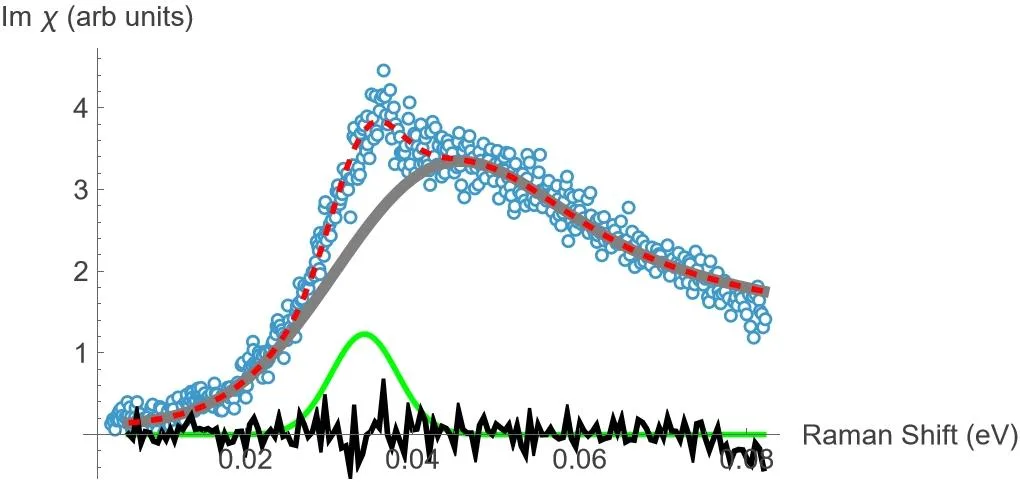
Below the critical temperature, a second memory channel appears — coherent, tied to the condensate of pairs. It adds a clear rhythm to the blurred Gaussian echo. The transition to the superconducting state redistributes spectral weight between these two channels: the incoherent memory of the pseudogap and the coherent memory of the condensate. Experiments in Raman scattering, ARPES (photoemission spectroscopy), and tunneling see different projections of the same Gaussian continuum, like shadows of one object from different sides.
Original abstract
as written by the authors arXiv:2607.03937
We develop a dynamical description of the superconducting pair field in which the Cooper-channel Hubbard--Stratonovich field $$\Delta$$ is treated as a memory-dressed Bogoliubov pair field rather than as a purely static order parameter. Starting from the standard pair-field effective action, we couple $$\Delta$$ to antinode-selected collective or self-generated fields. An ensemble of such modes produces a distribution of local Bogoliubov frequencies; when this distribution is approximately Gaussian, ensemble averaging gives the memory factor $$\exp[-t^2/(2\tau_g^2)]$$. In cuprate superconductors, the antinodal gap or pseudogap restricts the active electronic phase space and acts as a momentum-space spectral cavity. It selects fluctuation wavevectors $$\mathbf Q_a$$ that may become charge-density-wave-like instabilities in an ordered limit, but behave as a reservoir of local collective fields in the fluctuating regime. The same framework admits resonant algebraic prefactors, so that threshold and forced-oscillator responses generate the hierarchy $$p=-1/2,1/2,1,3/2,\ldots$$, while the Gaussian envelope cuts off secular growth and converts these branches into finite spectral components. The resulting picture contains a robust pseudogap memory channel and, below $$T_c$$, an additional condensate-assisted coherent channel proportional to $$|\Delta_0(T)|^2$$. Thus the superconducting transition primarily reorganizes pair-field spectral weight between incoherent pseudogap memory and coherent Bogoliubov memory. The frequency-domain response is expressed in terms of parabolic-cylinder functions, and comparisons with Raman, ARPES, tunneling, and doping-dependent ARPES scaling suggest that these probes are complementary projections of the same Gaussian-memory pair continuum. We compare our numerical results with the recent experimental data on Bi$$_2$$Sr$$_2$$CaCu$$_2$$O$$_{8+\delta}$$.
The parabolic cylinder functions used in this work first appeared in problems of light diffraction at the edge of a screen, and now they help understand the memory of superconducting pairs.