Memory of a Superconducting Pair express
Superconductivity is often pictured as a frozen dance of electrons: they pair up and move without resistance, like figure skaters on perfect ice. But in high-temperature superconductors, that ice turns out to be not so smooth. Karl Schwarzschild once showed how matter warps spacetime; here, the pair field itself warps its 'memory' of past states.
In the new work, the superconducting pair field Δ is no longer just a number in an equation. It interacts with local fields arising from special points on the Fermi surface — the antinodes. These points act like a mirrored corridor: they select only certain wavelengths of oscillations, creating a spectral cavity (a resonator for electronic waves). As a result, the pair's response to a kick decays not smoothly but along a bell-shaped curve — a Gaussian. The lifetime of this memory is about $τ_g$ — a characteristic scale that can be measured.
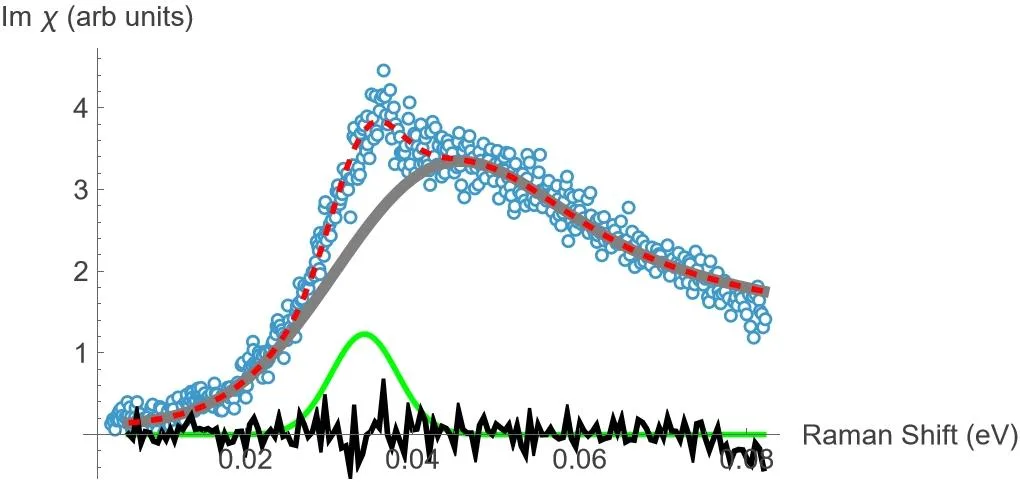
Below the critical temperature, a second memory channel appears — coherent, tied to the condensate of pairs. It adds a clear rhythm to the blurred Gaussian echo. The transition to the superconducting state redistributes spectral weight between these two channels: the incoherent memory of the pseudogap and the coherent memory of the condensate. Experiments in Raman scattering, ARPES (photoemission spectroscopy), and tunneling see different projections of the same Gaussian continuum, like shadows of one object from different sides.
The parabolic cylinder functions used in this work first appeared in problems of light diffraction at the edge of a screen, and now they help understand the memory of superconducting pairs.