Four Cold Giants: How Gravity Reveals Distant Planets ✛
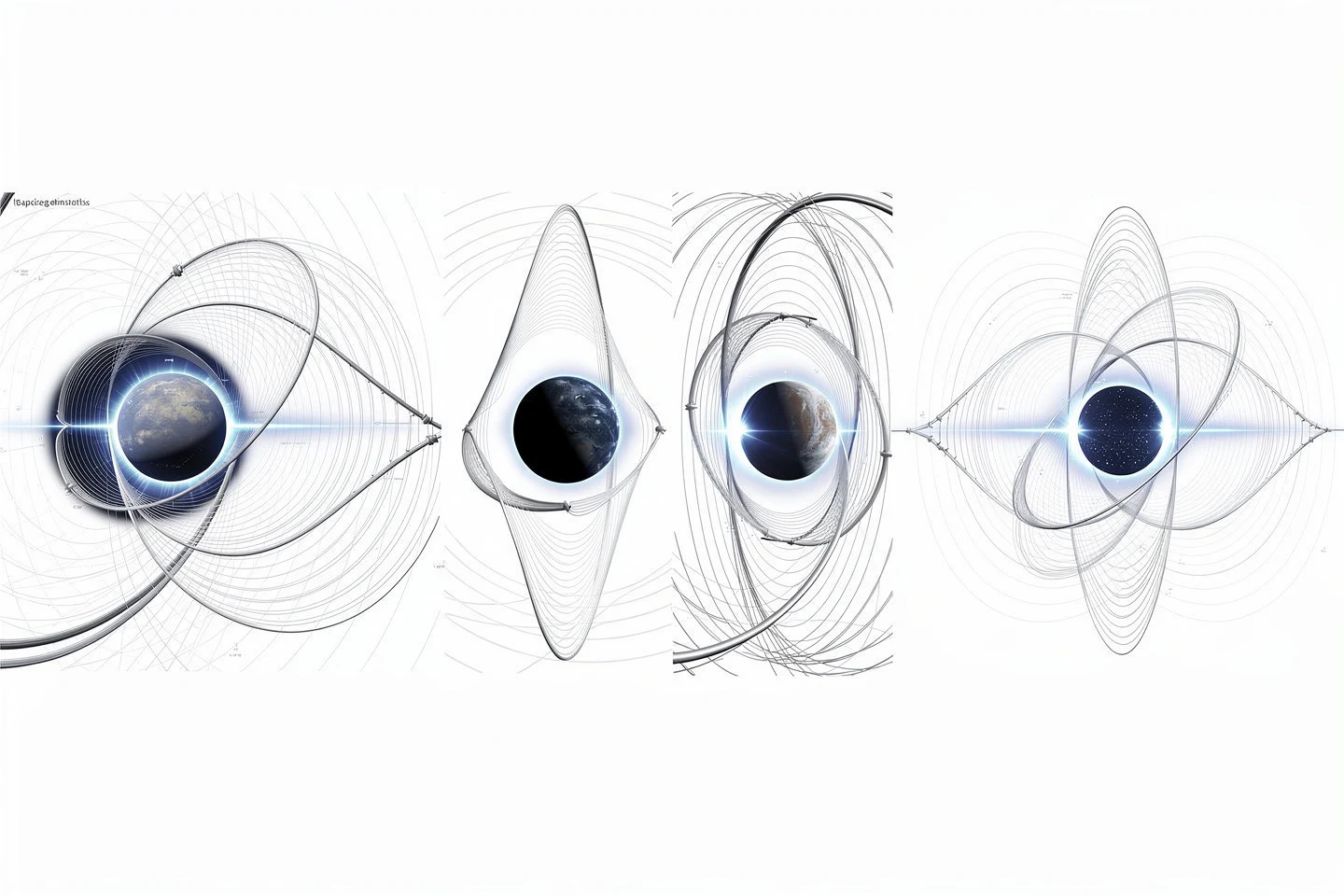
Imagine a drop of water on a windowpane: it collects the light from a streetlamp, and for a moment it shines brighter. Gravity works in a similar way: a massive celestial body bends the space around it and, like a lens, magnifies the light of a star that happens to be behind it. This effect is called gravitational microlensing. Unlike the transit method, where a planet blocks some of its star’s light (that’s how William Borucki hunted for planets), microlensing lets us spot distant, cold worlds that would otherwise remain almost invisible. Light, meanwhile, always travels at the same speed of light, and that constancy is key to all the calculations.
That’s exactly how astronomers discovered four planets in the center of our Galaxy — the bulge. Their masses range from one-fifth to two and a half times that of Jupiter, and their parent stars are quite light; some are so small that they can’t even ignite hydrogen (and it’s hydrogen burning that powers stars, as Cecilia Payne-Gaposchkin first realized). These planets orbit far beyond the snow line, where perpetual cold reigns and water exists only as ice. Interestingly, the same space-warping principle, but billions of times stronger, generates gravitational waves when black holes collide. And microlensing also helps search for dark matter — the mysterious substance that might itself be made of massive dark objects.
In the future, the Hubble Space Telescope, named after Edwin Hubble, will help refine the properties of these distant systems. For now, even without direct spectroscopy, the method that splits a star’s light into a spectrum, scientists have been able to estimate the masses and distances using models of the Galaxy. Findings like these suggest that giant planets around small stars are more common than theories predicted, forcing us to rethink how worlds are born.
Planets beyond the snow line receive so little heat from their stars that temperatures there drop below minus 200 degrees Celsius — colder than on Pluto.