Motohide Tamura

6 articles · 30 co-authors · latest: 2026-07-06
31 citations · h-index 3 · 9 papersData: Semantic Scholar

We have retold 6 papers by this author. 2 of them with a full read. most often about: exoplanet atmosphere, protoplanetary disk, galaxy. 30 co-authors across our retellings.

Links in the knowledge graph
The Signature of Infalling Gas in the Light of a Newborn Planet
In 2022, the Subaru telescope photographed a point of light 100 astronomical units from the star AB Aurigae. The point was named planet AB Aur b, but debates did not subside: what exactly is glowing, the planet itself or dust around it?
Exoplanets2026-01-151 minarXiv:2601.10598express
Four Teenage Planets Around a Young Star
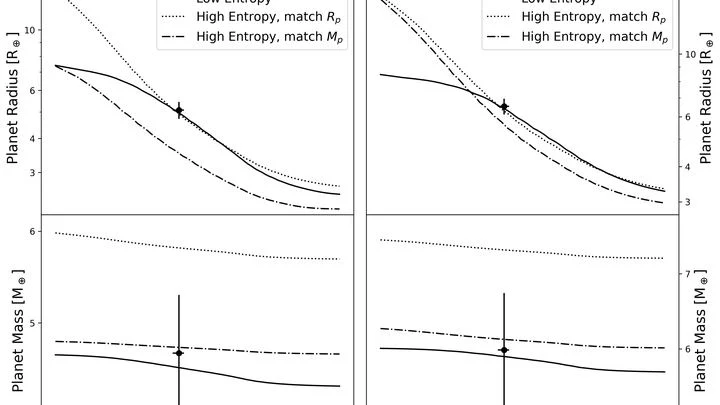
350 light-years away, four planets orbit the star V1298 Tau. They are 5–10 times larger than Earth but lighter than they appear. For nine years, astronomers tracked their motion to understand what they are made of and how they lived in the past. The planets are lined up in a chain: their orbital periods are nearly in 3:2, 2:1, and 3:1 ratios.
Exoplanets2026-01-161 minarXiv:2601.11469express
Invisible Lens Reveals a Planet 40 Times the Mass of Earth
One night, a star at the edge of the sky suddenly flickered and brightened for a few days. It wasn't a supernova, and no cloud passed by — an invisible planet drifted between the star and Earth. Its gravity bent the light of the distant star like a pair of glasses focusing a sunbeam.
Exoplanets2026-02-231 minarXiv:2602.20346express
Cosmic Disks Flicker Like Candles
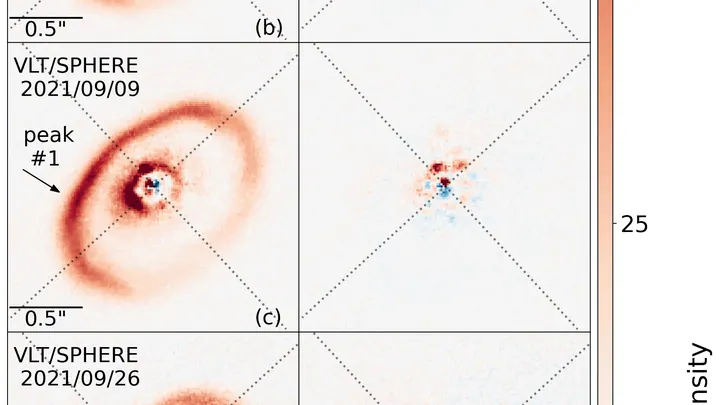
Around young stars, flat clouds of gas and dust swirl — the building material for future planets. Starlight reflects off these clouds, and astronomers see them as faint disks. But sometimes bright spots or dark bands appear in such disks. Fresh observations with the Subaru Telescope show these patterns can change within a matter of months.
Stellar2026-04-041 minarXiv:2604.03767express
A Star’s Companion Hides a Secret Twin
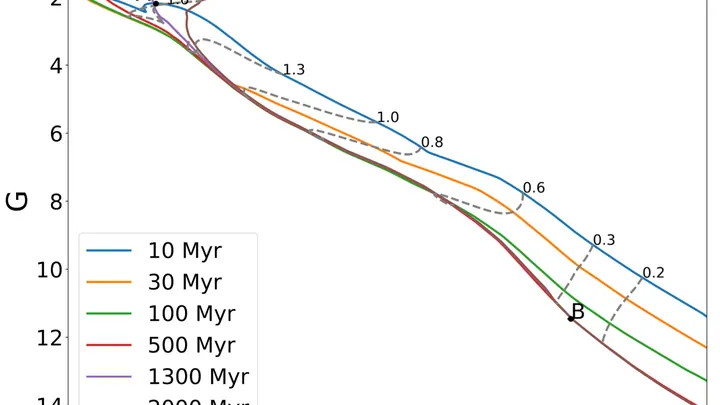
The companion of the star HIP 53005 has stumped astronomers. Its color and brightness and spectrum point to a mass of about 80 Jupiters — right at the hydrogen-burning limit, where an object is no longer a planet but not yet a star. Yet its orbital motion demands nearly twice that mass: 185 Jupiters.