Cosmic Drops: How Gravity Revealed Four New Cold Giants ✛
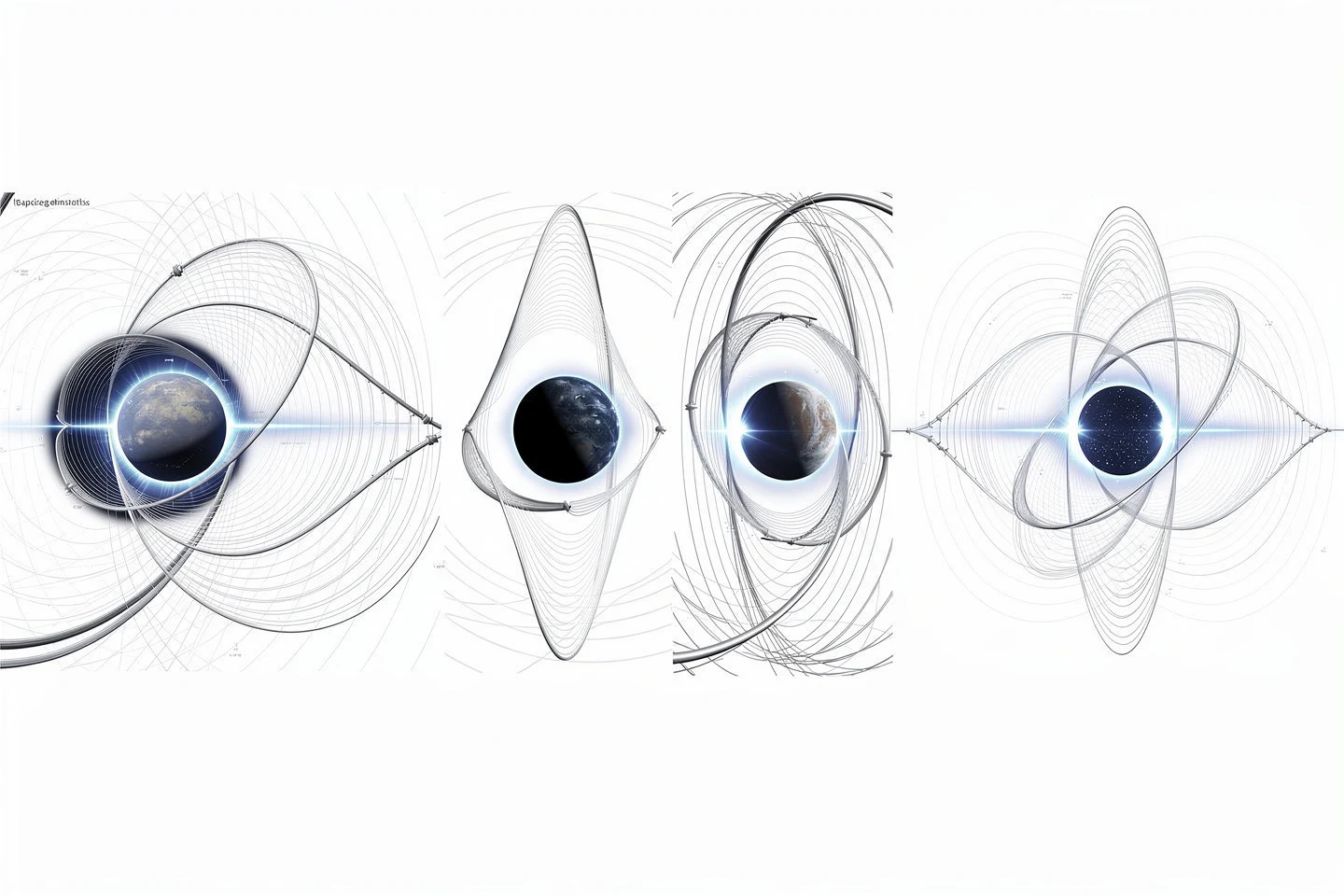
In the Galactic bulge, where the light of billions of stars merges into a continuous glow, four cold giants passed unnoticed. You can't see them through a telescope — too far, too dim. But gravity acted as a cosmic lens: when such a planet, together with its star, passes in front of a more distant background star, it warps spacetime and focuses the light, just as a raindrop on a windowpane intensifies the flame of a candle outside. These sudden spikes in brightness — microlensing events — were recorded by the robotic sky surveys KMTNet, OGLE, and PRIME.
In these four cases, the light curves bore a characteristic signature: on the smooth rise and fall, a brief anomaly appeared — an extra blip lasting just a few hours. This happens when the lens star has a planet, and its gravitational field creates a secondary, tiny 'bubble' on the main droplet. Analysis of the parameters — timescale, mass ratio — allowed the picture to be reconstructed. The angular Einstein radius, which sets the scale of the whole picture, is inversely proportional to the speed of light — that's why the gravitational lens is so delicate. The planet masses turned out to be in the range 0.2 to 2.5 Jupiter masses, and their parent stars from 0.07 to 0.63 solar masses; since direct spectroscopy was not possible, the spectral type was determined by color. One system lies right on the boundary of brown dwarfs, where hydrogen no longer burns — the element that Cecilia Payne-Gaposchkin first pointed to as the main component of stars. Projected orbits from 0.7 to 6 astronomical units place all the planets far beyond the snow line, in the realm of icy worlds.
The discovery adds important details to the statistics of cold planets. The traditional transit method, used by William Borucki on Kepler, is powerless at such distances — it requires the planet to pass exactly across the star's disk, and the orbital period would be years. Microlensing, on the other hand, requires neither direct light nor periodicity; it catches random alignments. That's how we can peer into the bulge — at a distance of 7 kiloparsecs, where stellar density is high and metals are scarce. And this raises the question: why do low-mass stars in metal-poor environments still manage to produce giants? Core accretion models predict the opposite. Perhaps the answer lies in the lensing process itself — after all, this technique is also sensitive to dark matter, once sought in the form of massive compact objects, and to solitary black holes.
Peering into these shimmering drops of light, we see not only new planets but also the contours of future astronomy. Infrared observations with Hubble (the telescope named after Edwin Hubble) and the James Webb will allow us to separate the light of the lens and source, refining masses and orbits. Next-generation telescopes — Roman, Euclid, as well as ground-based observatories with high-precision cameras — will turn scattered drops into a downpour of data. Then it will become possible to measure parallax directly from light curves, unambiguously determine masses and orbits, and most importantly, gather statistics that will show how the bulge differs from the disk, and how in the early Universe after the Big Bang the first solid worlds were born. In the end, each such flare is not just an anomaly on a graph, but an instant portrait of a distant planetary system, painted by gravity itself. And these distortions are reminiscent of gravitational waves from merging black holes — only here the lens is static, and the ripples run across the still fabric of space, plucking invisible planets from the darkness.
During microlensing, a star's brightness can increase a hundredfold, but each event is unique — there will never be a repeat.