The Forge of Black Holes: Stellar Mergers as a Source of Spin ✛ ✎
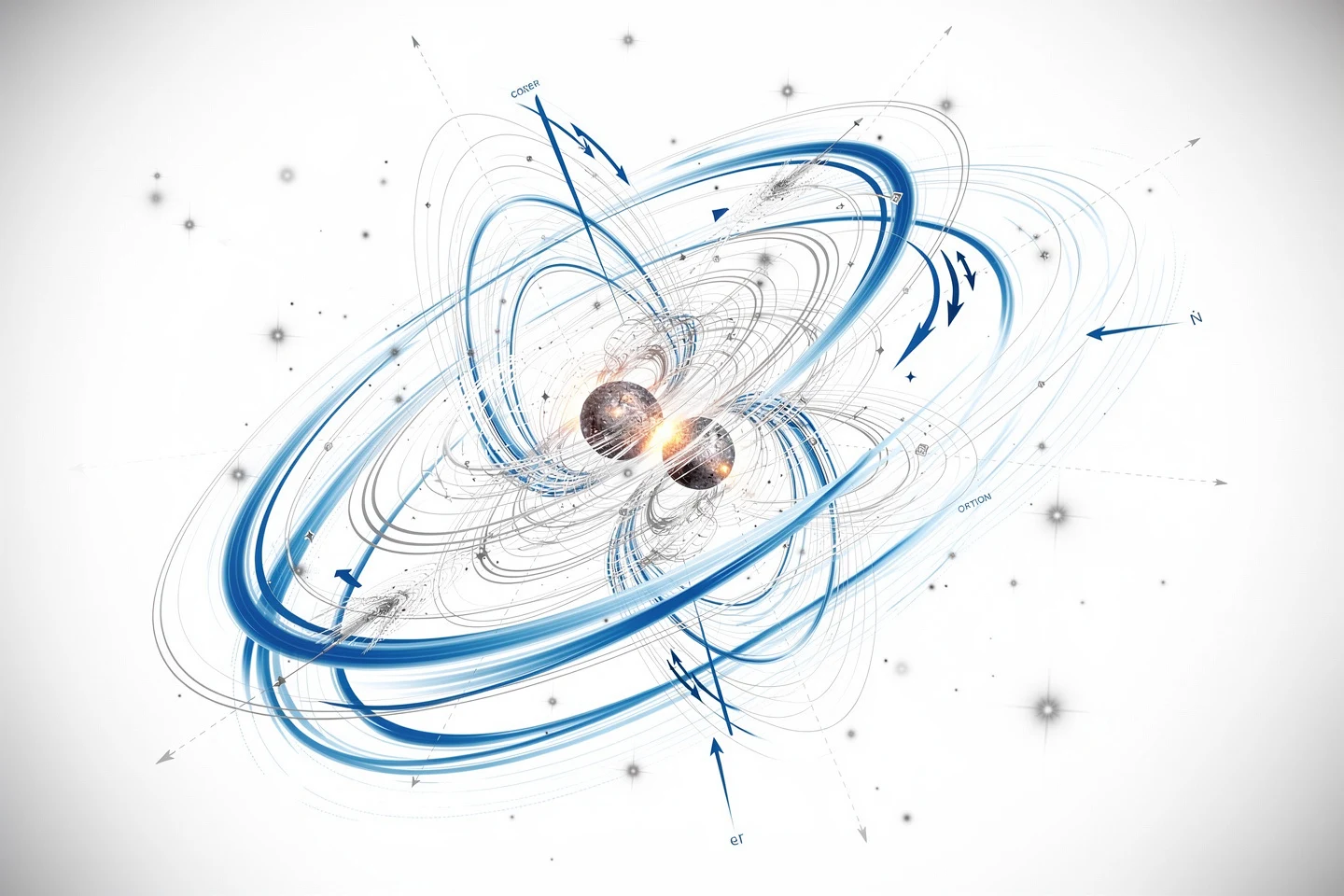
In the heart of a dense star cluster, a true forge reigns: here stars, like glowing blanks, collide and merge under gravity, and these mergers are not a catastrophe but an opportunity. Each strike of the stellar hammer transfers spin to the future black hole. For a long time, astrophysicists couldn't understand where black holes get their noticeable spin: an isolated massive star, swelling into a red supergiant and shedding its envelope, loses almost all its angular momentum. But in globular clusters, where thousands of stars are packed per cubic parsec, frequent interactions rewrite the script. As calculations show, in a typical cluster, up to half of all black holes have undergone at least one stellar merger before their own collapse.
The key to success is the mass ratio of the partners. If the second star is at least a third lighter than the first (q > 0.3), the merger product transforms into a blue supergiant: compact, hot, with a temperature above 8000 K, enveloped in a hydrogen shell. It doesn't waste time bloating into the red phase, thus preserving rapid rotation. That's the secret of the cosmic forge: to hammer two cores together in time, without letting the star puff up. Evolutionary simulations confirm that when such a giant collapses, it gives birth to a black hole with a dimensionless spin parameter of 0.5–0.8. By comparison, the spin of an isolated black hole rarely exceeds 0.1. The difference is like that between a top just barely set in motion and a spinning top buzzing from rotation.
These rapidly spinning objects not only surprise gravitational wave detectors, whose signals travel to us at the speed of light, but also shape the architecture of the clusters themselves. When two black holes merge, the asymmetric emission of gravitational waves imparts a kick to the system — a recoil. Back in the day, Jacob Bekenstein first estimated the velocity of such a gravitational “gun.” Modern calculations show that for a typical cluster with a mass of a million Suns, the escape velocity is about 66 km/s. The spin of spun-up holes adds punch to the recoil, and the newborn black hole can fly out of the cluster like a spark from under the hammer. This hinders the accumulation of massive holes in the center and slows down hierarchical mergers. Yet some objects are retained, forming a population with high spins.
The implications of this research reach far beyond a single puzzle. The link between stellar mergers and spins sheds light on the nature of long gamma-ray bursts — collapsars, where a rapidly rotating core collapses into a black hole and launches relativistic jets. Future observations by the Hubble Space Telescope and its successor Roman, combined with refined codes that account for merger hydrodynamics, will confirm this picture. Moreover, studying the spectra of blue supergiants via spectroscopy will directly measure their rotation, testing predictions. Thus, step by step, we piece together the mosaic from the era of the Big Bang to modern mergers, where every stellar collision is a step toward understanding how the Universe creates its most enigmatic objects.
In the standard picture, isolated massive stars lose almost all their angular momentum and produce black holes with negligible spin. However, a single close merger in a dense cluster can spin up the future black hole nearly to the limit. Remarkably, even a modest increase in the binary fraction among massive stars boosts the number of such rapidly rotating objects by an order of magnitude.
Such black holes resemble Gargantua from 'Interstellar': their rapid spin is set at birth.