Black Hole Without Singularity: A New Geometry of Space express
At the center of a classical black hole lurks a singularity — a point where the density and curvature of spacetime become infinite. Physics goes silent there. Karl Schwarzschild was the first to solve Einstein's equations for such an object, but the singularity remained a mystery.
The black bounce metric replaces the singularity with a smooth transition — space doesn't crush into a point but rather turns inside out. Everything hinges on a single parameter $a$. If it's below a certain threshold, we have an ordinary regular black hole without a singularity. If it's larger, a tunnel to another region of the Universe emerges — a traversable wormhole.
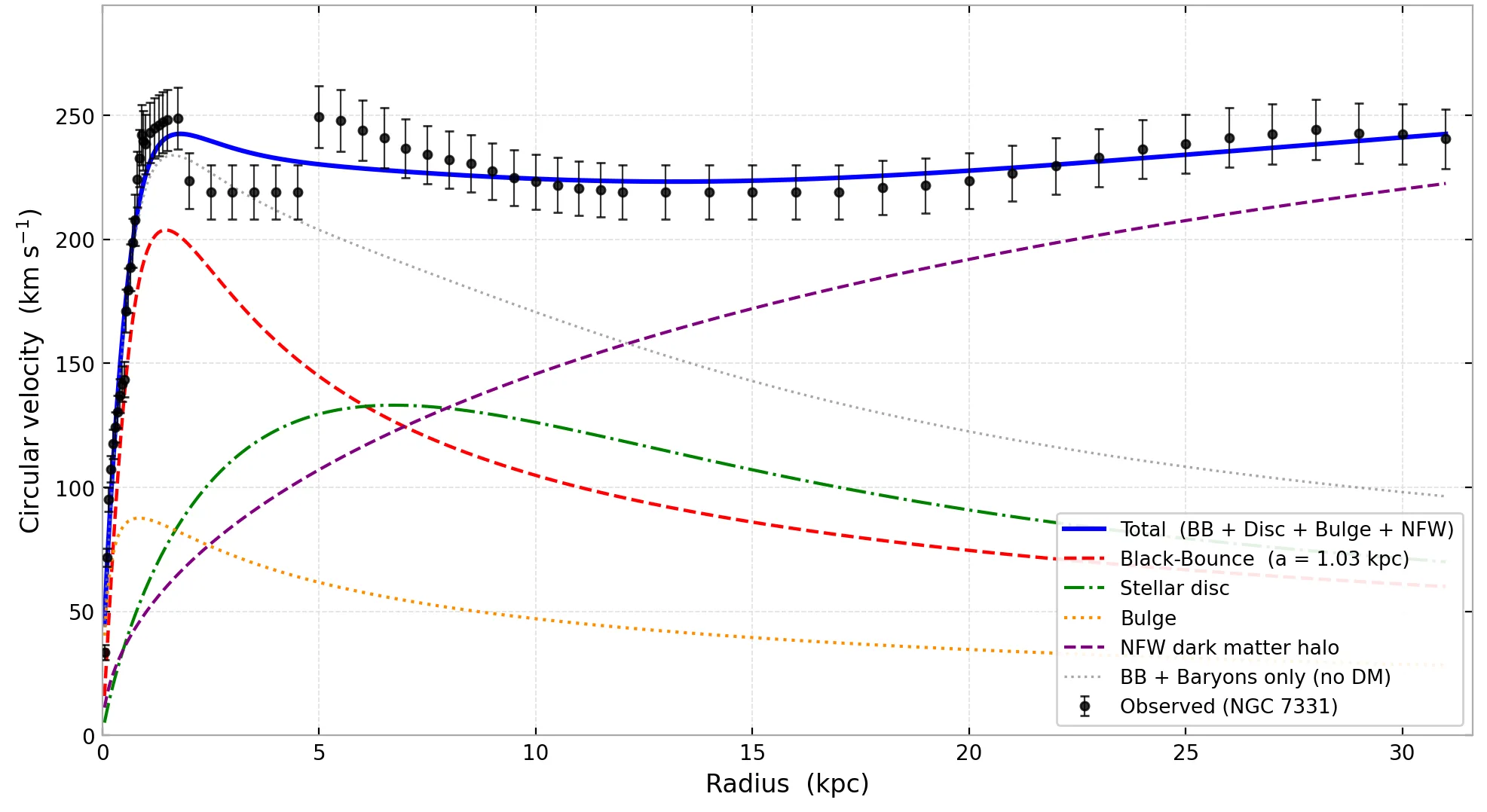
This is the first time the bounce parameter has been measured not in a thought experiment but from a real galaxy. The model not only removes the singularity at the core but also aligns beautifully with the standard dark matter halo at large distances. The Solar System also feels this parameter: the paper calculates tiny corrections to Mercury's perihelion shift, light deflection, and radio signal delay. They are small, but may become testable in the future.
Original abstract
as written by the authors arXiv:2607.09840
The black-bounce spacetime provides a regularized modification of the Schwarzschild metric by introducing a free parameter $$a$$ that eliminates the central singularity while preserving the exterior geometry of a classical black hole. This work investigates the physical implications of this metric across three complementary observational windows. First, we examine the horizon structure and the transition between a regular black hole ($$a < 2M$$) and a traversable wormhole ($$a > 2M$$), offering a viable singularity-free alternative to classical black hole solutions. Second, we perform Solar System precision tests perihelion precession of Mercury, gravitational lensing, and the Shapiro time delay of radar signals demonstrating that the bounce parameter $$a$$ introduces small but measurable corrections relative to general relativity. Third, and for the first time, we apply the black-bounce metric to galactic dynamics by deriving the circular velocity field and fitting it to the observed rotation curve of NGC~7331. A four-component mass decomposition black-bounce central potential, Freeman exponential disc, Hernquist bulge, and a Navarro--Frenk--White dark matter halo yields $$a = 1.035 \pm 0.119$$~kpc , providing the first observational constraint on the bounce parameter from galaxy kinematics. Our results confirm that the black-bounce metric regularises the inner galactic core while remaining fully consistent with a standard dark matter halo at large radii, establishing this spacetime as a compelling testbed for singularity-free alternatives to classical black holes.
The bounce parameter for NGC 7331 turned out to be on the order of three thousand light-years — comparable to the distance from us to the center of our own Galaxy.
The idea of a traversable wormhole as a bridge between distant regions of space is explored in the film 'Interstellar', where characters travel through a wormhole near Saturn.