Black Hole Without Singularity: A New Geometry of Space express
At the center of a classical black hole lurks a singularity — a point where the density and curvature of spacetime become infinite. Physics goes silent there. Karl Schwarzschild was the first to solve Einstein's equations for such an object, but the singularity remained a mystery.
The black bounce metric replaces the singularity with a smooth transition — space doesn't crush into a point but rather turns inside out. Everything hinges on a single parameter $a$. If it's below a certain threshold, we have an ordinary regular black hole without a singularity. If it's larger, a tunnel to another region of the Universe emerges — a traversable wormhole.
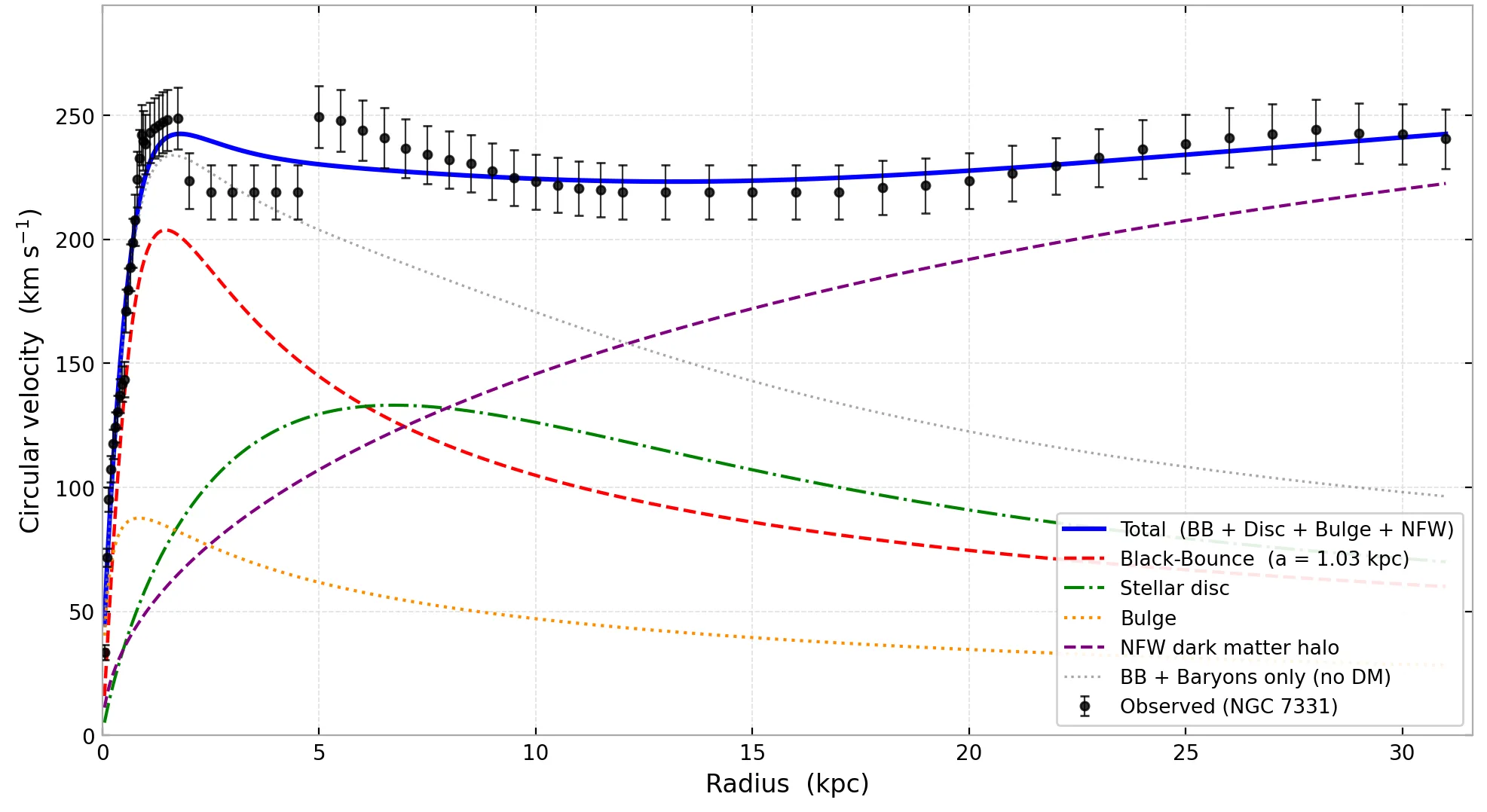
This is the first time the bounce parameter has been measured not in a thought experiment but from a real galaxy. The model not only removes the singularity at the core but also aligns beautifully with the standard dark matter halo at large distances. The Solar System also feels this parameter: the paper calculates tiny corrections to Mercury's perihelion shift, light deflection, and radio signal delay. They are small, but may become testable in the future.
The bounce parameter for NGC 7331 turned out to be on the order of three thousand light-years — comparable to the distance from us to the center of our own Galaxy.
The idea of a traversable wormhole as a bridge between distant regions of space is explored in the film 'Interstellar', where characters travel through a wormhole near Saturn.