When a Medium Loses Stability express
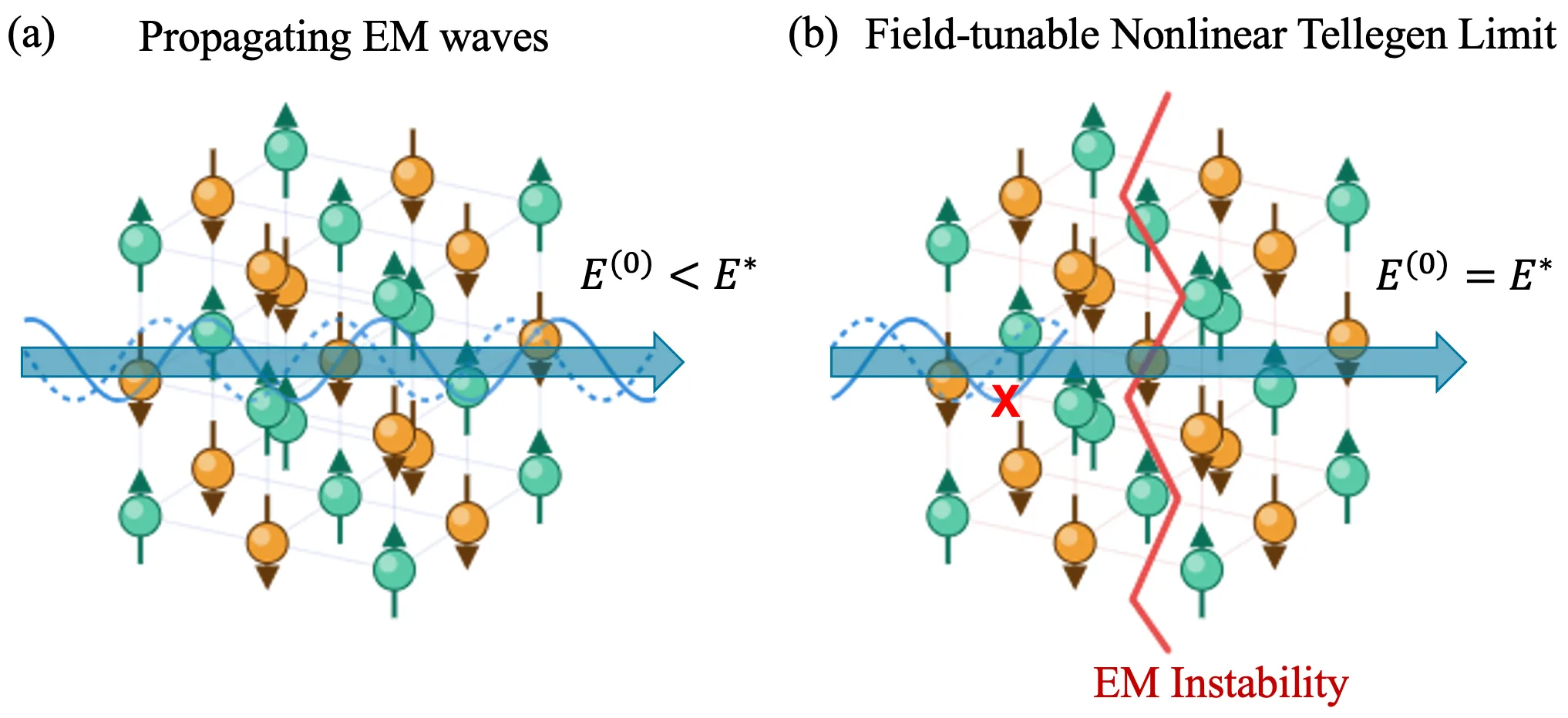
A Tesla coil crackles, and a beam of light begins to rotate around it. The medium it passes through is still stable, but the field grows, and the rotation intensifies. This is not a trick but the behavior of special materials that couple electricity and magnetism. For such coupling, there is a fundamental limit — the Tellegen limit. Cross it, and the medium loses electromagnetic stability.
Previously, it was thought that this limit was rigidly fixed by the material's own properties. Now the authors have shown that in nonlinear media, it becomes field-tunable. Apply a static field, and the system moves toward instability. The critical point depends on the symmetry of the crystal's magnetic structure. The study tested this on two materials: a d-wave altermagnet and an M-type hexagonal ferrite. Their symmetry dictates the shape of the nonlinear magnetoelectric tensor and the path to breakdown.
In practice, this means that by varying the external field, one can smoothly control the optical response up to the stability boundary. Beyond that — either destruction or a transition to a new state. The authors constructed a phase diagram in field space: it shows where the material works and where it 'breaks.' Such a tool will be useful for fine-tuning devices that use magnetoelectric effects, from sensors to optical isolators.
The Tellegen limit is named after the Dutch engineer Bernard Tellegen, who in 1948 proposed a hypothetical electrical circuit element — the gyrator. Only later was his name linked to the fundamental limit for magnetoelectric media.