Statistical analysis is the application of mathematical methods to collect, summarize, and interpret data, allowing researchers to test hypotheses and draw conclusions from observations. In physics, it is indispensable for extracting signals from noisy measurements, such as detecting a faint particle signal in a detector or identifying patterns in cosmic microwave background radiation. It bridges the gap between raw data and physical laws, enabling scientists to quantify uncertainties and make predictions.
History
The foundations were laid by Carl Friedrich Gauss (method of least squares, 1809) and later formalized by Ronald Fisher in the 1920s, who introduced concepts like p-values and analysis of variance.
How it works
Statistical analysis involves choosing a model for the data, estimating parameters (e.g., mean, variance), and using probability distributions to assess how likely the observed data are under different hypotheses. Techniques like maximum likelihood estimation, Bayesian inference, and hypothesis testing (e.g., chi-squared tests) are used to determine whether a result is statistically significant or just a fluctuation. In complex systems, methods like Monte Carlo simulations help model uncertainties and compare theoretical predictions with data.
In practice
Statistical analysis is used in particle physics to confirm discoveries (e.g., the Higgs boson), in epidemiology to model disease spread, and in machine learning for data-driven predictions.
Fun fact
The discovery of the Higgs boson in 2012 required a statistical significance of 5 sigma, meaning the chance of a false positive was less than one in a million.
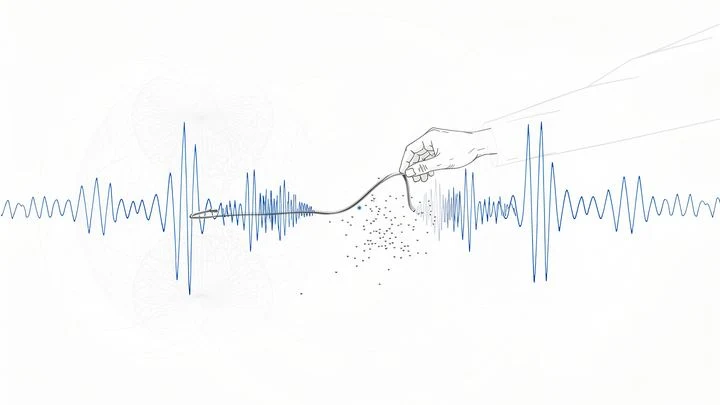
The standard way of digitizing speech: taking volume readings thousands of times per second. It's like tasting broth with a teaspoon: each sip is watery, with almost no detail. The data stream swells, though the substance is minuscule.
Scientists proposed first "simmering down" the audio signal.
Statistical models are an attempt to stretch a perfect mathematical web over the uneven landscape of data. When a model resists, it emits tension, but we've grown accustomed to ignoring it. Researchers spend hours staring at residual plots, trying to guess where the model is 'coming apart at the seams.' Squealer translates this resistance into sound.
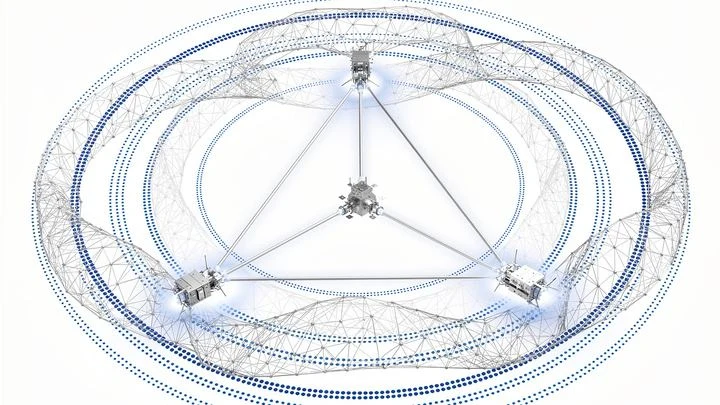
The Universe is not silent: it is filled with a continuous gravitational-wave hum. In a decade, the LISA space observatory will tune its "ears" to the millihertz range, and the richest source will be our Galaxy — tens of thousands of white dwarf pairs whirling in a frantic dance.
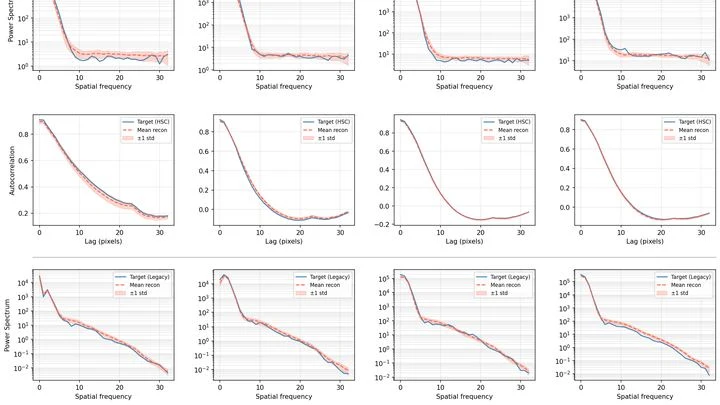
If you photograph the same mountain with a film camera and a modern smartphone, you get different images: colors are brighter in one, details are blurrier in the other. The same goes for telescopes: each instrument sees the sky in its own way, adding its own distortions to the true light of galaxies, like a filter through which we look.
A charged particle spiraling in a magnetic field doesn't stay silent: it emits light. This light is called synchrotron radiation, and it shows up everywhere — from distant galaxies to laboratory accelerators.
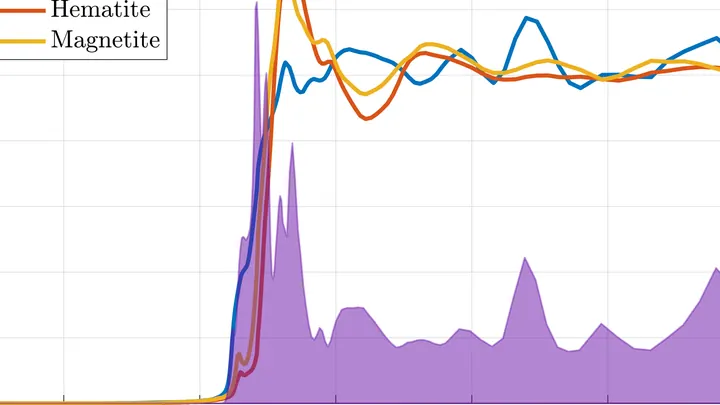
A chemical map of a sample is like a mosaic: each point has its own color, its own chemical composition. To assemble such a mosaic, a spectromicroscope scans the sample point by point, recording a spectrum at each location — a "fingerprint" of how the material absorbs or emits light.
A long conversation between two people can be condensed into a few key phrases that preserve the essence. That is exactly how a macrovariable works: temperature stands in for billions of moving molecules, and sea level for thousands of waves.