Magnetic Hearing at Kilohertz Frequencies express
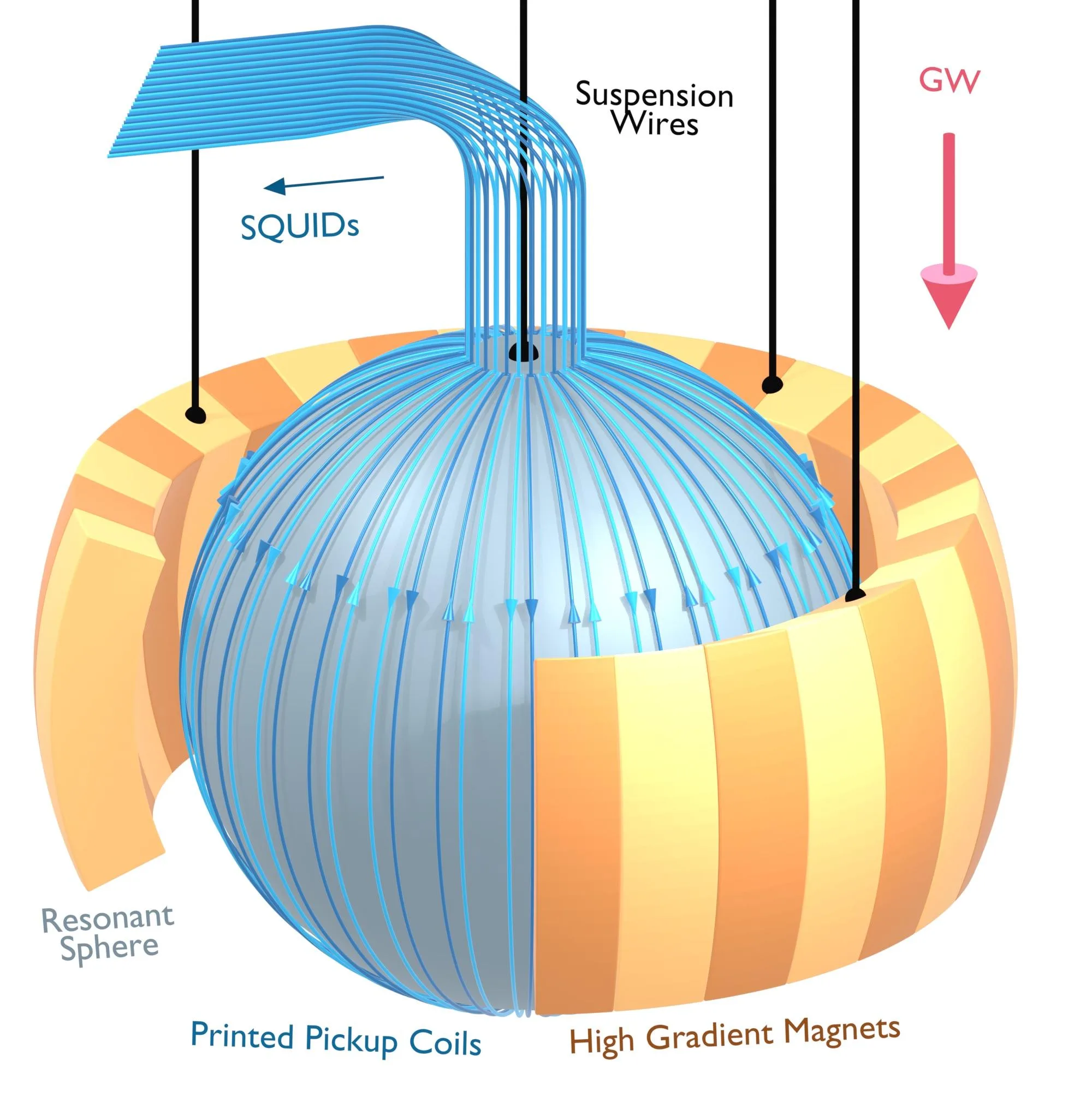
A bell rings not from the strike but from a fleeting shudder of space. A gravitational wave, like ripples on a pond, passes through a massive magnet, and it deforms ever so slightly. That deformation can be turned into an electrical signal. But an ordinary magnet with a uniform field is like a microphone that only hears loud shouts. The authors propose tuning the 'ears' differently: use a Halbach array — a set of magnets where the field is amplified on one side and nearly cancels on the other.
Such a magnet works like a tuning fork on a spring: after a brief nudge, it keeps oscillating at its resonant frequency. Scientists catch that decaying ring — the ringdown. With current technology, they could achieve a sensitivity of about 10⁻²¹ 1/√Hz at frequencies around 10 kilohertz. That's like hearing a snowflake land across town while traffic hums around you.
For broadband searches at higher frequencies, sensitivity is still modest — around 5·10⁻²⁰ 1/√Hz. But the authors outline a path to improve it by two to three orders of magnitude, down to 10⁻²³ 1/√Hz. That would require quieter amplifiers and cooling, but nothing like a science-fiction breakthrough.
So a magnetic bar becomes a sensitive seismograph for the fabric of spacetime. Where laser beams are powerless, iron might sing.
Original abstract
as written by the authors arXiv:2607.29388v1
Magnetic Weber Bars have been proposed to search for gravitational waves in the kHz to GHz regime by exploiting the mechanical deformation of a large magnet induced by a gravitational wave. Here we propose to increase the effectiveness of such devices by considering magnetic field configurations with strong gradients, albeit lower field strengths, such as Halbach arrays. We focus on one of the most challenging but most realistic signals, with short duration and low coherence, exploiting the ring-down period of the mechanical resonator. We show that with demonstrated technology this setup can reach sensitivities of $$S_h^{1/2} \simeq 10^{-21}/\sqrt{\text{Hz}}$$ at a broad set of frequencies around several resonance peaks at $$\sim 10$$ kHz, and $$S_h^{1/2} \simeq 5 \cdot 10^{-20}/\sqrt{\text{Hz}}$$ in a broadband search at higher frequencies. We discuss plausible upgrades to reach $$S_h^{1/2} \simeq (10^{-23} - 10^{-21})/\sqrt{\text{Hz}}$$ in a broadband search covering 10 kHz - MHz.
The Halbach array was invented to focus beams in particle accelerators, and now it helps 'hear' the Universe's tremors.
In Carl Sagan's novel 'Contact', a signal from space is caught by a radio telescope, but a magnet could have done the job too.