How geometry saves the quantum vacuum from infinity express
The quantum vacuum is not empty: it is permeated by entanglement linking distant regions. But when physicists tried to compute this entanglement, it turned out to be infinite. The culprit: particles with very low energy that can smear out over arbitrarily large volumes. They are like waves with no shores to contain them.
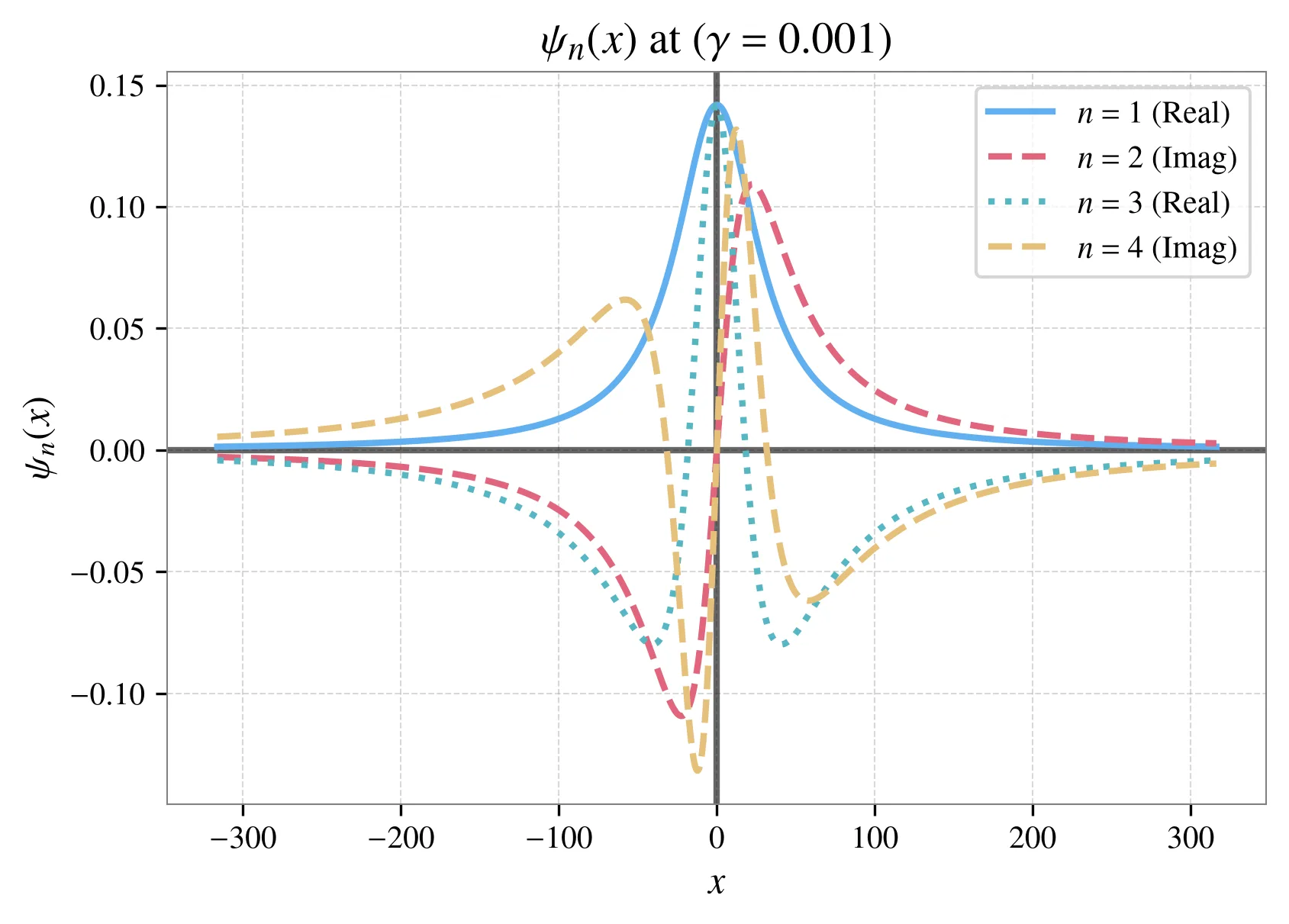
A group of researchers proposed a natural solution: space itself prevents such waves from spreading without bound. They used the extended uncertainty principle — a correction to ordinary quantum mechanics that accounts for the curvature of space on large scales. It turns out that this correction creates an invisible "cage" for each particle: its position cannot be arbitrarily uncertain; there is always a maximum spread.
The scientists tested the idea on a chain of harmonic oscillators — the simplest model of many quantum systems. When they included the geometric constraint, the entanglement entropy stopped growing with the chain length and leveled off to a constant value. The entanglement spectrum became discrete, with equal spacings, like the steps of a ladder. This means that even in the strictly massless limit, the system does not slide into infinity.
Thus, the geometry of space itself acts as a regulator, preventing quantum fluctuations from running away. Infinity retreats, and the vacuum becomes computable — without fine-tuning, by the sheer force of curvature.
Original abstract
as written by the authors arXiv:2607.29427v1
The entanglement entropy of quantum systems typically exhibits both ultraviolet and infrared (IR) divergences. In the low-frequency limit, the IR divergence is intimately tied to the unbounded spatial delocalization of zero-modes, a pathological feature common to both coupled harmonic oscillators and massless scalar fields. In this work, we demonstrate that this infinite growth is naturally resolved by invoking the Extended Uncertainty Principle (EUP), which introduces large-length-scale geometric corrections to the canonical commutation relations. By exactly solving the simple harmonic oscillator under the EUP framework, we establish the existence of an intrinsic geometric confinement that enforces a strict upper bound on the position variance, limits spatial delocalization, and introduces an intrinsic localization length scale related to the background Ricci scalar. We extend this regularizing mechanism to many-body systems by evaluating the entanglement entropy and entanglement spectrum of a one-dimensional harmonic chain and a massless scalar field. We show that the EUP-induced spatial bounds prevent the accumulation of low-lying long-wavelength modes, keeping the entanglement spectrum discrete and evenly gapped even in the strictly massless limit. This non-vanishing modular gap effectively caps the local entanglement temperature of the vacuum. Consequently, the entanglement entropy saturates to a finite value, providing a robust, geometric resolution to the zero-mode IR divergence problem in quantum field theory.
In the extended uncertainty principle, the minimal position uncertainty is linked to the curvature of space: the more curved the world, the tighter the "cage" for particles.
In Neal Stephenson's novel "Anathem," mathematical manipulations of space geometry alter the very fabric of reality — much like in this work, where curvature dictates quantum limits.