The generalized uncertainty principle (GUP) is a proposed refinement of quantum mechanics that modifies the standard Heisenberg uncertainty relation to include a minimum measurable length. In ordinary quantum mechanics, the uncertainty in position can be made arbitrarily small by allowing a correspondingly large uncertainty in momentum. The GUP posits that at very high energies—near the Planck scale—this trade-off breaks down, and there is an absolute lower bound on position uncertainty, on the order of the Planck length (~10⁻³⁵ meters). This implies that space is not infinitely divisible but has a discrete, granular structure at the smallest scales.
History
The idea of a minimum length in quantum gravity was explored in the 1980s and 1990s, notably by Amati, Ciafaloni, and Veneziano in the context of string theory, and by Kempf, Mangano, and Mann in the mid-1990s who formulated the GUP as a modified commutation relation.
How it works
The GUP typically adds a term proportional to the square of the momentum uncertainty to the standard uncertainty relation, so that Δx ≥ ħ/(2Δp) + α (Δp)², where α is a small constant. At low momenta, the standard term dominates, recovering ordinary quantum mechanics. At very high momenta, the new term grows, preventing Δx from shrinking below a finite value. This behavior emerges naturally in various approaches to quantum gravity, such as string theory and loop quantum gravity, where the Planck length acts as a fundamental cutoff.
In practice
The GUP is used in theoretical studies of black hole thermodynamics, where it modifies the Hawking temperature and entropy, and in phenomenological models that search for quantum-gravity signatures in high-energy physics and cosmology.
Fun fact
The GUP implies that at the Planck scale, the concept of a continuous spacetime breaks down, and the very notion of 'position' becomes fuzzy, a feature sometimes called 'spatial foam'.
A chef tastes tiny morsels from different edges of the plate and tries to reconstruct the recipe of a complex dish. Each morsel offers only a hint of flavor, and the samples are a bit blurred — too much salt here, not enough sugar there. That's roughly how nuclear physicists study the matter inside neutron stars — the densest objects in the universe after black holes.
The quantum vacuum is not empty: it is permeated by entanglement linking distant regions. But when physicists tried to compute this entanglement, it turned out to be infinite. The culprit: particles with very low energy that can smear out over arbitrarily large volumes. They are like waves with no shores to contain them.
A driver on a slippery road doesn't know exactly how the car will respond to the steering wheel, and learns on the go, leaving room for error. A smart control algorithm behaves in a similar way.
A snowflake grows, an oil slick spreads, a crowd moves — each case has its own equations. But the end result is often the same: shape, speed, and pattern follow a simple scheme that repeats across scales. This is universality — when a common law hides behind the details.
A handful of sand falls onto a table: each grain rolls down until it rests in a hollow. That's how a potential works: the table's surface tells the grains where to go. But in a river with whirlpools, there's no single basin everything flows into. Water swirls, returns, and meanders. For such systems, the usual map of 'pits and hills' doesn't apply.
In the hot early universe, like in an overcrowded dance hall, magnetic monopoles swirled — loner particles carrying only a north or only a south pole. In an ordinary magnet, poles always come in pairs, but here each one is on its own. Theories that unify all forces of nature predict that such particles should have been produced in vast numbers, yet today we don't see them.
You're pouring water into a glass, but you want exactly one million drops — not approximately, but exactly. An ordinary faucet pours a stream where the number of drops always varies. In the quantum world, photons have the same problem: a laser emits light where the number of particles fluctuates like a crowd in a square.
The quantum world is usually drawn with points, but real instruments only see blurry spots. Heisenberg and von Neumann long suspected: precision is unattainable.
A hot coffee on the table cools down: heat spreads from the hot center to the edges. The authors suggest that the universe behaves in a similar way, just on scales of billions of light-years. Their model describes not the usual dark energy, but a smooth redistribution of energy within the cosmos, akin to the slow flow of heat from denser regions to rarefied ones.
An ice cube in a glass of water doesn't just float: it gets pushed. Water molecules bombard it from all sides, and this bombardment gives rise to a force you can measure. In physics, there's a similar force, but it acts not on ice but on anything with mass, and it arises not from molecular jostling but from information. It's called entropic force.
In particle physics, it has long been taken for granted that the forces of nature (electromagnetism, the weak and strong interactions) obey a strict symmetry called gauge symmetry. It's like a set of rules by which particles exchange force carriers. But where do the rules themselves come from?
A distant orchestra plays a symphony, but the recording is full of noise. The melody is written for two instruments, yet a third voice seems to break through the static — quiet and unfamiliar. This is how astrophysicists listen to gravitational waves, trying to catch the slightest deviations from Einstein's predictions.
If space is a canvas, then brushstrokes cannot be infinitely thin. There's a tiniest segment, shorter than which there's no point in measuring. This quantum 'graininess' alters the geometry itself: the motion of galaxies and the growth of large-scale structures bear its mark.
The quantum world loves order, but reality often brings disorder. In this work, physicists study one-dimensional chains of spins — tiny magnetic arrows that can point up or down. Usually, topological phases (stable states protected by symmetry) are defined for pure states, where each arrow is precisely known.
The birth of the Universe is usually associated with the Big Bang — a point of infinite density. But at that point, the laws of physics break down, which bothers scientists. Stephen Hawking and James Hartle back in the 1980s proposed a different view: time has no boundary, like the surface of a globe.
Quantum computers use GKP states, dreamed up by Alexei Kitaev, John Preskill, and Daniel Gottesman. Their hallmark is built-in stabilizer checks that catch errors. For a long time, it was believed that a successful check guaranteed a nearly perfect state. Alas, it's an illusion.
A black hole in anti-de Sitter space is not a void but rather a pot of boiling liquid. This liquid has two phases: small and large black holes, like steam and water. At a certain pressure, they merge at a critical point, just as water at 374 °C and 218 atmospheres loses the distinction between liquid and gas.
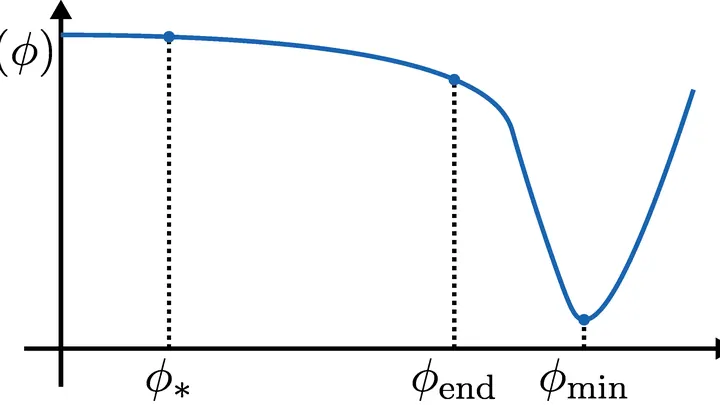
In the first moments after the Big Bang, space expanded at an incredible rate. A tiny quantum ripple, embedded in the uncertainty principle itself, pushed matter apart more strongly than any known force. This ripple is the generalized uncertainty principle, or GUP.