Radio Bursts to Map the Invisible Universe express
A flashlight beam cuts through fog. The denser the fog, the more the light scatters and the later it reaches your eye. A similar principle works with fast radio bursts — mysterious, super-powerful pulses from distant galaxies. As their radio waves travel through space, they interact with free electrons — particles stripped from atoms. This interaction delays the signal. The more electrons in the path, the greater the delay. By measuring this delay (called the dispersion measure), astronomers can 'count' all the invisible matter between galaxies.
This new work turns that principle into a precise scientific tool. Using an approach similar to analyzing galaxy spectra (spectroscopy), the authors built a model linking radio burst delays to the distribution of galaxies on the sky. The key result: free electrons turn out to be an almost perfect 'mirror' of all matter. Their clumps and rarefactions trace the cosmic web with high accuracy. The correlation coefficient is close to one. This means that a map of electrons is essentially a ready-made map of dark and visible matter.
The practical value is enormous. Future sky surveys, such as LSST and Euclid, will be able to use radio bursts to calibrate their weak lensing measurements, where the unknown gas distribution is a major nuisance. In the first years of the new telescopes, data will become so abundant that this method will become standard. It's like being able to see not only the stars but also the very air between them, and understanding how that air moves and is stirred by galaxies.
Original abstract
as written by the authors arXiv:2608.03235v1
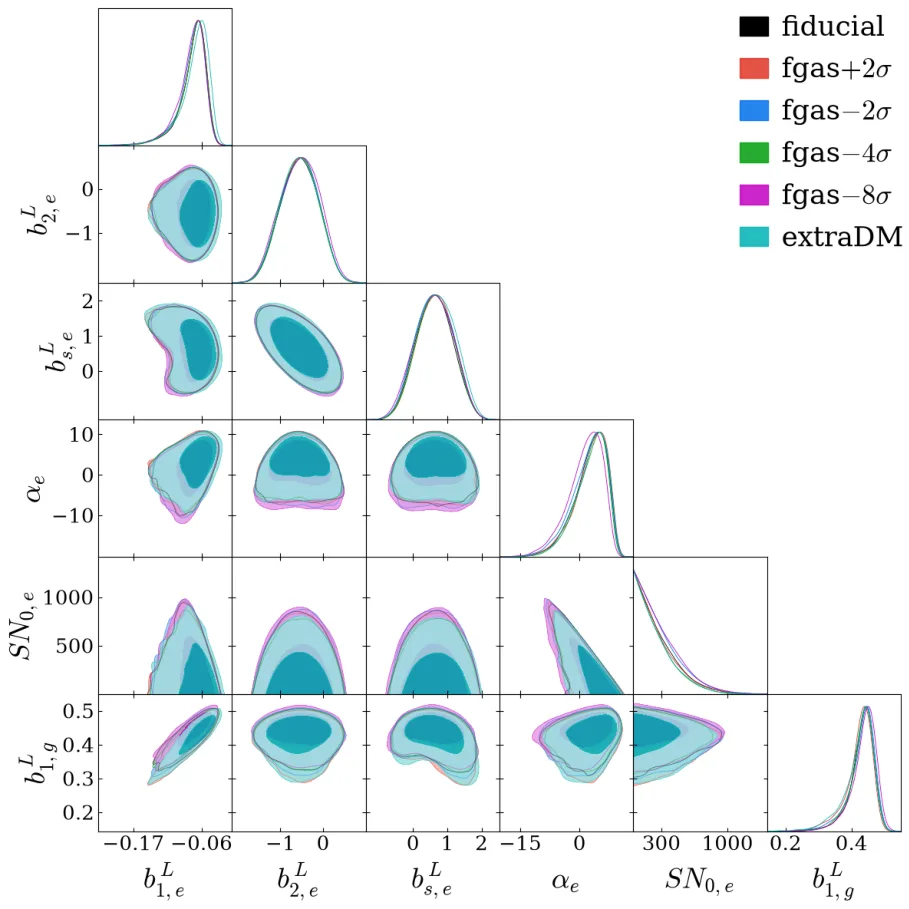
Fast radio burst (FRB) dispersion measures trace free electron column densities and will soon offer a unique probe of low-$$z$$ baryons. Such measurements can constrain cosmology directly, with the free electrons serving as a new tracer of large-scale structure, and probe the baryonic feedback of galaxies, a leading systematic for weak lensing surveys such as LSST and Euclid. We prepare for both science cases using effective field theory (EFT) and hydrodynamical simulations. We construct the one-loop EFT description of the free-electron auto-spectrum $$P_{ee}$$ and electron-galaxy cross-spectrum $$P_{eg}$$, placing FRB dispersion clustering on the same theoretical footing as spectroscopic galaxy analyses, and quantify the FRB densities at which this modeling is useful. We also investigate suitable galaxy samples for cross-correlations, finding that current spectroscopic catalogs provide appropriate redshift range and sufficient density. We validate the model against the FLAMINGO simulations, jointly fitting $$P_{ee}$$, $$P_{eg}$$, and $$P_{gg}$$ for DESI-like samples at $$z=0.2$$ and 0.5. The model describes all three spectra to $$k\sim0.2\,h\,{\rm Mpc}^{-1}$$, with an electron linear bias $$b_{e,1}\simeq0.92$$, higher-order biases consistent with zero, and all parameters stable across feedback variants. Together with the near-perfect electron-matter correlation $$r_{em}\simeq1$$, this establishes free electrons as nearly unbiased, feedback-robust tracers of matter, supporting a key assumption of FRB-based feedback constraints. These properties make electron clustering an ideal application for Hybrid Effective Field Theory (HEFT), which would extend the modeling reach by a further factor of 2--3. The low-$$z$$ electron spectrum becomes signal-dominated beyond the linear regime within the first few years of next-generation surveys; the models developed here will be necessary on these timescales.
A single fast radio burst releases as much energy in a fraction of a second as the Sun does in several days, but due to cosmic distances, we receive it as a whisper barely audible against the galactic noise.
In Carl Sagan's novel 'Contact,' an alien signal serves as a key to understanding the structure of the universe — here, radio bursts play a similar role, but without the intervention of extraterrestrial intelligence.