Neural Network Learns to Read Molecules by Their Carbon Signature express
Every carbon atom in a molecule carries a passport — the energy with which its deepest electrons sit in their orbitals. This energy is sensitive to neighbors: add an oxygen nearby or a double bond, and the number in the passport changes. Chemists have long measured such energies with X-rays, but calculating each new molecule takes hours of machine time.
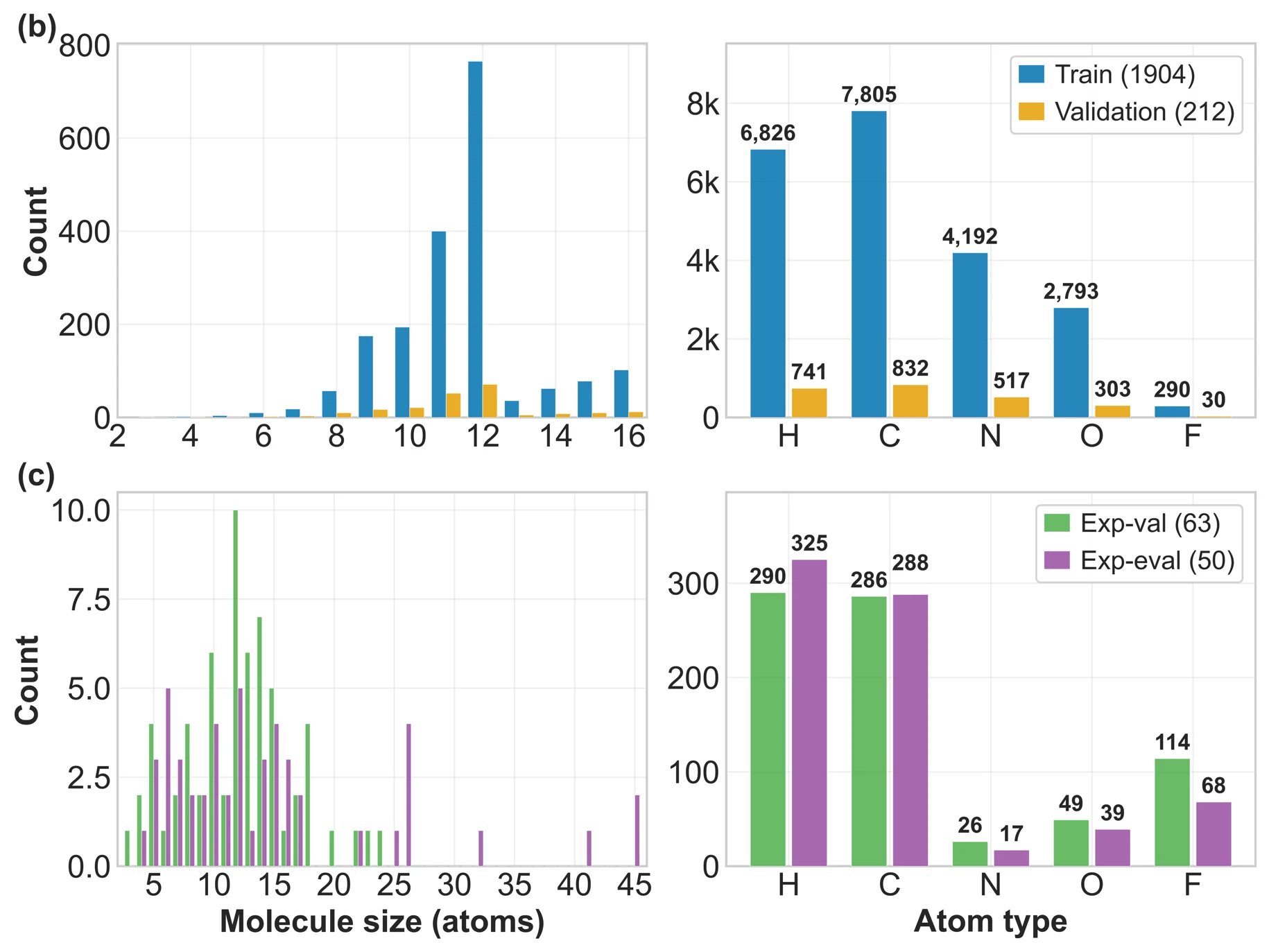
The new model works like a seasoned archivist who, from a single photo of a building, instantly determines the strength of its foundation. It sees a molecule not as a jumble of balls but as a graph — a network where atoms are nodes and bonds are edges. The neural network was trained on 8637 carbon centers in 2116 molecules ranging from 4 to 16 atoms, using data from multiconfigurational density functional theory (a sophisticated quantum calculation method). When tested on 570 real measurements in 113 molecules, some reaching 45 atoms, the average error was 0.33 electronvolts. That's roughly one hundredth of the energy of visible light.
A special feature of the model is chemically meaningful node features that reduce dependence on the depth of message passing in the graph. In simpler terms, the neural network doesn't need to 'ask' distant neighbors many times to understand an atom's environment. It's like gauging a person's mood not from their entire chain of conversations but from a few key words.
The model is also robust to distorted geometries: those that arise from thermal vibrations or early stages of a chemical reaction. It was tested on tautomers of avobenzone (45 atoms)—molecules that shift a hydrogen atom and are linked to UV protection. The neural network instantly distinguished the forms and produced energies consistent with experiment. This paves the way for rapid screening of drugs and materials.
And here's the curious thing: carbon's passport changes by several electronvolts depending on neighbors — enough to distinguish graphite from diamond by X-ray spectrum alone.
The energy of carbon's core electrons changes by several electronvolts depending on neighbors — enough to distinguish graphite from diamond by X-ray spectrum alone.