Catching Electron Signals Near Absolute Zero ✛
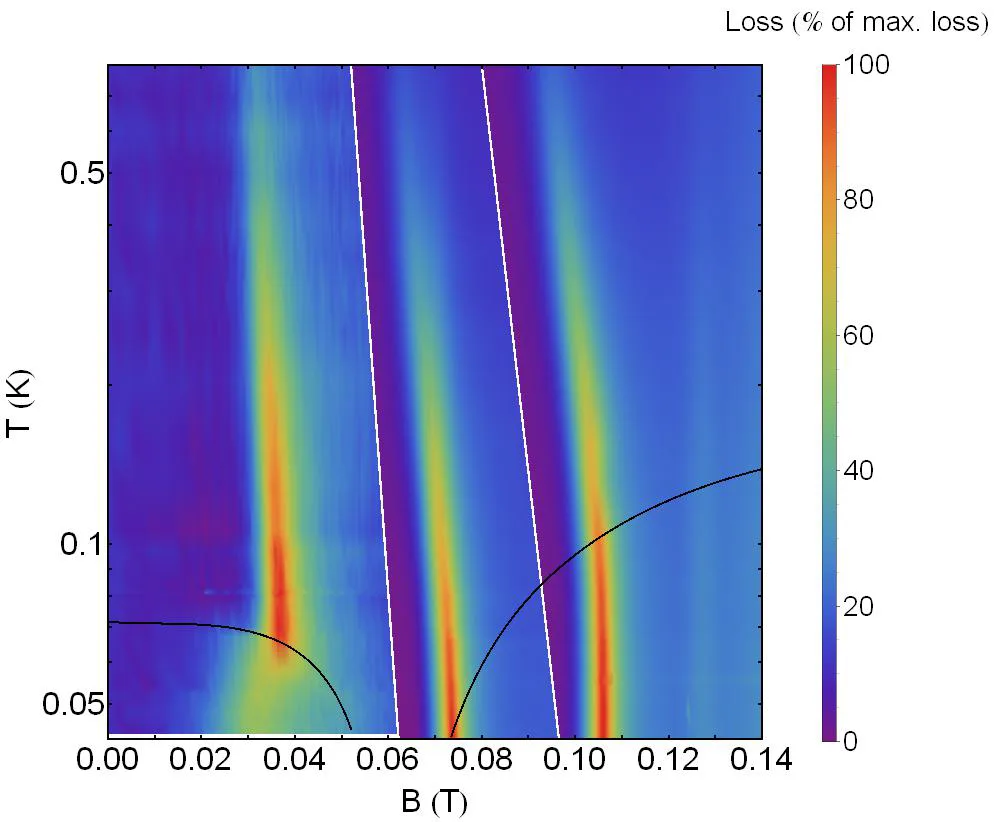
Tuning a radio to a station that changes frequency as you cross a phase boundary: that's one way to picture this work. In the metal YbRh2Si2, electrons behave like 'heavy' particles, with masses hundreds of times that of ordinary electrons. At very low temperatures, below 70 millikelvin (just 0.07 degrees above absolute zero), a magnetic order emerges in this material. You can destroy it with a weak magnetic field, roughly a hundred times weaker than the magnet on your fridge. Near the point where that order vanishes, the metal's properties change dramatically, but until now scientists couldn't probe that region.
To catch the signal, the researchers created superconducting resonators shaped like meandering strips, just a few millimeters across. They operate at 1.5 gigahertz, corresponding to a wavelength of about 20 centimeters, roughly the size of a palm. These resonators can be cooled to 40 millikelvin and placed in strong magnetic fields, like a radio receiver that tunes into different stations. Measurements showed that as the quantum critical point is approached, the g-factor continuously decreases and tends toward 2, as in free electrons. This means the 'heavy' electrons disappear, and the material transitions to a new state. So a radio tuned to the 'heavy fermion' station, upon crossing the phase boundary, starts picking up the free-electron station.
The resonance frequency of 1.5 GHz corresponds to a wavelength of about 20 cm, comparable to the size of a palm. Yet the resonator fits on a chip of only a few millimeters thanks to its meander geometry.
The idea of a quantum critical point as a special state of matter where familiar quasiparticles vanish echoes the concept of a 'phase transition' in Isaac Asimov's novel 'The Gods Themselves', where matter transitions to a new state under extreme conditions.