Electron Spin Resonance Across the Quantum Critical Point ✛
Context
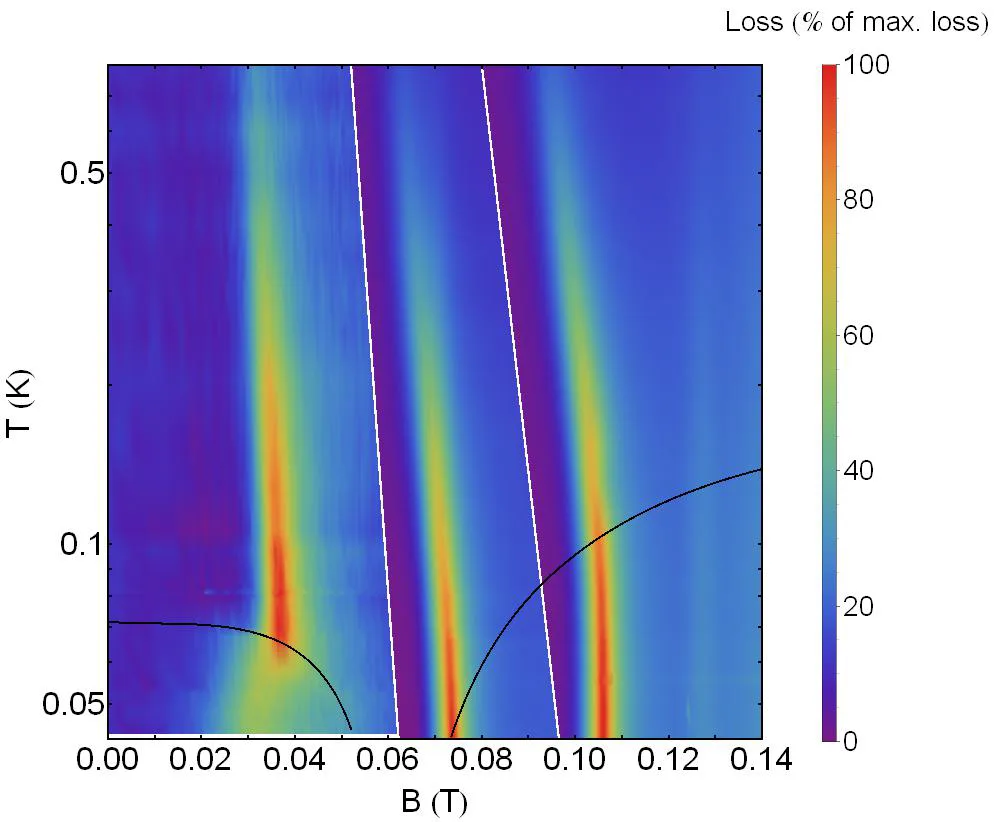
Heavy-fermion metals such as YbRh2Si2 are ideal model systems for studying quantum phase transitions driven by strong electronic correlations. In this compound, antiferromagnetic order emerges below 70 mK and can be suppressed by a magnetic field of about 60 mT applied perpendicular to the c-axis. Near the quantum critical point, anomalies in transport and thermodynamic properties are observed that cannot be described by Landau's Fermi-liquid theory. However, most spectroscopic methods, such as neutron scattering or photoemission, face severe technical limitations for YbRh2Si2. This work fits into the broader study of quantum criticality in strongly correlated systems, where related studies have examined magnetic resonance in oxides and superconductors but did not reach such low temperatures and fields.
Methods
The key innovation was the use of superconducting planar resonators based on niobium striplines on a sapphire substrate. The resonators were meander-shaped, allowing frequencies from 1.5 GHz to be achieved with a chip size of only a few millimeters. Three resonators with different fundamental frequencies (1.50, 2.07, and 2.65 GHz) and their harmonics (up to 13.4 GHz) provided coverage of a wide range of magnetic fields. Measurements were performed in a dilution refrigerator at temperatures from 40 mK to 4 K and fields up to 8 T. The YbRh2Si2 sample was mounted on a brass screw above the resonator, and the temperature was monitored with a ruthenium oxide sensor. For each temperature and field, the resonator quality factor was measured, from which the electron spin resonance contribution was extracted by subtracting the background dependence. The spectra were fitted to an asymmetric Lorentzian line shape.
Results
In the antiferromagnetic phase, cooling causes the resonance field to drop sharply, while the g-factor increases to values around 3.4, and the linewidth increases by more than an order of magnitude. In the paramagnetic Fermi liquid, the g-factor becomes temperature-independent, and the linewidth follows the dependence ΔB = aT² + const, with the coefficient a correlating with the coefficient A from electrical resistivity, which is proportional to the square of the effective mass. In the quantum critical regime, the g-factor shows a logarithmic temperature dependence, and the linewidth decreases upon cooling starting from the temperature corresponding to the Zeeman energy. As the quantum critical point is approached, the g-factor continuously decreases, tending toward the value of 2 characteristic of free electrons. Comparing the temperature and field dependences of the g-factor revealed a striking coincidence after shifting the frequency axis by 1.68 GHz, which corresponds to the resonance at g = 2 and the critical field of 60 mT.
Implications
This work provides the first direct spectroscopic data on spin dynamics across all phases of a quantum critical heavy-fermion metal. Unlike related studies that focused on individual materials or limited parameter ranges, this work covers the entire phase diagram near the quantum critical point. The observed tendency of the g-factor toward 2 as the Kondo breakdown quantum critical point is approached serves as experimental confirmation of the theoretical concept of heavy quasiparticle loss. This points to the dual nature of f-electrons: partly localized, partly itinerant. The results also demonstrate that electron spin resonance can serve as a sensitive probe of quantum criticality, complementing thermodynamic and transport measurements.
Future development
The proposed method of superconducting resonators with tunable frequency could be extended to other heavy-fermion materials where electron spin resonance is observed, such as β-YbAlB4. Further lowering of temperature and precise frequency tuning will allow testing whether the g-factor indeed converges to 2 at the quantum critical point itself. It may also be possible to study the superconducting phase of YbRh2Si2, which emerges at ultra-low temperatures and may be related to triplet pairing. Theoretical models describing collective spin modes in Kondo lattices will gain new constraints from these data.
Impact
The results will impact the understanding of quantum phase transitions in strongly correlated electron systems and the development of spectroscopic methods for low temperatures. The superconducting resonator technique could be used in studies of quantum materials and spintronics.
Next steps
Plans include applying the method to other quantum critical heavy-fermion compounds and performing measurements at even lower temperatures. It is also important to theoretically describe the observed coincidence of the temperature and field dependences of the g-factor.
Key open problems
This work is directly related to the unresolved problem of the nature of the quantum critical point in YbRh2Si2: whether it arises from Kondo breakdown or spin criticality. The obtained g-factor data support the Kondo breakdown scenario but require further theoretical analysis. The origin of superconductivity in this material and its connection to quantum criticality remains an open question.
The knowledge machine's view
This section is addressed to the author of the paper and their colleagues. Neighbouring works were found by meaning-based search across our archive, not by word overlap. We do not review: we show the field around the work.
What the work does
The authors developed superconducting planar resonators to measure electron spin resonance in YbRh2Si2 at ultralow temperatures (down to 40 mK) and over a wide frequency range. For the first time, they traced the behavior of the g-factor and linewidth across all three regions of the phase diagram: antiferromagnetic, quantum critical, and Fermi liquid. They observed a continuous decrease in both the g-factor and linewidth as the quantum critical point is approached, which they interpret as a loss of heavy quasiparticles.
Where its strength is
This work demonstrates a unique experimental capability to probe quantum criticality directly through spin dynamics, which is inaccessible by other methods. The combination of ultralow temperatures and low frequencies yielded data consistent with theoretical models of the Kondo breakdown quantum criticality.
Where it could go next
- It might be interesting to compare the observed behavior of the g-factor and linewidth with the magnetic resonance in chromium oxide, where the dependence of resonance parameters on temperature and magnetic field near magnetic transitions was also studied.based on: A String That Changes Stiffness: Magnetic Resonance in Chromium Oxide arXiv:2608.29712v1
- The developed superconducting resonator technique could be useful for studying spin dynamics in other strongly correlated systems, such as the superconductor UTe2, where the magnetic field induces several superconducting phases and a possible connection with magnetic fluctuations.based on: The Quantum Garden of UTe2: How a Magnetic Field Cultivates Three Superconducting Phases arXiv:2606.28904
- The idea of using planar resonators to detect weak spin signals resonates with approaches to measuring single spins, where resonator sensitivity is a key parameter; perhaps borrowing methods to improve the quality factor.based on: A Resonator That Catches a Single Spin arXiv:2603.25258
Worth trying
- Test whether the scaling of the g-factor and linewidth persists for other orientations of the magnetic field relative to the crystallographic axes.
- Use multifrequency measurements to construct a complete picture of the spin excitation dispersion near the quantum critical point.
- Validate the background subtraction method on samples with a known resonance to quantitatively assess systematic errors.
Why this may matter
These results could serve as a benchmark for theoretical models of quantum criticality in heavy-fermion metals, and the developed technique opens the way for systematic studies of spin dynamics in a broad class of strongly correlated materials.
Nearby works in our archive
- Dancing on a Carbon Thread: A Diamond Qubit with Millisecond Memorysimilarity 0.54
- A Resonator That Catches a Single Spinsimilarity 0.53
- A String That Changes Stiffness: Magnetic Resonance in Chromium Oxidesimilarity 0.52
- Quantum Crossroads with No Turning Backsimilarity 0.51
- The Quantum Garden of UTe2: How a Magnetic Field Cultivates Three Superconducting Phasessimilarity 0.51
- A Radio Receiver for the Whisper of an Invisible Fieldsimilarity 0.51
The archive is sparse around this work: the closest review is only 0.54, against a usual 0.64. It looks like few have drilled nearby.
The resonance frequency of 1.5 GHz corresponds to a wavelength of about 20 cm, comparable to the size of a palm. Yet the resonator fits on a chip of only a few millimeters thanks to its meander geometry.
The idea of a quantum critical point as a special state of matter where familiar quasiparticles vanish echoes the concept of a 'phase transition' in Isaac Asimov's novel 'The Gods Themselves', where matter transitions to a new state under extreme conditions.
Key numbers
- Critical field: 60 mT
- Néel temperature: 70 mK
- Minimum measurement temperature: 40 mK
- Minimum resonator frequency: 1.5 GHz
- g-factor in the antiferromagnetic phase: 3.4