A Radio Receiver for Electrons: Catching a Signal from the Quantum Critical Point ✛
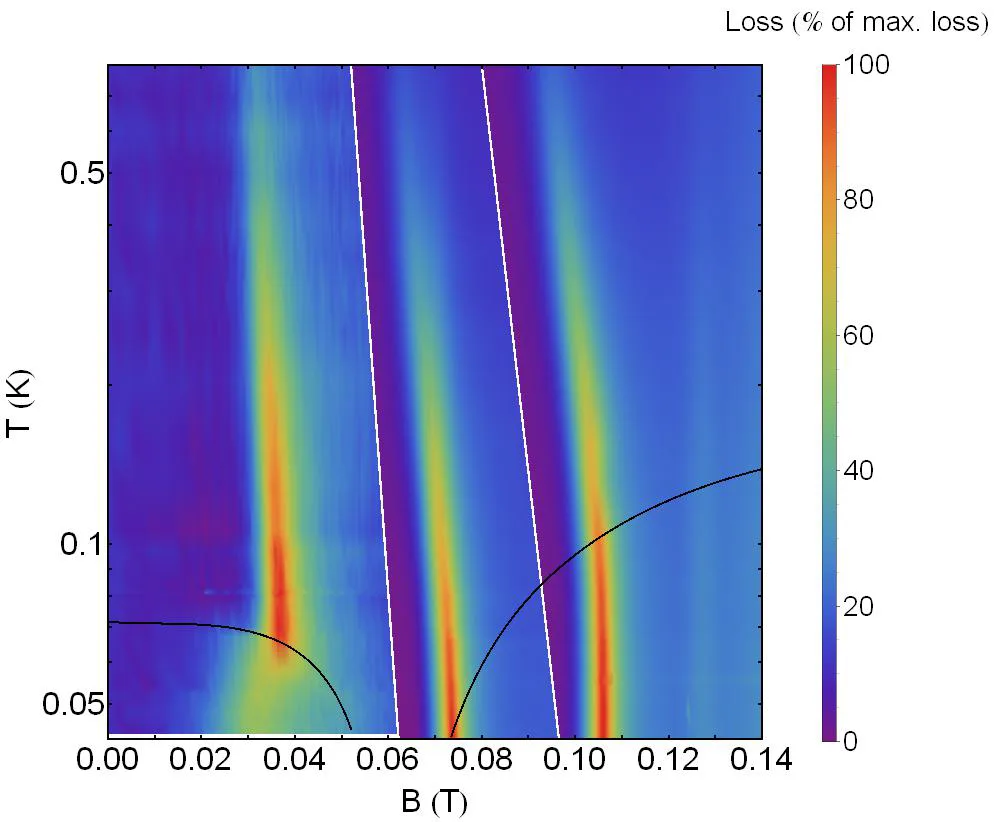
Tuning a radio receiver to a station that changes frequency as you cross a phase boundary: that is how you might picture the challenge facing the researchers. In the metal YbRh2Si2, electrons behave as "heavy" particles: their effective mass is hundreds of times that of a free electron. At temperatures below 70 millikelvin, this material develops magnetic order, which can be destroyed by a magnetic field of just 60 millitesla, roughly a hundred times weaker than the field of a refrigerator magnet. Near this point, known as the quantum critical point, the metal's properties change dramatically, but most methods could not probe this region due to technical limitations.
To catch the signal, the scientists built superconducting resonators shaped like a meander: a winding strip on a sapphire substrate just a few millimeters across. They operate at frequencies from 1.5 gigahertz, corresponding to a wavelength of about 20 centimeters, roughly the size of a hand. Thanks to this, the resonators can be cooled to 40 millikelvin and placed in strong magnetic fields. Three resonators with different fundamental frequencies, along with their harmonics, allowed the team to cover a wide range of conditions, as if a radio receiver could tune into many stations at once.
The results were striking. In the magnetic phase, cooling causes the g-factor to rise to 3.4, and the resonance linewidth increases by more than a factor of ten. In the paramagnetic Fermi liquid, the g-factor becomes temperature-independent, while the linewidth grows in proportion to the square of the temperature, with a coefficient that correlates with the effective electron mass. In the quantum critical regime, the g-factor changes logarithmically, and the linewidth decreases upon cooling, starting from a temperature that corresponds to the energy of the magnetic field.
The most important observation: as the quantum critical point is approached, the g-factor continuously decreases and tends toward 2. This value is characteristic of free electrons, which means the "heavy" quasiparticles disappear. Comparing the temperature and field dependences of the g-factor revealed a striking coincidence after shifting the frequency axis by 1.68 gigahertz, which corresponds to the resonance at g=2 and a critical field of 60 millitesla. It is as if a radio receiver tuned to the "heavy fermion" station loses that signal when crossing the phase boundary and starts picking up the free-electron station instead.
This result supports the theoretical concept of Kondo breakdown: at the quantum phase transition, local magnetic moments cease to be screened by conduction electrons, and the heavy quasiparticles disintegrate. The superconducting resonator method can be applied to other heavy-fermion materials, such as β-YbAlB4, to test whether the g-factor indeed converges to 2 at the critical point itself. Thus, tuning a radio receiver to a station that changes frequency has allowed us to hear matter lose its familiar particles at the threshold of absolute zero.
The resonance frequency of 1.5 GHz corresponds to a wavelength of about 20 cm, comparable to the size of a palm. Yet the resonator fits on a chip of only a few millimeters thanks to its meander geometry.
The idea of a quantum critical point as a special state of matter where familiar quasiparticles vanish echoes the concept of a 'phase transition' in Isaac Asimov's novel 'The Gods Themselves', where matter transitions to a new state under extreme conditions.