Substrate phonons switch magnetization
Context
Switching magnetization via substrate phonons had previously been demonstrated only on sapphire and glass-ceramics. It remained unclear whether the effect works on other materials and which substrate properties matter. Related studies examined magnetic responses in graphene heterostructures, lateral light shifts, and quantum sensors, but no direct test of phonon switching universality existed. This work fills that gap by systematically comparing seven substrates with different crystal lattice symmetries.
Methods
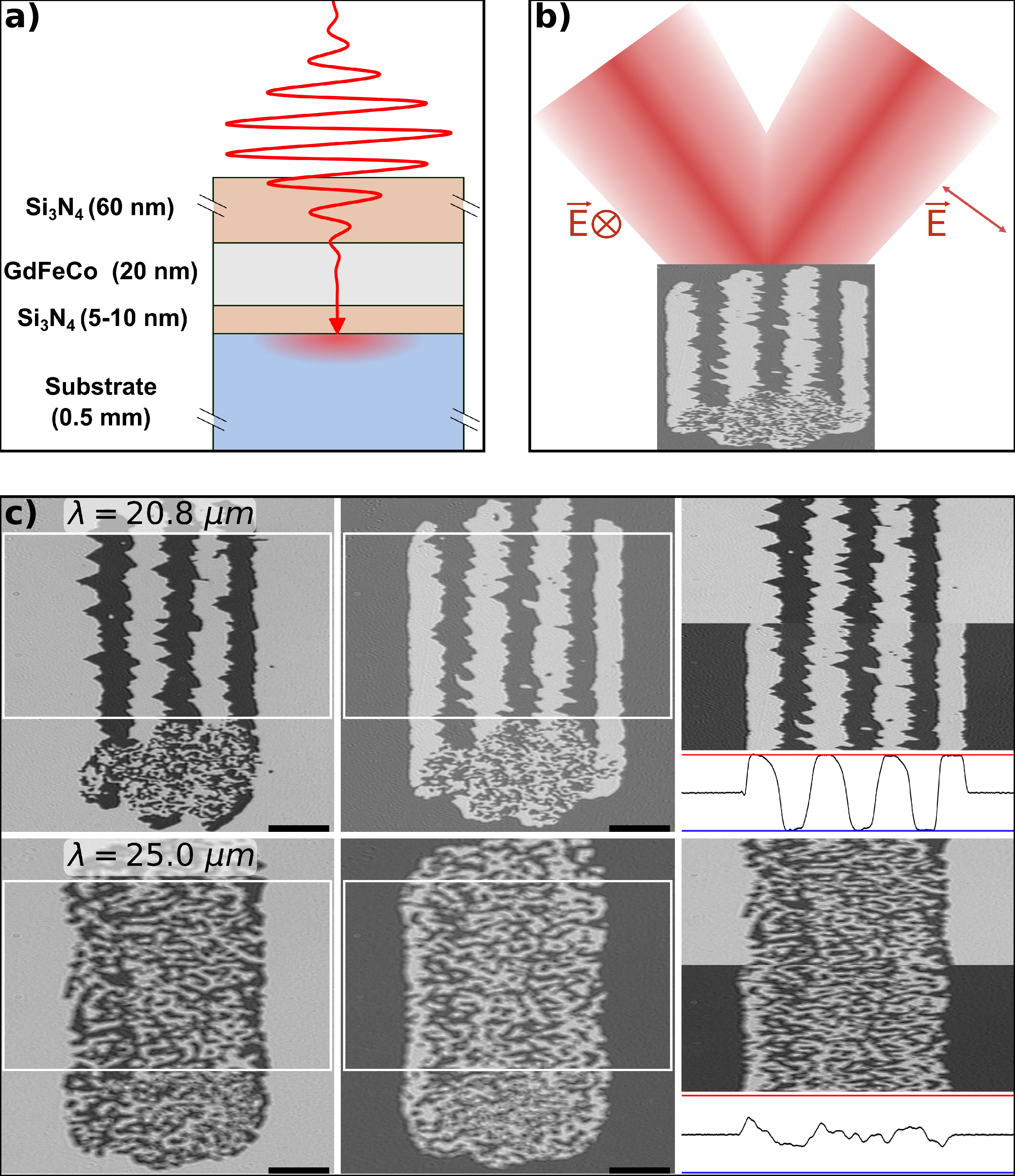
A 20 nm thick GdFeCo magnetic layer was deposited on TiO2, LiNbO3, KTaO3, ZnO, α-SiO2, MgO, and Al2O3 substrates. Excitation used infrared pulses from the FELIX free-electron laser with a tunable wavelength from 3 to 120 μm. Polarization was modulated so that a grating with alternating light helicity formed on the sample. After irradiation, the magnetic state was visualized using Faraday microscopy. Switching efficiency was estimated from the contrast between regions with opposite magnetization. Additionally, the electric field and absorbed power distribution in the multilayer structure were modeled using the transfer-matrix method.
Results
Magnetization switching was observed on all seven substrates, covering six point groups. The spectral range of switching generally coincided with the Reststrahlen bands of the substrates, but efficiency maxima systematically shifted to shorter wavelengths relative to transverse optical phonon resonances. For example, for MgO the maximum efficiency reached 96% at a wavelength of 20.8 μm, whereas the phonon resonance is near 25 μm. Efficiency varied strongly between substrates: from 30% for α-SiO2 to 95% for TiO2. Calculations showed that near resonance, absorbed energy concentrates in the first 200 nm of the substrate near the magnetic layer, which can cause local heating and suppress switching. The recovery of switching on the long-wavelength edge of the band for MgO, ZnO, and Al2O3 remained unexplained.
Implications
The work shows that phonon switching of magnetization is not limited to a specific crystal symmetry and is a general mechanism. Unlike neighboring studies that examined individual materials or effects, this work provides the first systematic comparison across seven substrates with different phonon spectra. The observed mismatch between switching and absorption spectra indicates that efficiency is determined not only by substrate absorption but also by the entire optical structure of the heterostructure. This shifts focus from simple resonant excitation to a balance between phonon generation and local heating.
Future development
The topic could develop toward controlling thermal effects at the interface, for example by varying the thickness of an intermediate layer or choosing materials with different thermal conductivities. It is also promising to investigate nonlinear lattice dynamics under strong excitation to understand how anharmonicity affects the amplitude of coherent phonons. It might be possible to find substrates where switching is more efficient by optimizing the polar strength of phonon modes.
Impact
The results could influence the development of spintronic and magnonic devices that require ultrafast magnetization control without external magnetic fields. They are also useful for understanding light-phonon interactions in heterostructures.
Next steps
The next step could be measuring the temperature near the interface during the excitation pulse. It would also be worth testing switching on substrates with known nonlinear phonon properties.
Key open problems
The work addresses the fundamental problem of coupling between spin and lattice degrees of freedom in solids. The question of how to efficiently transfer angular momentum from phonons to the magnetic subsystem remains open. The observed discrepancy between switching and absorption spectra points to unaccounted energy dissipation channels, which relates to the general problem of controlling heat flow at the nanoscale.
Effective magnetic fields generated by circularly polarized phonons can exceed tens of tesla, comparable to the fields of the most powerful pulsed magnets.
Key numbers
- magnetic layer thickness: 20 nm
- maximum switching efficiency: 96%
- excitation wavelength range: 3–120 μm
- number of substrates studied: 7
- energy localization depth at interface: 200 nm