Light as a Score: Photonic Chip Conducts Wave Packets ✛
A conductor raises the baton, and the orchestra produces not just sound but a complex score: each note sounds at its own moment, at its own pitch, with the right volume. Light can also be a score, if you control its spectrum and timing. Previously, this required bulky setups that could not be reconfigured after assembly. Now researchers have created a programmable photonic chip that conducts light pulses, and a neural network suggests how to achieve the desired pattern.
The system is based on a femtosecond laser whose pulses enter a chip with eight cascaded interferometers. Each cascade splits the pulse into two copies with an adjustable delay from 1 to 128 picoseconds. Thermo-optic phase shifters set the splitting ratios, forming a sequence of up to 256 pulses with a step of 1 picosecond. After amplification and compression, this sequence is launched into a highly nonlinear fiber, where a supercontinuum is born: a very broad spectrum of light from a single laser pulse.
To control the result, asynchronous optical gating is used: a second laser with a slightly different repetition rate scans the output, and a BBO crystal produces a spectrogram: a map of energy distribution over time and wavelength. Optimization is performed by a genetic algorithm and particle swarm, and a neural network predicts spectrograms from chip settings, speeding up the search.
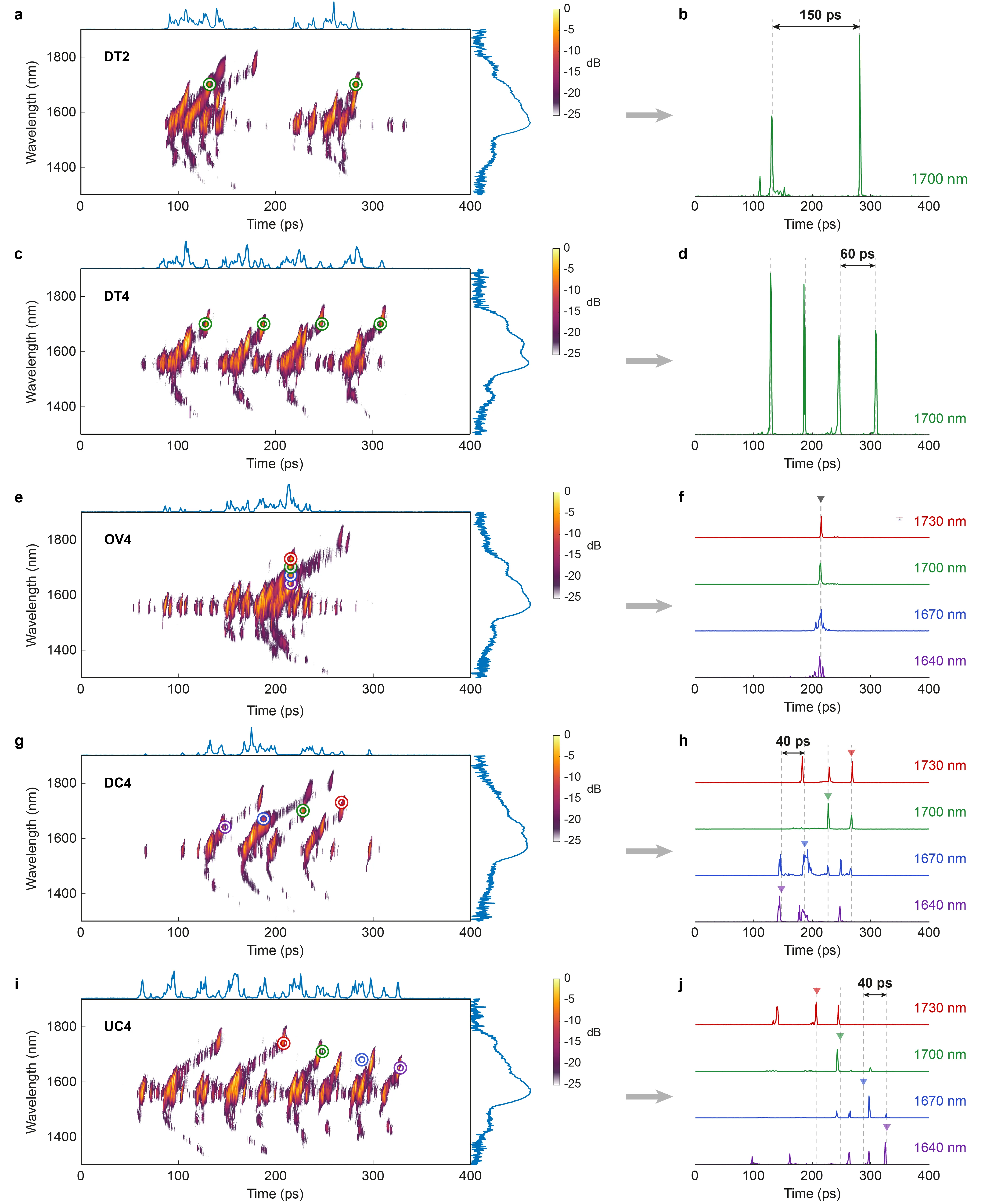
The experiment showed that the system can form five complex patterns in a 400 nm band with a temporal resolution of 922 femtoseconds. These include two pulses at 1700 nm with a delay of 150 picoseconds, four pulses with a step of 60 picoseconds, synchronous overlap of four wavelengths from 1640 to 1730 nm, and spectrally encoded delays of ±40 picoseconds. The neural network, trained on 5000 experimental spectrograms, predicted new ones with an error of 12.2% and reduced optimization time from 3 hours to minutes, that is, by a factor of 15.
Previously, broadband light sources had a fixed profile and could not be flexibly reconfigured. Now the user only specifies target coordinates in the spectrogram, and the system itself finds the chip settings. This turns the supercontinuum from a fixed source into a tunable tool that is already applicable in multiphoton microscopy, spectroscopy, and materials processing. The conductor chip performs any light score on demand.
The neural network predicted spectrograms in 50 microseconds, while an experimental measurement took 2 seconds, making it 40,000 times faster. Training on 5000 examples took only 6 minutes on a graphics processing unit.
The idea of programmable light that adapts to the task resonates with the concept of 'smart' optical systems from M. John Harrison's novel 'Light', where light is used as a computational medium and tool.