Light as a Score: Photonic Chip Conducts Wave Packets ✛
Context
Modern photonics strives for complete control over light in multiple dimensions simultaneously. Spatial beam control is well developed, but flexible tuning of the spectro-temporal structure of broadband pulses remains challenging. Conventional systems are bulky and cannot be reconfigured after fabrication. Alongside this work in the archive are studies on color vision through a single pixel, liquid crystals for light control, and laser printing of electron bunches, all seeking ways to make optics more controllable and compact. This paper continues that direction but focuses on temporal and spectral flexibility, combining a programmable chip with machine learning.
Methods
The experiment begins with a femtosecond laser at 1550 nm, whose pulses enter a programmable delay line on a photonic chip. The chip consists of eight cascaded Mach-Zehnder interferometers, each splitting the pulse into two copies with adjustable delays from 1 to 128 ps. Thermo-optic phase shifters set the splitting ratios, forming sequences of up to 256 pulses with a 1 ps step. After amplification and compression, the pulse train is launched into a highly nonlinear fiber, where a supercontinuum is generated. For result monitoring, asynchronous optical gating is used: a second laser at 1040 nm with a slightly different repetition rate scans the output, and sum-frequency generation in a BBO crystal yields a spectrogram. Optimization is performed by a genetic algorithm and particle swarm, while a neural network predicts spectrograms from chip settings, accelerating the search.
Results
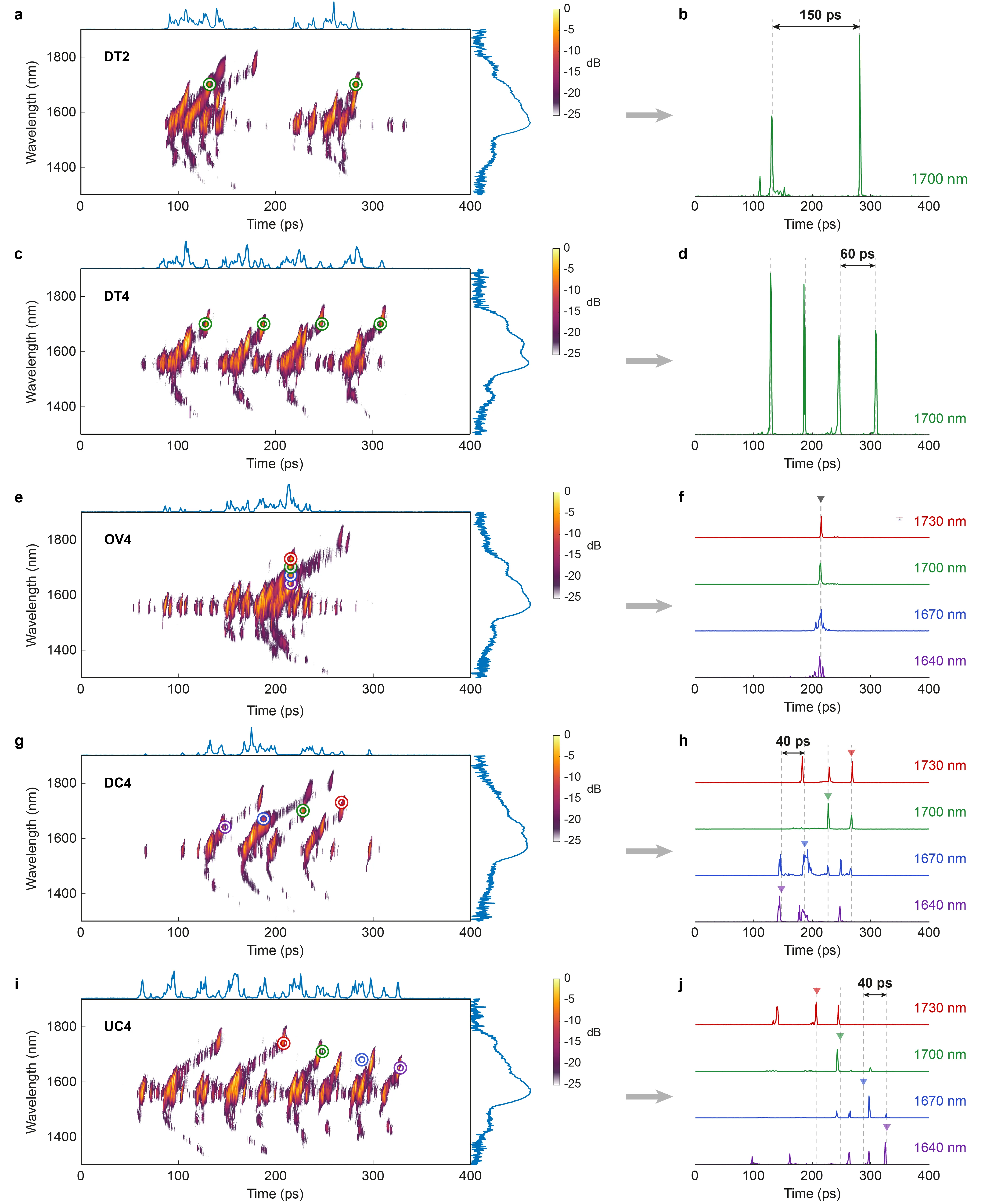
The system experimentally generated five complex spectro-temporal patterns across a 400 nm band with a temporal resolution of 922 fs. These include: two pulses at 1700 nm with a 150 ps delay, four pulses at 1700 nm with a 60 ps step, synchronous overlap of four wavelengths from 1640 to 1730 nm, and spectrally encoded delays of ±40 ps between these wavelengths, overcoming fiber dispersion. The neural network, trained on 5000 experimental spectrograms, predicted new ones with an error of 12.2% and reduced optimization time from 3 hours to minutes, that is, by a factor of 15. The hybrid approach consistently achieved objective function values twice as high as the best result from random search over 5000 measurements.
Implications
This work differs from neighboring studies in that it is the first to combine a programmable chip, machine learning, and fast characterization to control nonlinear light propagation. Neighboring works either control spatial modes or use passive elements, but do not achieve such flexibility in the spectro-temporal domain. Here, the user only specifies target coordinates in the spectrogram, and the system finds the chip settings by itself. This turns the supercontinuum from a fixed source into a reconfigurable tool, opening new possibilities for multiphoton processes where synchronization of different wavelengths is crucial.
Future development
The chip's reconfiguration speed is limited by the thermal response time of about 1 ms, but kilohertz speeds are possible in the future. Faster switches based on lithium niobate could accelerate the process by orders of magnitude. The neural network could be replaced with more advanced architectures or reinforcement learning, and porting the trained model to a microcontroller would enable portable systems. Additional flexibility could come from using multimode waveguides, adding a spatial dimension to control.
Impact
The method is directly applicable in multiphoton microscopy, where different modalities require different spectro-temporal excitation profiles. It is also useful for materials processing, coherent spectroscopy, quantum signal processing, and optical computing, where precise synchronization and spectral distribution are needed.
Next steps
The next step is to integrate feedback directly from the target application, such as the fluorescence signal in a microscope, instead of the intermediate spectrogram. This would optimize not the pulse shape but the final outcome, such as image contrast or excitation efficiency.
Key open problems
In photonics, the problem of complete control over multidimensional light states, including spectrum, time, polarization, and spatial mode, remains open. This work addresses part of that challenge for the spectro-temporal domain, but does not tackle polarization or spatial modes. The connection to unresolved questions in nonlinear dynamics, such as real-time control of soliton interactions, also remains promising.
The knowledge machine's view
This section is addressed to the author of the paper and their colleagues. Neighbouring works were found by meaning-based search across our archive, not by word overlap. We do not review: we show the field around the work.
What the work does
The work describes an experimental system that combines a programmable photonic chip based on a cascade of Mach-Zehnder interferometers, a nonlinear fiber for supercontinuum generation, asynchronous optical gating for characterization, and a neural network to accelerate optimization. The authors demonstrated the formation of five target spectro-temporal patterns with a temporal resolution of 922 fs and reduced the optimization time by a factor of 15.
Where its strength is
A strong point is the integration of a programmable chip, fast diagnostics, and machine learning into a single loop, enabling flexible control over the spectro-temporal structure of broadband pulses. This opens up possibilities for adaptive synthesis of complex optical fields.
Where it could go next
- It might be interesting to see how the on-chip light control approaches from work 2602.06790 could be adapted to extend your system's functionality, for example, for wavelength tuning or source integration.based on: Light on Demand: How to Tune an On-Chip Photon Source arXiv:2602.06790
- A related work, 2604.03830, discusses using liquid crystals for dynamic light control; perhaps their fast reconfiguration methods could complement thermo-optic phase shifters in your chip to increase speed and flexibility.based on: Liquid Crystals Teach Light to Change the Rules arXiv:2604.03830
- There is also a study in the archive, 2602.14240, about a quantum chip that brings order to the colors of light; perhaps some principles of spectral filtering or state manipulation could help improve control over the supercontinuum.based on: Quantum chip brings order to the colors of light arXiv:2602.14240
Worth trying
- Consider replacing thermo-optic phase shifters with electro-optic ones to speed up chip reconfiguration and shorten optimization time.
- Use machine learning methods to directly design chip settings for a desired spectrogram, bypassing iterative optimization.
- Investigate whether your system can be applied to generate entangled photon pairs by controlling spectral correlation through the chip.
Nearby works in our archive
- Light Learns to Countsimilarity 0.58
- Light on Demand: How to Tune an On-Chip Photon Sourcesimilarity 0.58
- Quantum chip brings order to the colors of lightsimilarity 0.57
- Liquid Crystals Teach Light to Change the Rulessimilarity 0.57
- Light Instead of Wires: Photonic Chip Computes Fastersimilarity 0.57
- A Rainbow at Your Fingertipsimilarity 0.57
The archive is sparse around this work: the closest review is only 0.58, against a usual 0.64. It looks like few have drilled nearby.
The neural network predicted spectrograms in 50 microseconds, while an experimental measurement took 2 seconds, making it 40,000 times faster. Training on 5000 examples took only 6 minutes on a graphics processing unit.
The idea of programmable light that adapts to the task resonates with the concept of 'smart' optical systems from M. John Harrison's novel 'Light', where light is used as a computational medium and tool.
Key numbers
- tuning bandwidth: 400 nm
- temporal resolution: 922 fs
- optimization speedup: 15 times
- neural network prediction speed: 50 μs per spectrogram
- number of pulses in sequence: up to 256