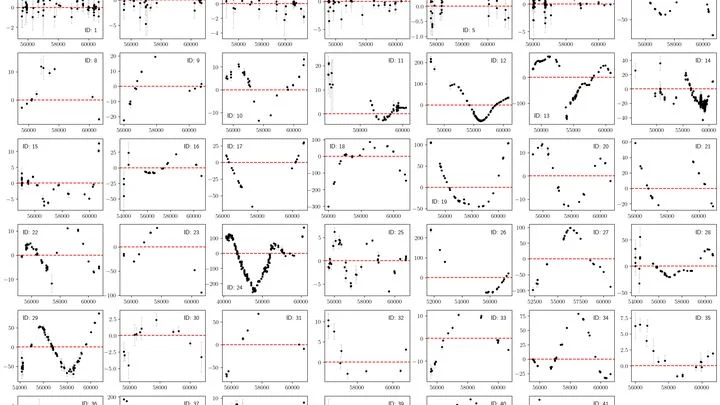
Black hole variability refers to the observed changes in brightness and emission from black holes over time, ranging from milliseconds to years. These fluctuations arise from the chaotic infall of matter, instabilities in accretion disks, and the dynamics of relativistic jets. Studying variability provides a window into the extreme physics near the event horizon, where gravity is intense and matter moves at near-light speeds.
History
Variability in quasars was noticed in the 1960s, but systematic studies began with X-ray satellites in the 1970s. The concept of quasi-periodic oscillations (QPOs) was established in the 1980s, and recent high-cadence observations have revealed more complex patterns.
How it works
Matter spiraling into a black hole forms a hot, turbulent accretion disk. Turbulence and magnetic fields cause clumps of gas to brighten and fade as they heat up and radiate. Periodic signals can emerge from orbital motions, disk oscillations, or jet precession. The observed light curve is a superposition of these processes, and its power spectrum reveals characteristic timescales that constrain the black hole's mass and spin.
In practice
Used to estimate black hole masses in distant galaxies and to test general relativity in strong-field regimes.
Fun fact
Some black holes exhibit quasi-periodic oscillations with frequencies that scale inversely with mass, allowing astronomers to 'weigh' them from light curves alone.
The heart of a black hole beats unevenly. One thump is brighter, another dimmer, and this rhythm encodes the temperature of the electrons swirling right at the horizon. Astronomers call this rhythm the spectral index: a number that shows how much brightness changes as you move from one radio frequency to another.
A black hole paired with a star works like a pump: it pulls gas from its companion, swirls it into a glowing disk, and occasionally ejects some of that matter in two narrow jets. In 2021, the system 4U 1543-475 put on such a show.
A black hole is not just an abyss. It is a seething cauldron whose temperature rises as it evaporates. The authors of the study found that when the heat reaches a critical threshold, the hole seems to boil. It emits superheavy particles — the very ones that exist on a scale where any theory of gravity collapses.
It is commonly believed that a black hole is a merciless cosmic vacuum cleaner, sucking in everything indiscriminately. But new research flips the picture: right at the horizon, curvature transforms from a trap into a trampoline.
A black hole horizon is like a soap film stretched over an abyss. From a distance it looks perfectly smooth, but up close it trembles. This ripple arises from quantum fluctuations — the continuous birth and death of particles in the vacuum.
Light falling into a black hole carries information — for instance, the path a photon took. The horizon (the surface from which nothing returns) responds by changing its entropy — a measure of disorder, akin to the number of shuffled pages in a book.
Photographing the vicinity of a black hole is like shooting a fountain: a short exposure freezes the droplets, a long one blends everything into blurry streaks. Light from the superheated gas swirling around the hole reaches us along different paths. Some rays curve around it in an arc, others make multiple loops due to spacetime curvature.
At the center of the Milky Way lies the supermassive black hole Sagittarius A*. It is four million times more massive than the Sun, but by cosmic standards it behaves quietly: it only occasionally flares up when it swallows a clump of gas.
The black hole Swift J1727.8-1613 emits X-ray bursts in a strict rhythm — like a cosmic heart. Gas falling onto the hole forms a spinning disk, and its glow pulsates. A Chinese telescope picked up this rhythm, like a stethoscope catching a heartbeat.
A garden hose blasts a powerful stream of water. If you pinch it or give it a jerk, the stream starts to writhe like a snake, and spray flies everywhere. Something similar happens with the giant plasma jets that black holes shoot out.
Eclipses in binary stars are like clockwork: a white dwarf (the dense remnant of a star) regularly passes in front of its companion, and the light briefly dims. But for most such pairs, the clock runs fast or slow by seconds over years. Astronomers measured these glitches in 43 systems and found a pattern.
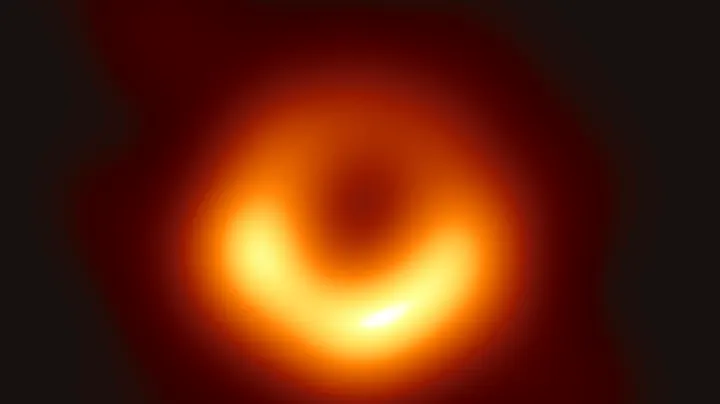
In 2019, astronomers unveiled the first-ever image of a black hole's shadow — a dark void encircled by a lopsided orange ring. This is the supermassive black hole at the heart of galaxy M87, 55 million light-years away. The ring isn't just glowing: one side is noticeably brighter than the other, like a campfire burning unevenly, with flames leaping higher on one side.