Zhen Zhang

6 articles · 30 co-authors · latest: 2026-08-20
77 citations · h-index 4 · 22 papersData: Semantic Scholar

We have retold 6 papers by this author. most often about: gamma-ray burst, Gamma radiation, fast radio burst. 30 co-authors across our retellings.

Links in the knowledge graph
High Energy2026-01-121 minarXiv:2601.07688express
Record-Bright Flare from a Gamma-Ray Burst
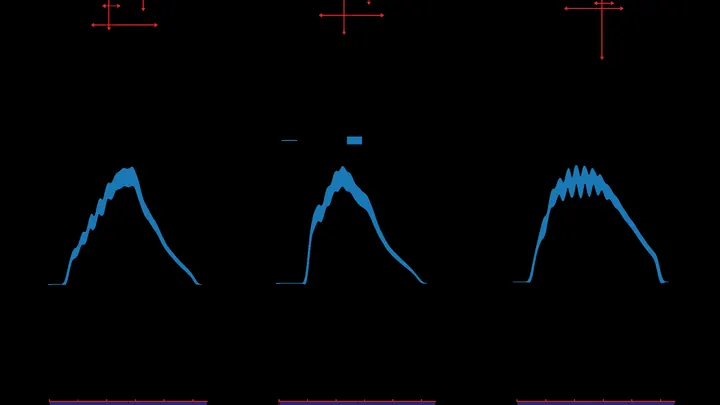
In October 2022, the space-based detector GECAM-C caught the most powerful gamma-ray burst ever seen, GRB 221009A — an explosion that briefly became the brightest source of gamma rays in the sky. But the most interesting part came after: the instrument detected a series of additional flares, and one of them was record-breaking.
physics.acc-ph2026-03-161 minarXiv:2603.15996express
Laser Printing of Electron Bunches
A typical accelerator is like an assembly line where electrons are the workpieces. To get the desired X-ray pulse, the workpiece is fine-tuned after it's already on the line: squeezed, filtered, corrected. In the new work, engineers decided to take a different approach — shaping the workpiece before it even hits the conveyor. At LCLS-II, electrons are knocked out of a metal by a short laser pulse.
physics.acc-ph2026-04-111 minarXiv:2604.09969express
Attosecond X-ray Flashes from an Accelerator
An ordinary camera flash lingers for hundredths of a second, but for atoms, that's an eternity. Inside molecules, electrons jump in attoseconds: billionths of a billionth of a second. To capture that, you need a light pulse shorter than the event itself. Physicists take an electron beam in a linear accelerator and compress it so that individual bunches become thinner than a hair — in time.
Atomic Physics2026-06-072 minarXiv:2606.08870express
Nuclear clock ticks for the first time
A pendulum that almost nothing can knock off balance (not shaking, not heat, not magnetic fields) because it is hidden in the very heart of the atom. That is the kind of pendulum physicists used when they first switched on a nuclear clock. Previously, the best clocks, optical ones, relied on electron transitions.
Nuclear Theory2026-07-212 minarXiv:2607.19220express
How Quarks Help Neutron Stars Avoid Collapsing
A handful of sand in your fist: the grains press against each other, and your hand can't squeeze any further. Ordinary matter behaves similarly. But in a neutron star, compression is billions of times stronger — atoms are crushed, electrons are squeezed into protons, and nearly all space is filled with neutrons.
An Antibiotic Like an Overheated Engine
A bacterium hit with a dose of ampicillin behaves like a runner pushed to the limit: first it gasps out acid, then falls out of rhythm. Scientists measured this breakdown with sensors thinner than a human hair: they detect pH changes right at the bacterial surface. Ampicillin doesn't just break the bacterial wall.