Invisible Molecule Teaches Chemistry of Space express
Two guitar strings are stretched on the same neck. They are almost identical, but one is slightly shorter — and they sound different. That's roughly how the two isomers of ethanimine work: molecules with the same set of atoms but rotated differently in space. Astronomers spotted this molecule in the dense clouds near the center of our Galaxy. Ethanimine is interesting because it belongs to the "prebiotic" class — from such building blocks, the first steps toward life might have assembled.
In cold gas, molecules constantly collide with neighbors — mostly helium atoms and hydrogen molecules. Each jolt makes the molecule spin faster or slower. Usually, frequent collisions bring rotation to equilibrium: fast and slow "spinning tops" settle into a strict distribution, like sand that has settled after a shake. But observations showed that ethanimine behaves differently: its rotational states are frozen in a non-equilibrium pattern. This means that collisions and the emission of energy into space pull the blanket in different directions, and neither wins.
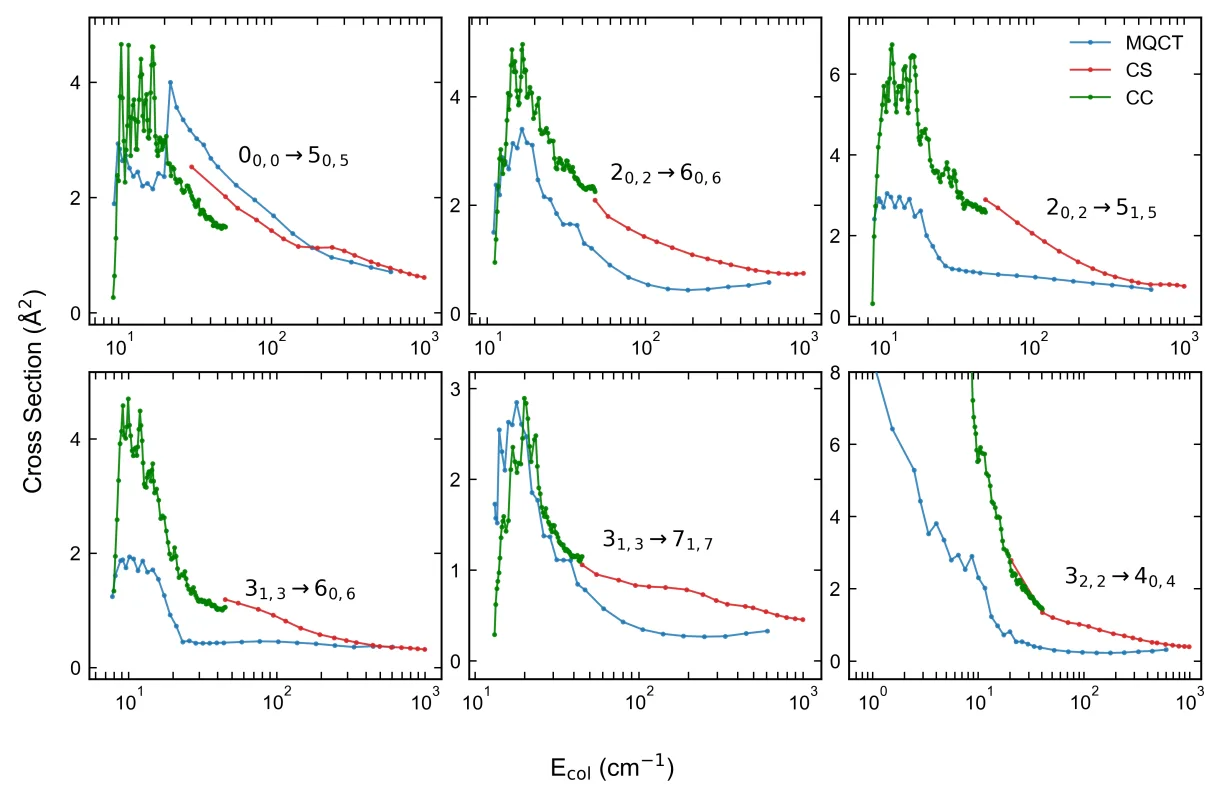
To sort this out, the authors built a detailed map of how a helium atom interacts with each of the two isomers. They obtained "potential energy surfaces" — essentially, the landscape of forces acting between particles as they approach. Then they played out three collision scenarios on this map: fully quantum (most accurate but heavy), simplified quantum, and mixed quantum-classical. It turned out that upon impact, the molecule prefers to change its rotation in a strictly defined way: either "roll" around one axis without changing speed around the other, or vice versa. This is like a spinning top that changes its tilt when flicked but keeps its spin speed.
The most practical of the findings is that the mixed quantum-classical method works well at high collision energies. It's like switching from hand engraving to lithography: faster, cheaper, and you hardly lose any detail. Now, plugging the computed transition probabilities into radiation transfer models, astronomers can more accurately read the chemical composition of distant clouds — the very ones where, from ethanimine and its neighbors, the first organic chains might have been born.
Original abstract
as written by the authors arXiv:2606.08846
The ethanimine molecule, CH3CHNH, is one of the prebiotic molecules detected by astronomers in chemically-rich molecular clouds in the Galactic Center. The observations indicate a non-equilibrium distribution of rotational state populations in both the E- and Z-isomers of ethanimine, resulting from the competition between radiative processes and collisions with background gases such as He and H2. Accurate interpretation of these observations requires the use of radiative transfer models with collisional state-to-state transition processes included. Here, in order to compute cross sections for state-to-state transitions in both ethanimine isomers, accurate potential energy surfaces for their interaction with a He atom were constructed and three complementary methods for inelastic scattering were utilized: full-quantum coupled-channel and coupled-states methods, and the mixed quantum/classical theory. Strong propensities of transitions toward $$\Delta j = 0$$ and either $$\Delta k_a = 0$$ (with $$\Delta k_c = \pm 1$$) or $$\Delta k_c = 0$$ (with $$\Delta k_a = \pm 1$$) are reported and the origin of this effect is identified. Small but non-negligible differences between energy transfer in the two isomers, on the order of 10%, were found. The utility of the mixed quantum/classical approach to collisional energy transfer at higher collision energies is discussed.
Ethanimine consists of just 8 atoms (two carbons, five hydrogens, and one nitrogen), but its two isomers differ like left and right gloves — and space "sees" that difference.
In Carl Sagan's novel "Contact," the alien signal contained blueprints for a machine, but building it required understanding the chemistry of the interstellar medium — exactly what collision calculations refine.