A Diamond Hears a Magnetic Field in a Single Instant express
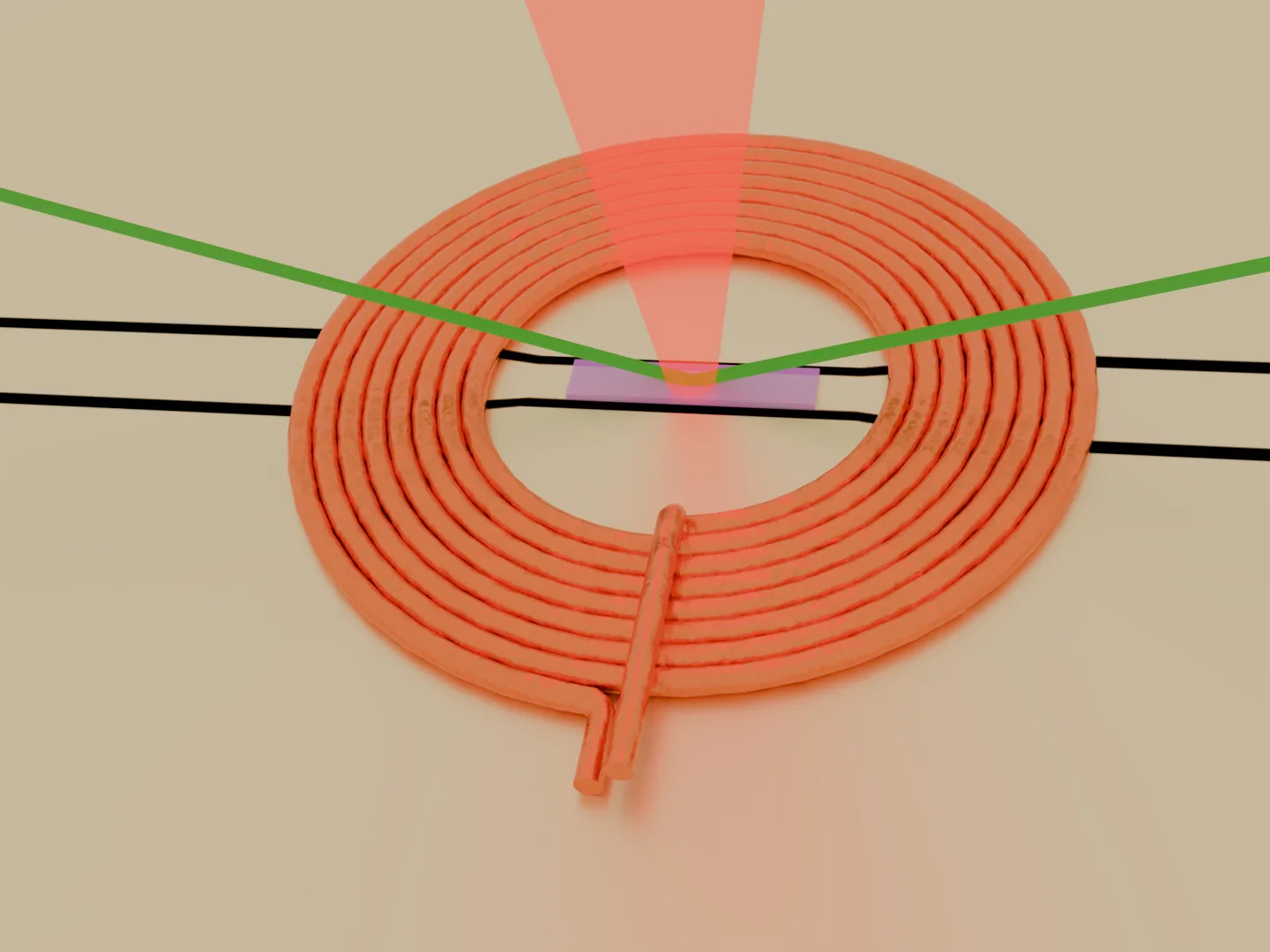
A tiny defect in a diamond crystal works like a sensitive antenna. When a magnetic field oscillates nearby, this defect, a nitrogen vacancy, responds by glowing. Previously, to hear the signal, you had to accumulate many repeated measurements, like listening to a whisper with your ear pressed against a door. Now a single short "look" suffices.
The authors showed that the strength and phase of an alternating magnetic field at a frequency of 4 megahertz can be extracted from just two consecutive measurements. The accuracy is 78 nanoteslas in amplitude and 63 milliradians in phase, with a temporal resolution of 320 microseconds. For comparison, 78 nanoteslas is roughly one hundred thousand times weaker than Earth's magnetic field.
The scientists also tested what happens when the probe frequency does not match the field frequency and how the method behaves in strong fields. Errors can be estimated in advance. Moreover, the protocol allows changing the probe frequency during the experiment, like tuning a radio on the fly.
This approach brings diamond sensors closer to observing fast magnetic processes in real time: from neuron firing to vortices in superconductors. One diamond, one measurement, and an instant snapshot of the invisible.
The nitrogen-vacancy center in diamond is so sensitive that it can detect the magnetic field of a single electron from a distance of several nanometers.