Caught: The Light That Lit Up the Young Universe express
After the Big Bang, the Universe was filled with cold gas — mostly neutral hydrogen and helium. It enveloped the cosmos like a morning fog, impenetrable to light. The Dark Ages began.
When the first galaxies ignited, their radiation, like a searchlight beam, started knocking electrons out of atoms. This process, reionization, gradually dispersed the fog, making space transparent.
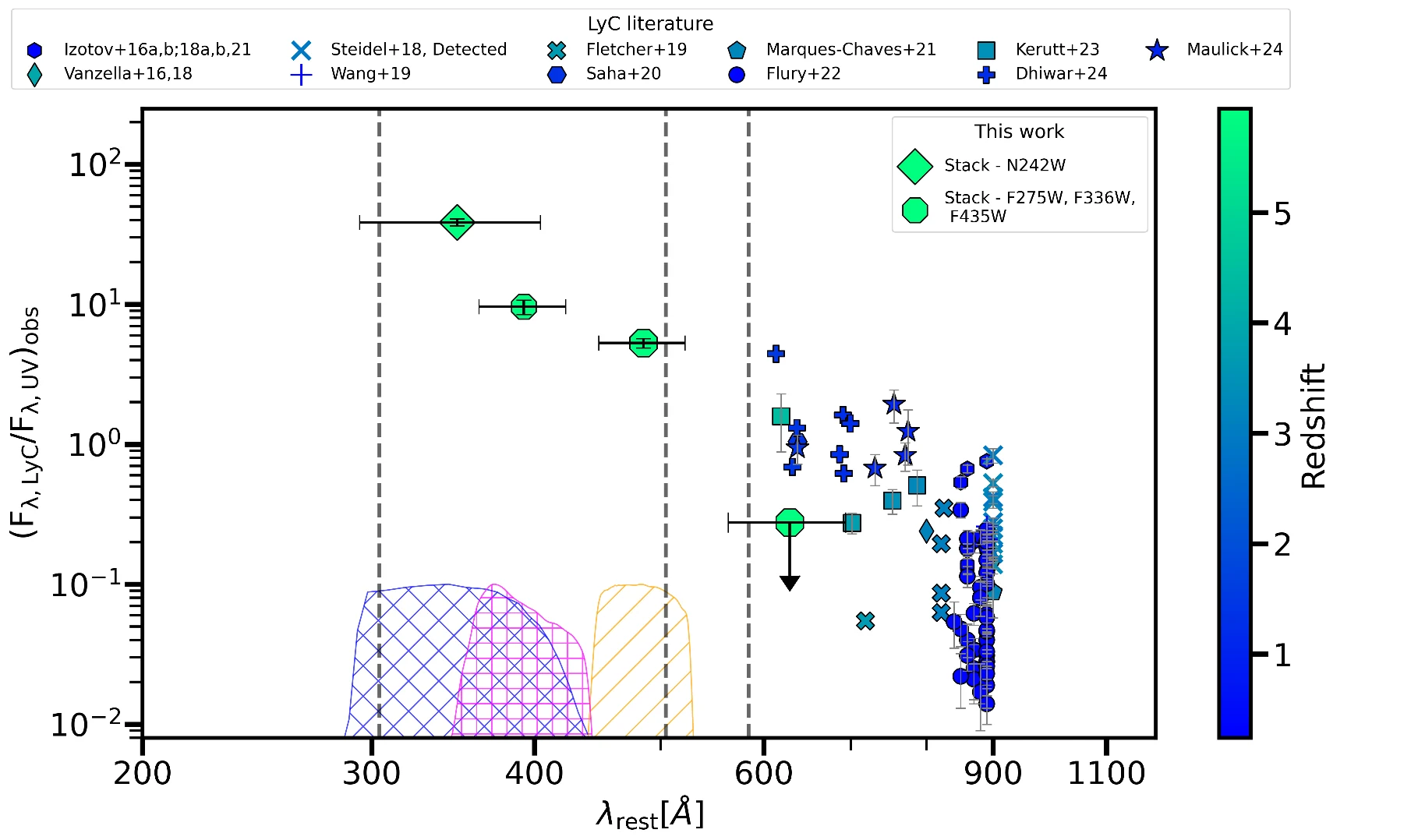
For the first time, astronomers have directly detected that very cleansing light. The James Webb Space Telescope and other instruments studied galaxies seen a billion years after the Big Bang. Spectrum analysis revealed: nearly 80% of ultraviolet light burst out — far more than models predicted. But the main surprise — some photons carried energy above 24.6 electron volts, enough to strip electrons even from helium. Previously, this was thought possible only at later stages. So the first stars were true titans, and their light was sufficient to clear the fog even from the most stubborn atoms.
Original abstract
as written by the authors arXiv:2604.13267
The end of the Cosmic Dark Age marked the onset of reionization, driven by extreme-UV photons from the first galaxies. Direct detection of such photons has remained challenging due to strong intergalactic attenuation. Here, we report the first direct detection of ionizing photons at rest-frame wavelengths $$350\r{A}$$, $$392\r{A}$$, and $$485\r{A}$$, using deep UV imaging from two independent space observatories: AstroSat and HST. These photons emerge from a stacked sample of spectroscopically confirmed Ly$$\alpha$$ emitters at $$5.9
The most energetic photons had energies above 24.6 electron volts — enough to strip electrons even from helium. Previously, this was thought to have happened much later.
In the series "Firefly," the ship "Serenity" flies through worlds aglow with the light of many suns. Astronomers, however, have captured that ancient light that ignited those suns.