The Cold Brain of a Quantum Computer express
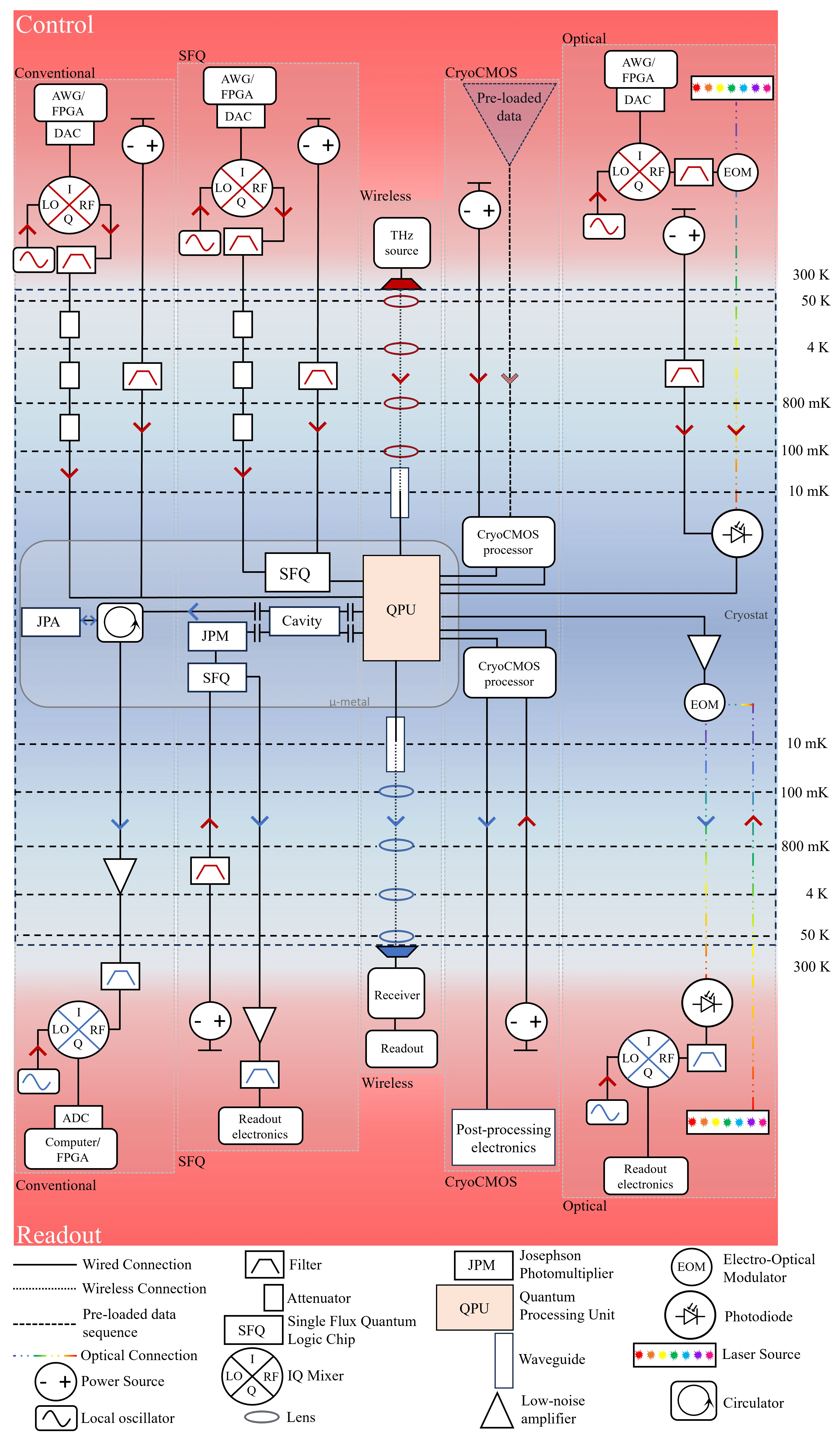
Imagine an orchestra where every musician plays an instrument that breaks at the slightest warmth. The conductor is the quantum processor, and the musicians are the qubits — fragile carriers of quantum information. To keep them in harmony, you need a whole team of tuners sitting in the next room, sending commands through a soundproof wall. In the quantum world, that wall is a cryostat — a device that cools the processor to near absolute zero (about -273°C). At such frigid temperatures, even air turns into a solid crust, and any stray heat can shatter the delicate quantum symphony.
The main issue highlighted in this review is not the qubits themselves, but the "tuners": the classical electronics that must send control signals and read out results. Ordinary microchips either stop working in such cold or generate too much heat. So engineers are looking for ways to move some of the control electronics right into the cryostat, closer to the qubits. To that end, they are developing special cryogenic chips — both semiconductor and superconducting. Superconducting circuits barely heat up but require even lower temperatures. Semiconductor chips can operate slightly warmer but are harder to make low-noise. It's like choosing between a silent but very fragile conductor and a rougher, hardier one.
The second approach is to keep the electronics outside, in a warm room, but then signals must travel to the qubits along long wires. Each wire is like a pipe through which sound gets distorted and attenuated. To get a clean signal through, you need complex filters and amplifiers. But progress is being made here too: scientists are experimenting with optical interfaces, where signals travel as light through fiber optics, and even with wireless communication inside the cryostat. Light introduces no extra heat and creates no electrical interference, and antennas the size of a grain of sand can talk directly to the qubits. It's as if the conductor sent notes to the musicians with a laser pointer instead of his voice, without breaking the silence of the hall.
Quantum computing is not a race for speed but an attempt to tame matter at the edge of the possible. Every step toward larger systems requires ingenuity not only from physicists but also from electronics engineers. And for now, the hottest point of the quantum revolution remains the coldest, literally. Back to our orchestra: the musicians play, the conductor leads, and the tuners in the icy room do everything to keep the symphony from stopping.
The temperature inside a cryostat for quantum processors is so low that the helium used for cooling becomes superfluid: it seeps through microscopic cracks and flows up the walls of its container.
In Dan Simmons' novel 'Hyperion', the TechnoCore uses quantum computers cooled to temperatures where time itself slows down, in order to predict the future.