The Sun as a Free Quantum Pump ✛
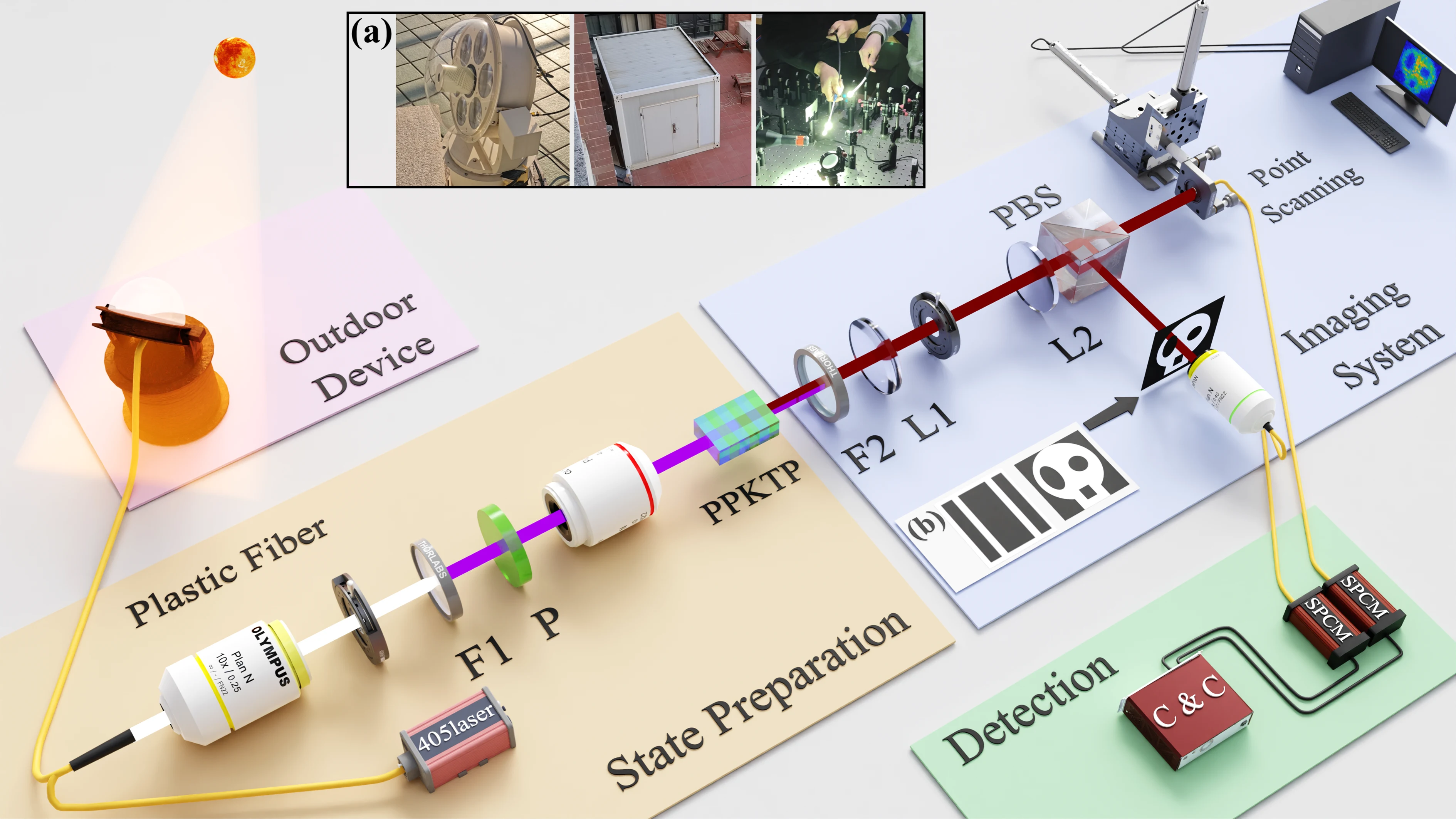
Sunlight collected by a Fresnel lens and passed through 20 meters of plastic fiber had a power of just 3 microwatts, a million times less than a typical laser pointer. That was enough to generate photon pairs correlated in position inside a nonlinear crystal. One photon from each pair passed through the object, the second was scanned by a detector, and coincidences built up the image. That is how quantum imaging works.
Previously, this required a laser, a coherent light source that needs power and precise alignment. In the new study, sunlight was collected on the roof, tracked across the sky, and sent into the lab via fiber. Inside the PPKTP crystal, solar pump photons split into pairs with lower energy. The position correlation, the link between the locations of the two photons, survived even the broad spectrum of sunlight.
This opens the way to quantum systems without lasers or external power. In space, sunlight is abundant, and such sources could reduce the mass and power consumption of equipment. The limitations, such as atmospheric effects and the minimum required coherence, remain to be studied. But the first step is taken: light that has bathed Earth for billions of years for free can now power quantum technologies.
Sunlight collected by a Fresnel lens and passed through 20 meters of plastic fiber had a power of just 3 microwatts—a million times less than a typical laser pointer—yet it sufficed for quantum imaging.
The idea of using natural light for quantum technologies echoes Arthur C. Clarke's novel 'Solar Wind', where spacecraft use the pressure of sunlight. Here, sunlight does not push but generates entangled pairs, yet both approaches exploit an omnipresent natural resource.