Sunlight Powers Quantum Imaging Without a Laser ✛
Context
Quantum imaging relies on entangled or correlated photon pairs, typically generated by pumping a nonlinear crystal with a laser. Lasers provide coherent light but require stable power and precise alignment, limiting deployment of quantum systems in remote or space environments. Previously, LEDs and pseudo-thermal light were tried as alternatives, but a fully incoherent natural source—sunlight—remained unexplored. This work joins a series of experiments on photon-pair generation with partially coherent pumping and is the first to extend the idea to natural solar radiation.
Methods
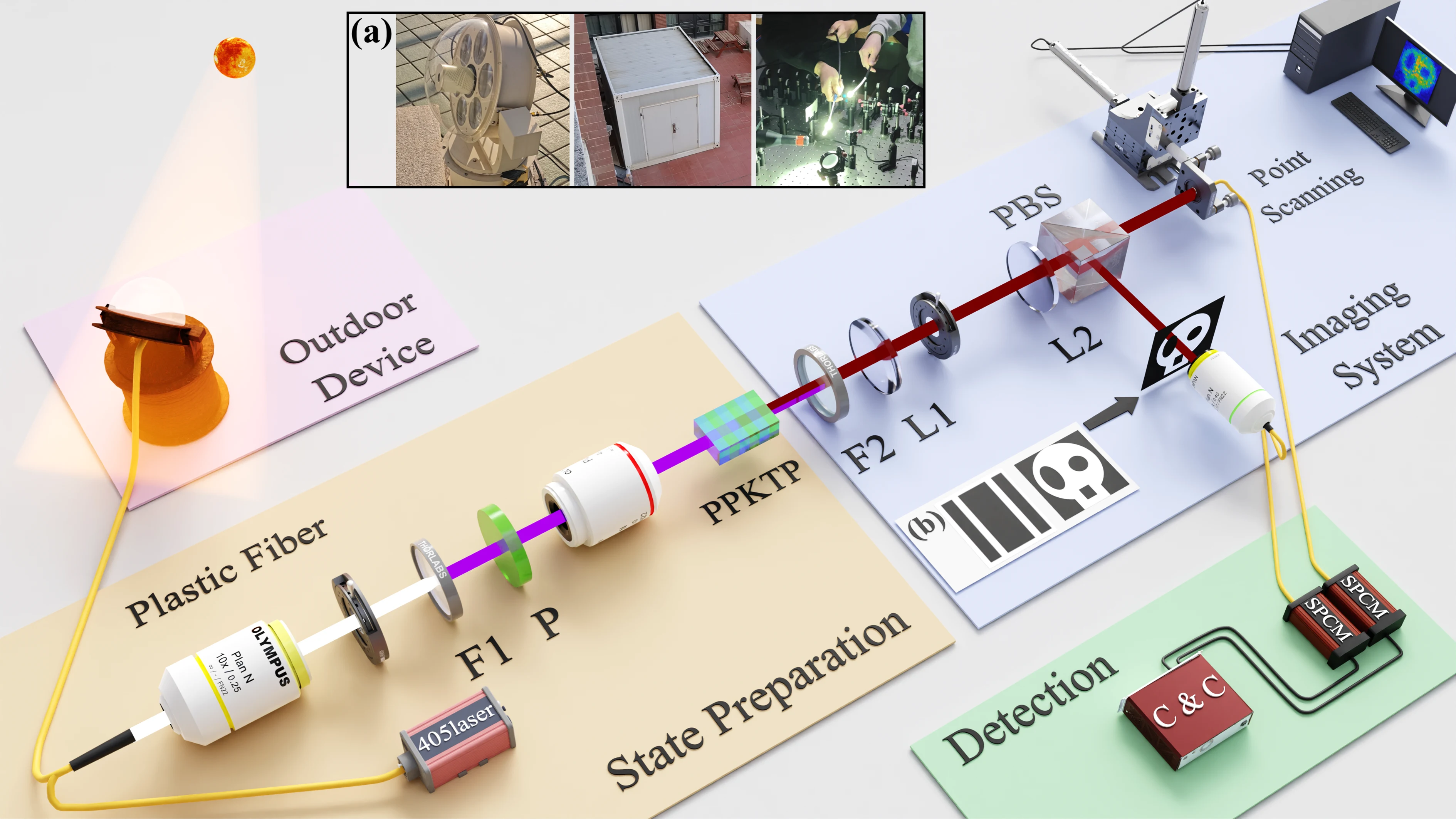
Sunlight was collected on the roof using an equatorial mount that automatically tracked the Sun, and focused by a 10 cm diameter Fresnel lens into a 20-meter-long plastic multimode fiber. In the lab, the light was collimated, passed through a polarizer and a narrowband 405 nm filter (10 nm bandwidth), and focused onto a 1×2×5 mm PPKTP crystal. The generated photon pairs were separated by a polarizing beam splitter: the signal photon passed through the object, while the idler was scanned with a point detector. Coincidences were recorded with a 1 ns time window. For comparison, the same setup was used with a single-frequency 405 nm laser attenuated to the same power of about 3 μW.
Results
With a solar pump power of about 3 μW, the coincidence rate was approximately 2.2‰ of single counts, comparable to previously reported values for LED pumping. Scanning a double slit with a 0.05 mm step produced an image with about 95% contrast, matching the laser-pumped result. A more complex object, a 'ghost face' of 2.3×2.3 mm, required a 23×23 scan grid; data were accumulated over ten days, and after summation a clear facial structure emerged. The broad solar spectrum (about 10 nm) did not destroy the position correlation of the pairs; instead, it allowed all generated pairs to be used without narrowband filtering before the detectors.
Implications
This work demonstrates for the first time that fully incoherent natural light can serve as a viable pump for quantum imaging, matching laser performance in image contrast. The distinction from neighboring experiments with LEDs and pseudo-thermal light lies in the use of solar radiation with its extremely short coherence length and unstable intensity, which demanded careful alignment and long accumulation times. This broadens the class of pump sources for quantum optics and opens the possibility of building quantum systems that are independent of lasers and electrical power.
Future development
Increasing the collection aperture, using shorter and more transparent fibers, and employing broadband nonlinear crystals or waveguides could raise the pump power to the milliwatt level and reduce image acquisition time from hours to seconds. Compressed sensing and deep learning methods could enable image reconstruction from few photons, further speeding up the process. A promising direction is the creation of sunlight-pumped entangled photon sources for space-based quantum communications, where sunlight is abundant.
Impact
The result could influence the development of space-based quantum communication, where sunlight could replace laser sources and reduce the mass and power consumption of equipment. It also paves the way for quantum imaging in field conditions without access to the power grid.
Next steps
Optimizing the light collection system and using more efficient nonlinear media to increase the pair generation rate. Applying compressed sensing algorithms to reduce scanning time and the number of measurements.
Key open problems
An open question in quantum optics is the minimum pump coherence required to preserve useful quantum correlations. This work shows that even sunlight, with a coherence length on the order of micrometers, is suitable, but the limits of this approach and the influence of atmospheric conditions remain to be studied.
The knowledge machine's view
This section is addressed to the author of the paper and their colleagues. Neighbouring works were found by meaning-based search across our archive, not by word overlap. We do not review: we show the field around the work.
What the work does
The work uses sunlight for the first time as a pump source for spontaneous parametric down-conversion, producing quantum-correlated photon pairs and imaging a double slit and a complex object with a contrast of about 95%, comparable to laser pumping.
Where its strength is
The strength of the work lies in demonstrating that fully incoherent natural light can serve as a viable pump for quantum imaging, matching laser contrast, which paves the way for laser-free and autonomous quantum sources.
Where it could go next
- It might be interesting to see how a similar solar-pumping approach applies to generating entangled states, like those discussed in the work on sunlight and quantum entanglement.based on: Sunlight Creates Quantum Entanglement arXiv:2602.15655
- A related avenue is using entangled photons for seeing through scattering media; perhaps solar pumping could extend this method to laser-free conditions.based on: Entangled Photons Find Their Target Through Fog arXiv:2602.08947
- Our archive has a full analysis of a work on quantum imaging in biological tissues; their noise suppression or signal processing techniques might help improve image quality under solar pumping.based on: The Quantum Waltz of Annihilation: What Photons Reveal About Tissues arXiv:2607.12182
Worth trying
- Try using spectral filtering before the detectors to increase the coincidence rate while maintaining contrast.
- Test a scheme with multiple crystals to increase the brightness of the solar-pumped source.
- Investigate the possibility of using sunlight for real-time quantum imaging with faster detectors.
Why this may matter
If such sources can be brought to practical application, it could radically simplify the deployment of quantum systems in remote or space conditions, where lasers and stable power supplies are unavailable.
Nearby works in our archive
- Sunlight Creates Quantum Entanglementsimilarity 0.59
- Entangled Photons from a Quantum Dotsimilarity 0.54
- How an Atomic Nucleus Catches a Photon with the Wrong Energysimilarity 0.53
- Laser learns to polarize gamma rayssimilarity 0.53
- Twin Photons for Quantum Networkssimilarity 0.52
- Entangled Photons Find Their Target Through Fogsimilarity 0.51
- The Quantum Waltz of Annihilation: What Photons Reveal About Tissuessimilarity 0.51
The archive is sparse around this work: the closest review is only 0.59, against a usual 0.64. It looks like few have drilled nearby.
Sunlight collected by a Fresnel lens and passed through 20 meters of plastic fiber had a power of just 3 microwatts—a million times less than a typical laser pointer—yet it sufficed for quantum imaging.
The idea of using natural light for quantum technologies echoes Arthur C. Clarke's novel 'Solar Wind', where spacecraft use the pressure of sunlight. Here, sunlight does not push but generates entangled pairs, yet both approaches exploit an omnipresent natural resource.
Key numbers
- image contrast: 95%
- solar pump power: 3 μW
- fiber length: 20 m
- accumulation time for complex object: 10 days
- coincidence rate: 2.2‰ of single counts