A Relativistic Quantum Heat Engine: Beating the Carnot Limit with Motion ✛
Context
Quantum heat engines have already been realized with trapped ions, atomic clouds, and superconducting qubits, but their relativistic counterparts remained mostly theoretical constructs. Neighboring works explore quantum motors based on atomic collisions, acceleration as a source of thermal radiation, and quantum engines that violate the Carnot prohibition. This article fills the gap: a continuous autonomous machine with moving reservoirs, where relativistic effects are embedded in the working mechanism itself.
Methods
We consider a three-level maser continuously interacting with two thermal reservoirs and a classical field. The reservoirs are modeled as quantum fields in thermal states, and the coupling is described by the Unruh–DeWitt Hamiltonian. The motion of the reservoirs at constant velocity is parametrized by the rapidity u, leading to a Doppler shift in photon occupancies. The system dynamics is governed by a Lindblad equation in the rotating frame, solved numerically for the steady state, and efficiency–power curves are extracted.
Results
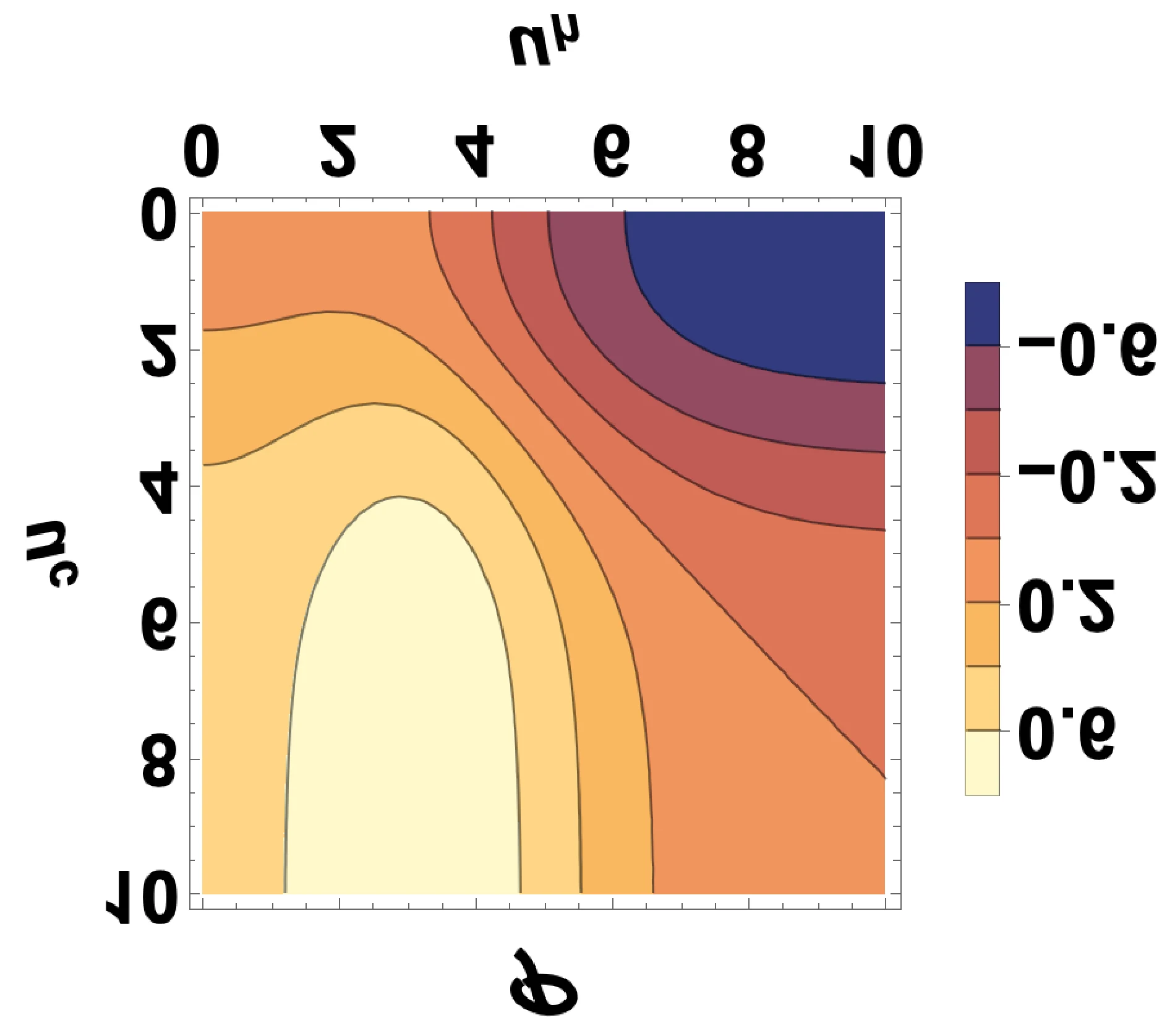
A generalized efficiency bound is found: $η_{up}$ = 1 − ($T_c$/$T_h$)·(u/sinh u), where u is the rapidity of the cold reservoir. As u→0, it reduces to the standard Carnot limit. The efficiency at maximum power can exceed the Carnot limit over a wide range of parameters, while remaining below the generalized bound. A strong asymmetry is shown between moving hot and cold reservoirs: motion of the cold reservoir favors the engine regime, while motion of the hot reservoir favors the refrigerator regime. When the reservoir temperatures are equal, positive work is extracted solely due to motion, without any temperature gradient.
Implications
This work differs from neighboring studies by using an autonomous three-level system with continuous interaction, rather than Otto cycles or two-qubit exchange engines. For the first time, an analytical form of the generalized Carnot bound is obtained for a continuous machine with moving reservoirs, confirmed by Monte Carlo methods. Relativistic motion becomes not merely a perturbation but a control parameter that changes the operating regimes.
Future development
A natural next step is to formulate a thermodynamic uncertainty relation for relativistic heat engines, linking power, fluctuations, and entropy production. Experimental implementation on platforms such as trapped ions or superconducting qubits, simulating reservoir motion through coupling modulation, would open the way to testing the predictions.
Impact
The results will impact quantum thermodynamics, relativistic quantum information, and the design of microscopic heat engines.
Next steps
Develop a thermodynamic uncertainty relation for moving reservoirs and propose an experimental scheme with controllable rapidity.
Key open problems
In quantum thermodynamics, the fundamental limits on the efficiency of engines with non-stationary reservoirs and the role of relativistic effects in entropy production remain open questions.
The knowledge machine's view
This section is addressed to the author of the paper and their colleagues. Neighbouring works were found by meaning-based search across our archive, not by word overlap. We do not review: we show the field around the work.
What the work does
This study examines a three-level quantum heat engine (maser) interacting with moving thermal reservoirs via the Unruh–DeWitt coupling. An analytical generalized Carnot bound is derived, which depends on the reservoir's rapidity, and it is shown that motion of the cold reservoir allows work extraction even when the temperatures are equal.
Where its strength is
The strength of this work lies in obtaining an analytical form of the generalized Carnot bound for a continuous engine with moving reservoirs and in demonstrating relativistic motion as a control parameter that alters the operating regimes.
Where it could go next
- It might be interesting to compare the obtained generalized Carnot bound with results for quantum engines that violate the Carnot prohibition via quantum correlations, and to look for common patterns in the extension of thermodynamic limits.based on: Quantum Engine vs. Carnot's Barrier: Power and Efficiency Without Compromise arXiv:2607.08713
- A related approach bypasses the laws of heat engines via speed; it may be worth considering how relativistic reservoir motion relates to such bypasses and whether these mechanisms can be unified.based on: Motion as Fuel: A Quantum Engine Beats Carnot arXiv:2508.11554
- In our archive there is a work on a quantum motor based on atomic collisions, where heat is controlled through microscopic coupling; perhaps adapting their coupling-control methods could expand the range of operating regimes of your engine.based on: A Quantum Motor Powered by Atomic Collisions: Steering Heat Through Microscopic Coupling arXiv:2608.12055v1
Worth trying
- Test the model with non-uniform reservoir motion (acceleration) and check how it affects the generalized Carnot bound.
- Consider the case where both reservoirs move with different rapidities and investigate possible new regimes (e.g., simultaneous work production and cooling).
- Check the robustness of the obtained bound against imperfections: finite interaction time, noise in the reservoirs.
Why this may matter
Extending the Carnot limit to the relativistic case could be relevant for understanding thermodynamics in strong gravitational fields or in relativistic quantum information, as well as for designing microscopic heat engines with controllable reservoirs.
Nearby works in our archive
- Motion as Fuel: A Quantum Engine Beats Carnotsimilarity 0.59
- A Quantum Motor Powered by Atomic Collisions: Steering Heat Through Microscopic Couplingsimilarity 0.56
- Quantum Engine vs. Carnot's Barrier: Power and Efficiency Without Compromisesimilarity 0.56
- Quantum Engines Powered by a Looksimilarity 0.53
- Glowing Atoms Create a Nearly Perfect Enginesimilarity 0.51
- Tiny Seesaw Cooled Almost to Absolute Zerosimilarity 0.51
The archive is sparse around this work: the closest review is only 0.59, against a usual 0.64. It looks like few have drilled nearby.
Even when the hot and cold reservoirs are at the same temperature, the machine can still produce useful work: it suffices that one reservoir moves at a relativistic speed.
Key numbers
- Maximum excess over the Carnot limit: up to 0.724 at u=2 and τ=0.5
- Number of random configurations in the Monte Carlo method: 105
- Transition frequency range Ω_c: 0.01–5
- Transition frequency range Ω_h: 0.01–10