Interstellar Visitors: How to Catch a Signal from Alien Technology ✛
In October 2017, the Pan-STARRS telescope in Hawaii spotted an object moving too fast to belong to the solar system. It was 1I/ʻOumuamua, the first interstellar visitor ever recorded by astronomers. Since then, two more have joined it: comet 2I/Borisov and object 3I/ATLAS. Each one is like a stone cast ashore by a wave, where we stand with a metal detector, trying to tell ordinary pebbles from artifacts of an alien mind.
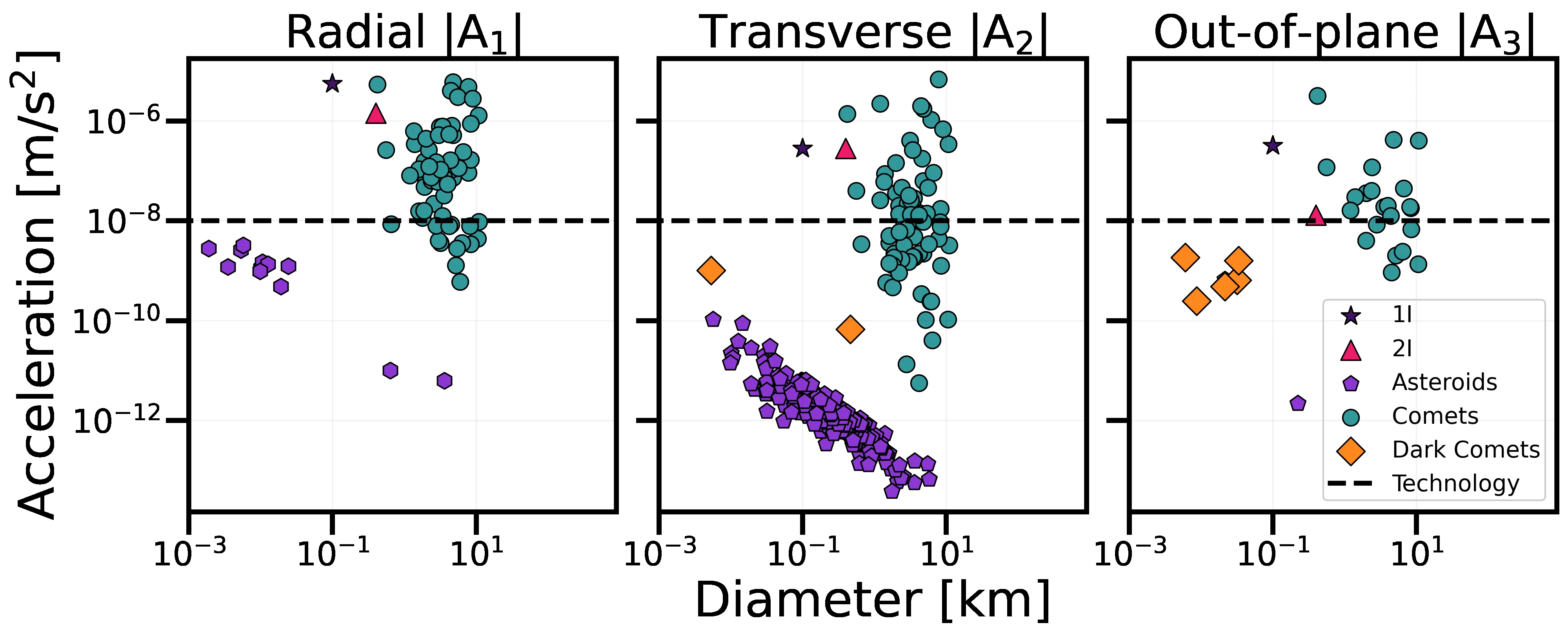
Searching for technosignatures among such objects is like combing a beach with a metal detector: we look for rare artificial items among countless natural stones, but each type of "metal" requires its own search mode. The review's authors identify four modes. First, anomalous trajectories: if an object changes speed not solely due to gravity, it could indicate an engine or mass loss. Second, unusual spectra and colors: artificial materials such as metals or plastics reflect light differently than rock and ice. Third, strange shapes: an overly elongated silhouette or a perfectly smooth surface is suspicious for nature. Fourth, artificial transmissions: a radio signal or laser beam emanating from the object would be unambiguous proof of technology.
So far, none of the three known interstellar objects has shown a clear technosignature. ʻOumuamua exhibited non-gravitational acceleration, but it can be explained by natural ice sublimation or solar radiation pressure. The colors of all three objects fall within the range of typical asteroids and comets, though they differ from each other. But that's no reason to give up: each new object is a new opportunity. With the Vera Rubin Observatory coming online, we expect to discover between 6 and 51 interstellar objects per decade, and then beachcombing will become routine. The key is to tune our metal detectors in advance for all modes and not miss the moment when a wave washes ashore something with a steely glint.
The review mentions that the Tesla Roadster launched into space in 2018 has unusual colors that stand out from most asteroids, but still fall within the range found in natural bodies.
Arthur C. Clarke's novel 'Rendezvous with Rama' describes the discovery of a large cylindrical object passing through the Solar System that turns out to be artificial, a scenario that directly resonates with the idea of searching for anomalous shapes in interstellar objects.