Interstellar Visitors: How to Hunt for Technology in Objects from Other Star Systems ✛
Context
This work fits into the rapidly growing field of technosignature searches in the Solar System, alongside studies of anomalous objects like interstellar comets and asteroids, as well as hunts for radio signals from specific targets such as 3I/ATLAS. Neighboring works have already proposed an anomaly rating scale (the 'Loeb scale'), considered interstellar comets as a possible background for dark matter searches, and even looked for Earth's shadow as a way to detect alien probes. This review stands out for its systematization: instead of dissecting a single object or a single type of signal, it offers a complete set of observational strategies for the entire population of interstellar objects.
Methods
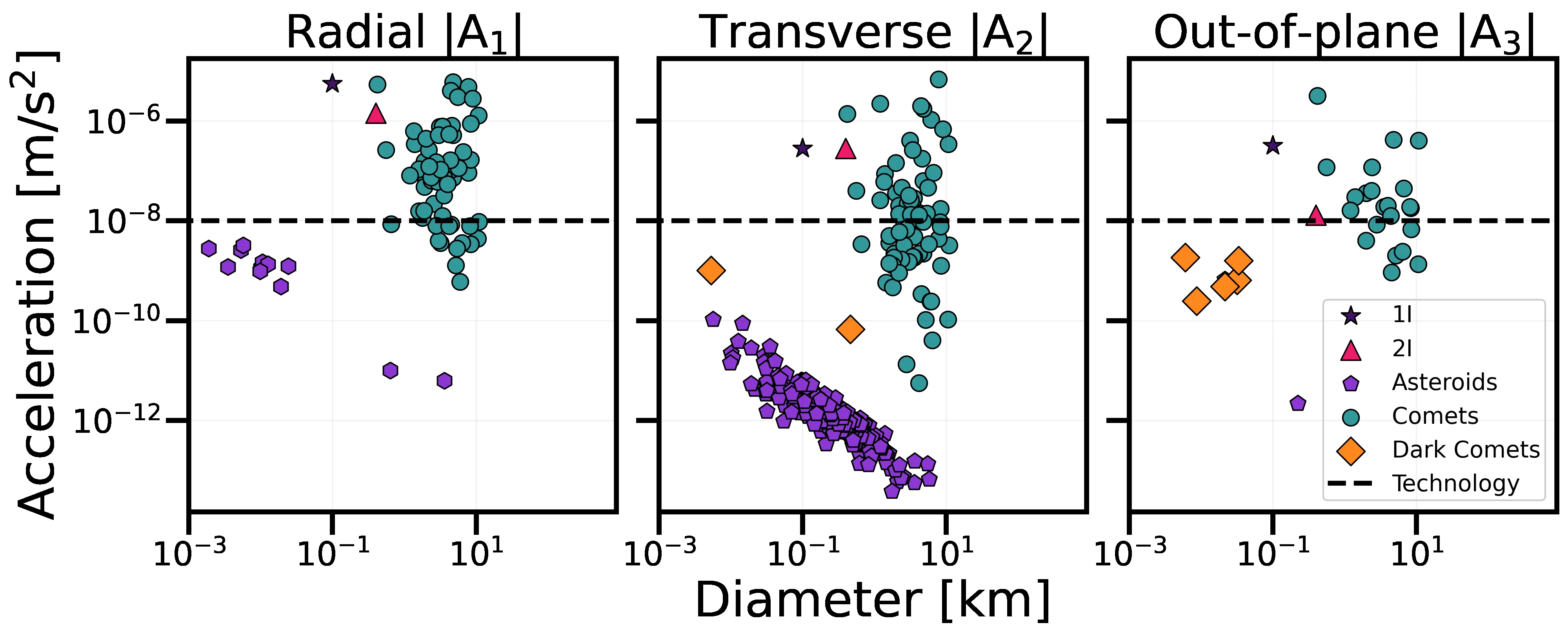
The authors did not conduct new observations; instead, they gathered and analyzed existing data and literature on the three known interstellar objects: 1I/ʻOumuamua, 2I/Borisov, and 3I/ATLAS. They identified four classes of technosignatures that can be sought in ISOs: anomalous trajectories (non-gravitational accelerations), anomalous spectra or colors, anomalous shapes, and artificial transmissions (radio or laser). For each class, they determined what observational data are needed (astrometry, photometry, spectroscopy, polarimetry, radar) and at what point during the object's passage through the Solar System these data are most informative. As illustrations, they simulated a narrowband radio signal from an object with a trajectory similar to 3I/ATLAS and added a simulated 1 W laser to the real spectrum of 3I/ATLAS to show how easily even a weak artificial signal can be detected.
Results
The review shows that searching for technosignatures in interstellar objects is possible right now with existing telescopes, and the transmitter power requirements for detecting a signal from a distance of a few astronomical units are comparable to the power of household devices such as a mobile phone. The authors emphasize that anomalies by themselves are not proof of artificial origin: for 1I/ʻOumuamua, the non-gravitational acceleration is explained by natural causes (sublimation or radiation pressure), and its elongated shape and brightness variability are consistent with a natural body. The colors of all three known ISOs fall within the range typical of ordinary Solar System asteroids and comets, although they differ from each other. Modeling shows that even a 1 W laser at a distance of 4 AU produces a flux easily discernible in low-resolution spectra, and a narrowband radio signal from an object with a known trajectory can be searched in a narrow frequency drift range, drastically reducing the search volume. The authors note that reliable identification of technosignatures requires repeated observation of the object throughout its entire flyby, since a single snapshot might miss an obvious signal.
Implications
This work differs from neighboring studies in that it does not focus on a single object or a single type of signal, but rather proposes a holistic observational scheme for the entire future population of interstellar objects. Unlike works that search for specific signals from 3I/ATLAS or consider interstellar comets as a background for other tasks, here for the first time all major classes of technosignatures are brought together and tied to the phases of an object's flyby. This makes the review a practical guide for observers, not just a theoretical discussion. Furthermore, the authors explicitly caution against hasty conclusions based on comparisons with Solar System objects, since the properties of the ISO population are still poorly known, and natural anomalies could be mistakenly taken for artificial ones.
Future development
With the Vera Rubin Observatory coming online, the discovery of between 6 and 51 interstellar objects per decade is expected, making their detection and tracking routine. This will require the SETI community to be ready for rapid follow-up observations across a wide range of wavelengths. Automated alert and observation coordination systems, similar to those used for gamma-ray bursts or gravitational waves, will likely emerge. A statistical approach to assessing object anomaly will also develop, possibly with the creation of a special scale analogous to the Torino scale for asteroid impact hazard, but the authors currently consider such a scale premature due to the small sample size.
Impact
The review's results will be useful for astronomers planning observations on large telescopes, as well as for data processing specialists from sky surveys who can anticipate rapid response modes for detecting new interstellar objects.
Next steps
The next step will be developing specific observation protocols and software for automatic analysis of Rubin Observatory data to identify anomalies in real time, as well as coordinating a network of telescopes for rapid signal confirmation.
Key open problems
A key unresolved problem in the field of technosignature search is the lack of clear criteria for distinguishing an artificial signal from a natural anomaly. This work directly addresses this problem by proposing a systematic data collection approach that will accumulate statistics on natural variations in interstellar objects, thereby increasing the reliability of future claims of technology detection.
The knowledge machine's view
This section is addressed to the author of the paper and their colleagues. Neighbouring works were found by meaning-based search across our archive, not by word overlap. We do not review: we show the field around the work.
What the work does
The authors have systematized four classes of technosignatures for interstellar objects (ISOs): anomalous accelerations, unusual spectra and colors, strange shapes, and artificial transmissions. They describe the required observations and optimal timing for each class, drawing on data from 1I/ʻOumuamua, 2I/Borisov, and 3I/ATLAS, and model the detectability of faint radio signals and lasers.
Where its strength is
The strength of this work lies in creating a comprehensive observational roadmap for searching for technosignatures across the entire population of interstellar objects, rather than analyzing individual cases, making it a practical guide for future surveys, including the Vera Rubin Observatory.
Where it could go next
- It might be interesting to compare the proposed classification with the formalized anomaly scale already used to evaluate unusual objects: this would allow unifying the criteria for selecting targets for detailed observations.based on: The Loeb Scale: When a Strange Rock Isn’t Just a Rock arXiv:2604.20896
- Related work exists on the systematic miss of fast-moving objects by telescopes; accounting for this effect could help correct the expected number of detectable ISOs and optimize observing strategies.based on: Speed Filter of the Skies: How Swift Visitors Elude Telescopes arXiv:2606.05344v1
- Since the authors consider laser signatures, it is worth noting a recent survey on searching for laser pulses from extraterrestrial civilizations: there may be additional ideas on data processing and detection thresholds.based on: Space Fireflies: Hunting for the Laser Pulse of Extraterrestrial Civilizations arXiv:2607.12106
Worth trying
- Test the application of the Loeb scale to the three known ISOs to calibrate anomaly thresholds.
- Assess how the velocity filter of sky surveys will affect the expected number of detectable interstellar objects.
- Compare the sensitivity of the proposed methods for searching for laser signatures with those from the survey on laser pulses.
Why this may matter
A systematic approach to searching for technosignatures among interstellar objects could lay the groundwork for coordinated observational campaigns and increase the chances of detecting artificial objects, if they exist, at minimal additional cost.
Nearby works in our archive
- Return of the Galactic Ghosts: Our Own Among Strangerssimilarity 0.56
- A Lunar Telescope Will Reveal the Shadows of Distant Black Holessimilarity 0.55
- Earth's Shadow Hunts for Alien Probessimilarity 0.55
- The Loeb Scale: When a Strange Rock Isn’t Just a Rocksimilarity 0.54
- Speed Filter of the Skies: How Swift Visitors Elude Telescopessimilarity 0.53
- Space Fireflies: Hunting for the Laser Pulse of Extraterrestrial Civilizationssimilarity 0.53
The archive is sparse around this work: the closest review is only 0.59, against a usual 0.64. It looks like few have drilled nearby.
The review mentions that the Tesla Roadster launched into space in 2018 has unusual colors that stand out from most asteroids, but still fall within the range found in natural bodies.
Arthur C. Clarke's novel 'Rendezvous with Rama' describes the discovery of a large cylindrical object passing through the Solar System that turns out to be artificial, a scenario that directly resonates with the idea of searching for anomalous shapes in interstellar objects.
Key numbers
- expected number of ISOs from Rubin Observatory per decade: 6–51
- speed of 3I/ATLAS: more than 60 km/s
- power of the simulated laser: 1 W
- distance at which the laser is easily detectable: 4 AU
- number of known interstellar objects: 3