A Carbon Forge on a Windy Planet Around a Pulsar ✛
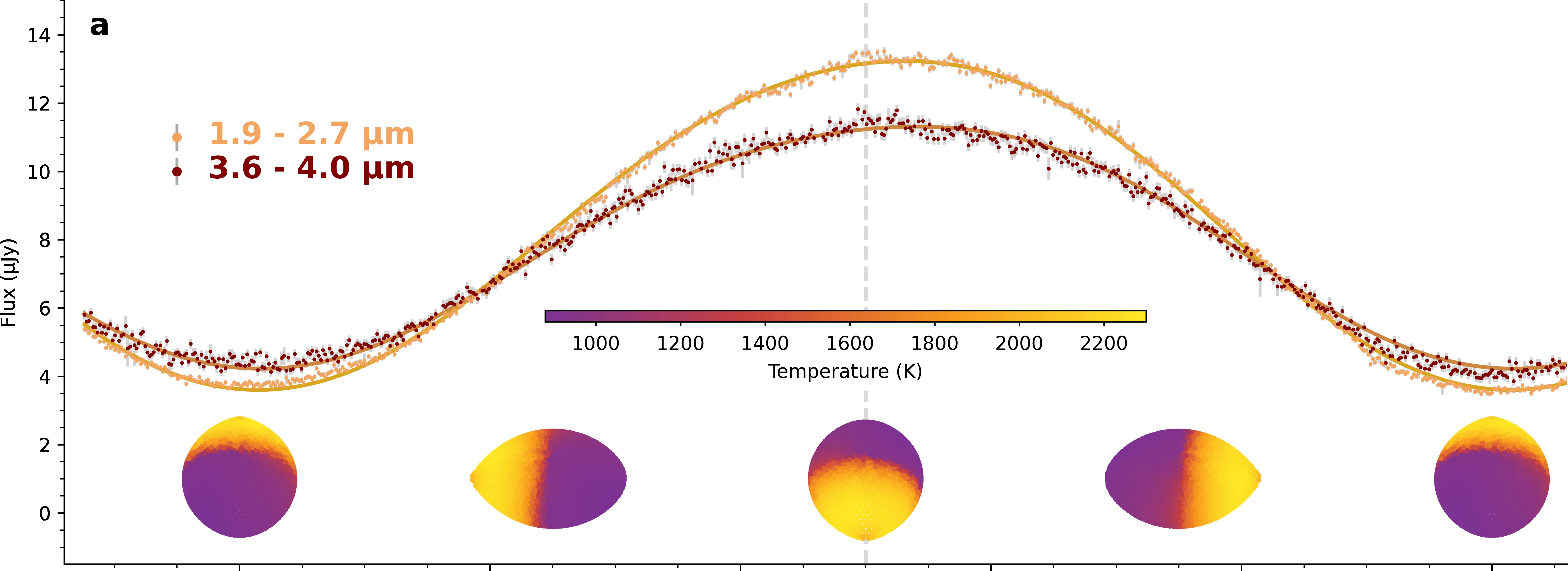
A wind blowing against the planet's rotation stokes a carbon forge. That is what the atmosphere of PSR J2322-2650b looks like: a Jupiter-like companion to a millisecond pulsar. Over two November evenings in 2024, the James Webb Space Telescope monitored this system, taking spectra from 0.6 to 5.3 micrometers. The data showed clear absorption bands that could be identified as C3 and C2 molecules. A sharp drop in C3 opacity at 3.014 micrometers coincided with a flux decrease, and a sawtooth structure between 2.45 and 2.85 micrometers revealed a series of C2 bands. Cross-correlation with a C2 template gave a detection at the 21-sigma level, while CO, CN, H2O, CH4, and other molecules were not detected at all.
The absence of CO and CN points to extremes. For carbon molecules to dominate while oxygen and nitrogen hide, the C/O ratio must exceed 100 and the C/N ratio must exceed 10,000. Such carbon enrichment is not explained by standard 'black widow' models: a pulsar evaporating its companion leaves behind a more varied elemental composition. Here, the forge has produced nearly pure carbon. Phase curve analysis added dynamics: the thermal emission peak is shifted 12° west of the sub-pulsar point. This means strong westward winds carry heat from the scorching dayside, blowing against the planet's rotation. The measured projected orbital velocity of the companion, Kp = 190 ± 2 km/s, corresponds to an orbital inclination of about 31° and a pulsar mass of about 2.0 solar masses.
Previously, the atmosphere of such an object was unknown. Denser pulsar companions have shown spectra resembling stellar ones, while exoplanet atmospheres around ordinary stars have been studied under very different conditions. Here, for the first time, a planet-like object heated by gamma-ray radiation from a pulsar has been studied, and the result was unexpected: a carbon atmosphere with an extreme chemical composition. The obtained constraints on C/O and C/N challenge formation models of 'black widows'. The observed westward shift of the thermal maximum is the first observational confirmation of the dynamical regime predicted for rapidly rotating planets with external heating.
For now, this is pure knowledge with no obvious applications. But the forge keeps working. To determine whether the composition of PSR J2322-2650b is unique or typical for the class of ultra-light pulsar companions, spectroscopic observations of other similar objects are needed, especially PSR J1719-1438. Improved line lists for C2H and C3H molecules, as well as for larger carbon clusters C4 and C5, will allow more accurate spectral modeling. Three-dimensional circulation models that account for deep gamma-ray heating will help explain the observed atmospheric dynamics. The wind that stokes the carbon forge will yet reveal how such strange worlds are born.
The temperature of the hottest spots on the dayside reaches 2300 K, which is hotter than a blast furnace used to melt steel.
A planet with a carbon atmosphere around a pulsar evokes worlds from Anne McCaffrey's novel 'Dragonsdawn', where humans colonize a planet periodically subjected to deadly stellar flares.