Black Holes: Absolute Rigidity express
If two steel balls circle each other, their mutual attraction is powerless to change each other's shape. A water ball, on the contrary, would stretch out like a droplet. A fresh analysis of gravitational waves from the merger of black holes GW250114 — the cleanest ever recorded — shows: black holes are like perfectly rigid steel balls. They do not deform, no matter how hard the neighbor pulls.
The new result, obtained after processing the signal from LIGO and Virgo detectors, sets a record bar: tidal forces caused by spacetime curvature and billions of times stronger than those the Moon exerts on Earth's oceans left not a hint of stretching. The allowable deformation is so minuscule that if a black hole were the size of a soccer ball, its point of no return (event horizon) would shift by less than the thickness of a proton. This rules out exotic hypotheses like boson stars — quantum lumps without a solid shell. Weiss and Thorne once searched for such deviations, but nature appears to prefer simplicity.
Original abstract
as written by the authors arXiv:2512.01918
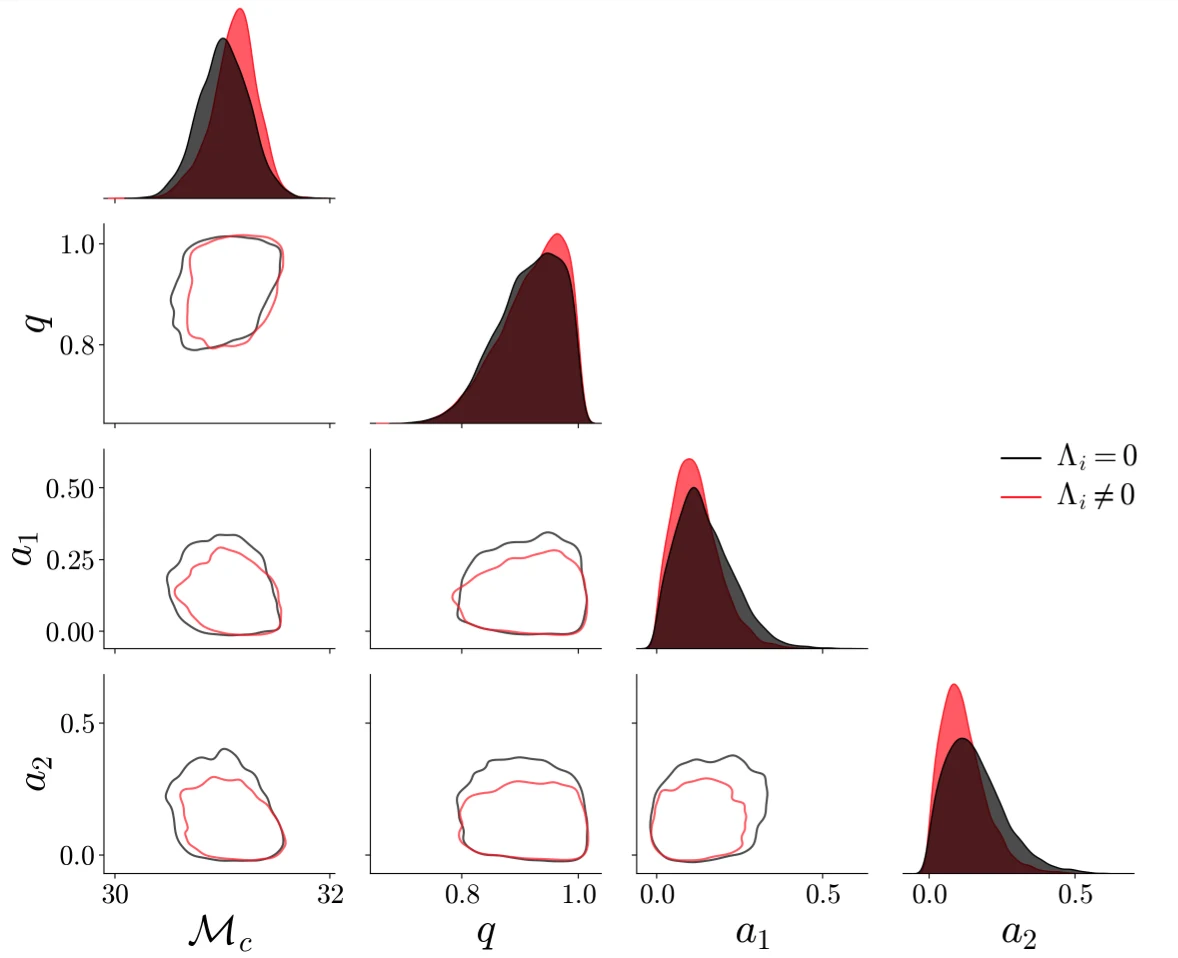
Tidal Love numbers of black holes, zero in classical general relativity for Kerr black holes in vacuum, become non-vanishing in the presence of exotic matter or in alternative theories of gravity, making them a powerful probe of fundamental physics. The gravitational-wave event GW250114, observed with an unprecedented signal-to-noise ratio, provides a unique opportunity to test this prediction. By analyzing this event, we conclude that the data is consistent with the binary black hole hypothesis, and we place a 90\% upper limit on the effective tidal deformability of $$\tilde{\Lambda} < 34.8$$. These bounds imply that any environment surrounding the black holes must contribute less than $$\sim 7\times 10^{-3}$$ of their mass, and they rule out some models of boson stars. Our findings provide the strongest observational constraints yet on black hole tidal deformability and show that the data remain fully consistent with the Kerr black hole prediction of vanishing tidal Love numbers.
If a black hole the size of a soccer ball were subjected to tidal forces, the allowable deformation of its horizon would be less than the thickness of a proton.