Popular

Black Holes: Absolute Rigidity ⚡ экспресс

Original: "No Love for black holes: tightest constraints on tidal Love numbers of black holes from GW250114"
arXiv:2512.01918 · 2025-12-01 · CC BY 4.0 · ⏱ 1 min · General Relativity High Energy
Gravitational waves from the latest merger prove that black holes don't deform one bit.
Abstract

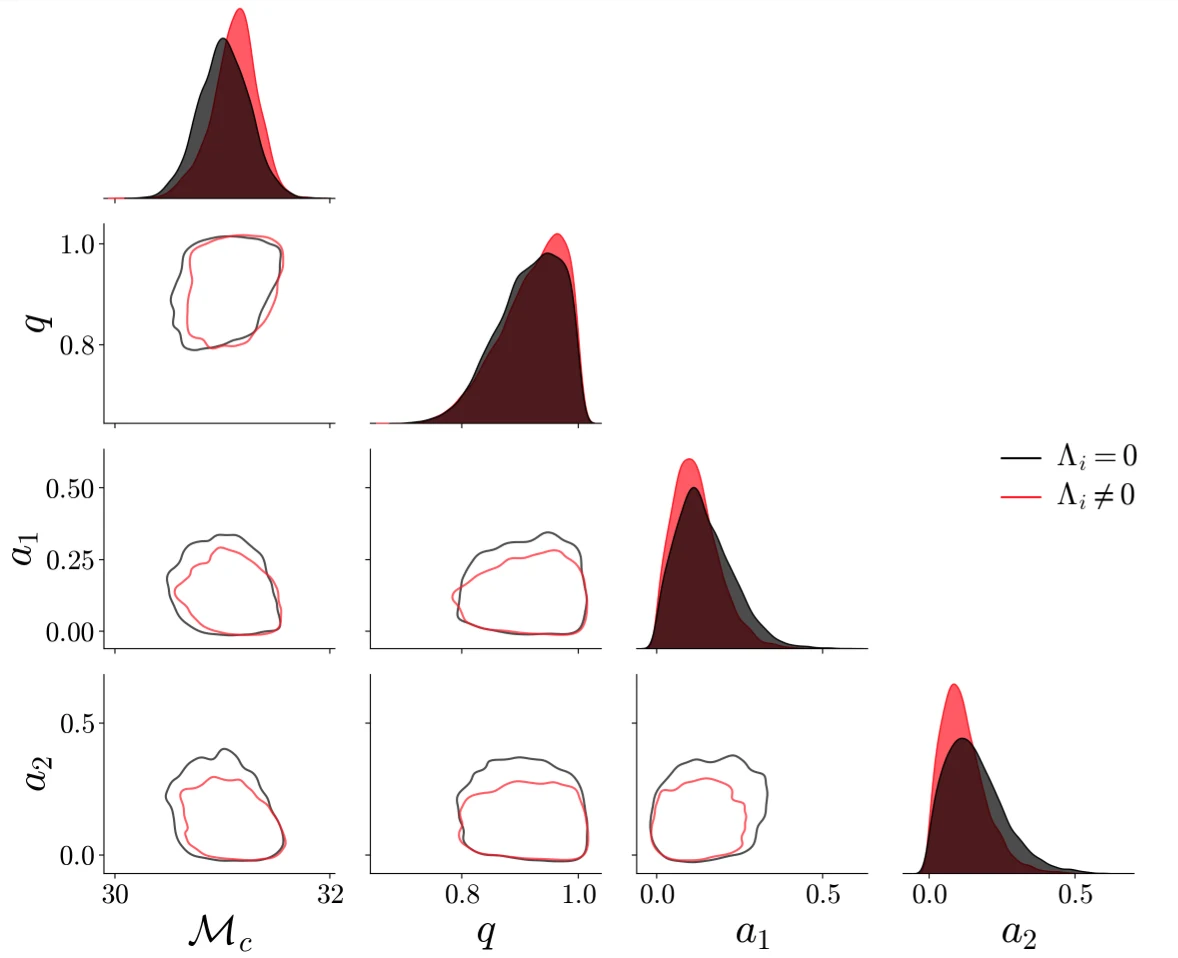
In classical theory, black holes have no tidal deformations (Love numbers), but exotic matter or modified gravity could create them. An analysis of the gravitational-wave event GW250114 with a record signal-to-noise ratio showed that the effective tidal deformability is constrained from above to a value of 34.8 (90% confidence). This means that the matter around black holes makes up less than 0.7% of their mass, which rules out some boson star models and confirms the classical picture. Just as a drop of mercury holds its shape, black holes turned out to be remarkably rigid objects.

Links in the knowledge graph 1

📄 Showing the "Simple" version — "Popular" is not ready yet. Add it to favorites to help prioritize it.

If two steel balls circle each other, their mutual attraction is powerless to change each other's shape. A water ball, on the contrary, would stretch out like a droplet. A fresh analysis of gravitational waves from the merger of black holes GW250114 — the cleanest ever recorded — shows: black holes are like perfectly rigid steel balls. They do not deform, no matter how hard the neighbor pulls.

Astrophysicists measure deformability with the Love number. For rocky Earth, it's about 0.3 — because of tides, the crust rises half a meter twice a day. For a neutron star, it's in the hundreds, but for a black hole, according to Einstein, it's exactly zero.

The new result, obtained after processing the signal from LIGO and Virgo detectors, sets a record bar: tidal forces caused by spacetime curvature and billions of times stronger than those the Moon exerts on Earth's oceans left not a hint of stretching. The allowable deformation is so minuscule that if a black hole were the size of a soccer ball, its point of no return (event horizon) would shift by less than the thickness of a proton. This rules out exotic hypotheses like boson stars — quantum lumps without a solid shell. Weiss and Thorne once searched for such deviations, but nature appears to prefer simplicity.

🎯 If a black hole the size of a soccer ball were subjected to tidal forces, the allowable deformation of its horizon would be less than the thickness of a proton.

\tilde{\Lambda} < 34.8
Dimensionless parameter of tidal rigidity: the closer to zero, the harder it is to deform an object.
Scientists
Stephen HawkingJacob BekensteinAlbert EinsteinFritz ZwickyVera RubinBernhard Riemann
Tags
gravitational waves black hole spacetime curvature
Laws
Hawking radiationgravitational lensingBekenstein-Hawking entropyEinstein field equationsequivalence principleno-hair theorem
Original: arXiv:2512.01918 · CC BY 4.0 · bridge42worlds