How the Quantum Vacuum Blurs Time express
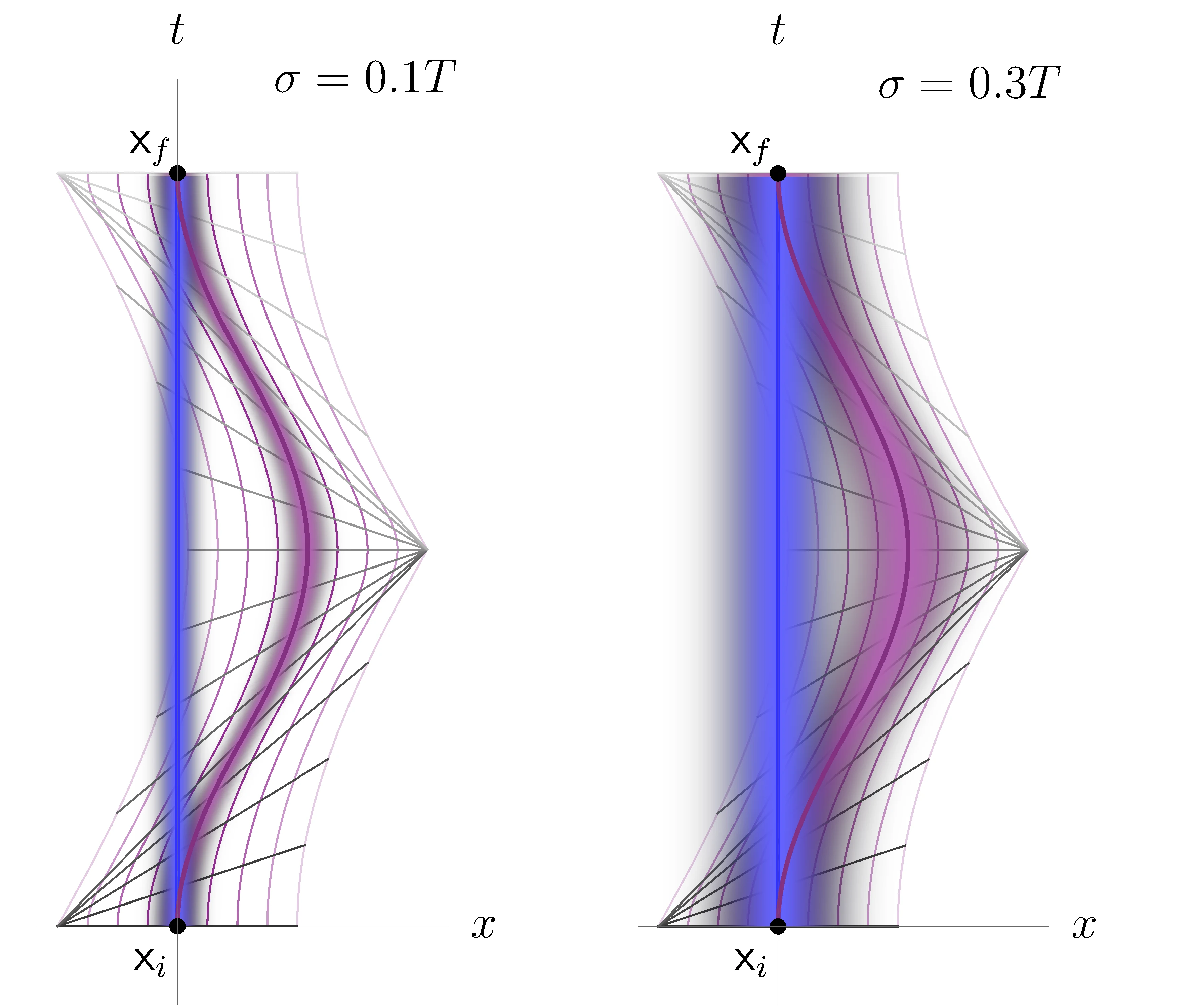
Time is like a highway: from afar it looks flawlessly paved, but zoom in and every pothole appears. These bumps are the quantum fluctuations of the vacuum, making it impossible to measure the journey exactly. Physicists built a clock model whose operation relies on spontaneous particle creation from the void. It turned out that different clocks, even when placed side by side, run at different rates — everything depends on how their design interacts with the fluctuating background. This is how the micro-world blurs time. This effect resembles the twin paradox from Einstein's theory of relativity, but here aging depends not on speed or gravity, but on internal design. The culprit is the sea of virtual particles that constantly pop in and out of existence even in absolute emptiness, as proved by Feynman in quantum field theory. This seething cannot be stopped by cooling to absolute zero or by complete isolation. It is an inherent property of space, and for anything smaller than a speck of dust, time ceases to be uniform. The most precise clocks will drift simply because they live in a bubbling world.
Original abstract
as written by the authors arXiv:2512.06076
Vacuum fluctuations in quantum field theory impose fundamental limitations on our ability to measure time at arbitrarily short scales. To investigate the impact of universal quantum field theory effects on observer-dependent time measurements, we introduce a clock model based on the vacuum decay probability of a finite-sized quantum system. This model defines an effective notion of proper time that depends on the microscopic properties of the clock and on how it samples vacuum fluctuations along its trajectory. We show that, in the long-time regime, this notion of time reduces to the usual proper time of special relativity. However, by studying a microscopic twin-paradox scenario, we find that, in general, time is not determined solely by the trajectory connecting two events, but also by how vacuum fluctuations interact with the internal structure of the clocks.
Quantum noise cannot be eliminated by cooling or shielding — it is etched into the foundation of the cosmos, making any clock eternally imprecise.