Black Hole Stretches Cloud Like Taffy express
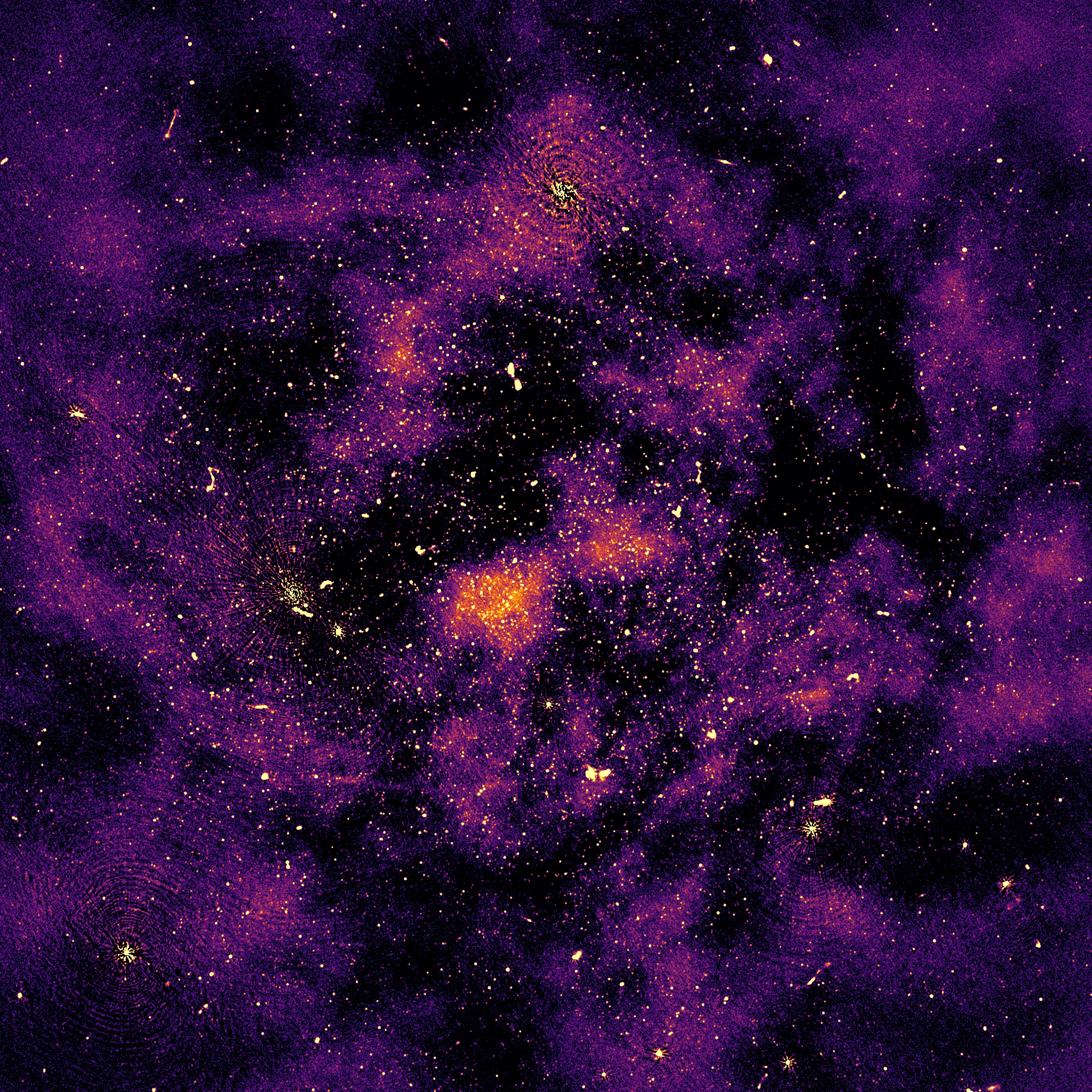
The black hole in the binary system V4641 Sagittarii behaves like a giant blender. It sucks in matter from its companion star and flings it back into space in two narrow jets. These jets slam into the surrounding gas like a water jet hitting sand, gradually carving out a huge cavity around the hole.
The MeerKAT radio telescope in South Africa observed this system for several hours. The images revealed a bow-tie-shaped cloud — two elongated loops extending from the hole in opposite directions. The cloud spans 35 light-years. That's like stretching a glowing thread from the Sun to the nearest star, then pulling it ten times longer.
What accelerates particles to such energies? Most likely, shock waves within the jets. When a fast flow plows into slower gas, it piles it up ahead like a bulldozer. At this front, particles bounce back and forth across the boundary, gaining speed. This is how electrons in the cloud get accelerated to energies thousands of times beyond what the Large Hadron Collider can achieve.
The cloud around V4641 Sagittarii is a rare find. It shows that even small black holes can 'blow' into space for decades, creating structures as large as entire star clusters. Perhaps such clouds once helped cosmic rays fill our Galaxy.
Original abstract
as written by the authors arXiv:2601.03140
Black holes (BHs) in microquasars can launch powerful relativistic jets that have the capacity to travel up to several parsecs from the compact object and interact with the interstellar medium. Recently, the detection of large-scale very-high-energy (VHE) gamma-ray emission around the black hole transient V4641 Sgr and other BH-jet systems suggested that jets from microquasars may play an important role in the production of galactic cosmic rays. V4641 Sgr is known for its superluminal radio jet discovered in 1999, but no radio counterpart of a large-scale jet has been observed. The goal of this work is to search for a radio counterpart of the extended VHE source. We observed V4641 Sgr with the MeerKAT radio telescope at the L and UHF bands and produced deep maps of the field using high dynamic range techniques. We report the discovery of a large-scale (35 pc), bow-tie-shaped, diffuse, radio structure around V4641 Sgr, with similar angular size to the extended X-ray emission discovered by XRISM. However, it is not spatially coincident with the extended VHE emission. After discussing the association of the structure with V4641 Sgr, we investigate the nature of the emission mechanism. We suggest that the bow-tie structure arose from the long-term action of large-scale jets or disk winds from V4641 Sgr. If the emission mechanism is of synchrotron origin, the radio/X-ray extended structure implies acceleration of electrons up to more than 100 TeV as far as tens of parsecs from the black hole.
The MeerKAT radio telescope consists of 64 antennas, each the size of a three-story building. Together, they capture radio waves as sharply as a single giant eye 8 kilometers in diameter.