Dark Matter from the Bends of Space express
Back in the last century, Vera Rubin discovered that stars on the outskirts of galaxies rotate too fast, as if held by some invisible substance. Since then, dark matter has remained a puzzle. Usually, its origin is linked to new particles or forces. But a new study points to a simpler source — the geometry of space itself.
Right after the Big Bang, the universe underwent inflation — a sudden expansion that physicist Alan Guth described theoretically. When inflation ended, the curvature of space changed abruptly. This shift acted on the dark matter field like a sudden dip in the road that shifts the load in a truck bed. The field briefly lost stability and ejected a flood of particles from the vacuum. Although called tachyonic instability, it doesn't mean faster-than-light motion — it's a sign of losing equilibrium, followed by the birth of matter.
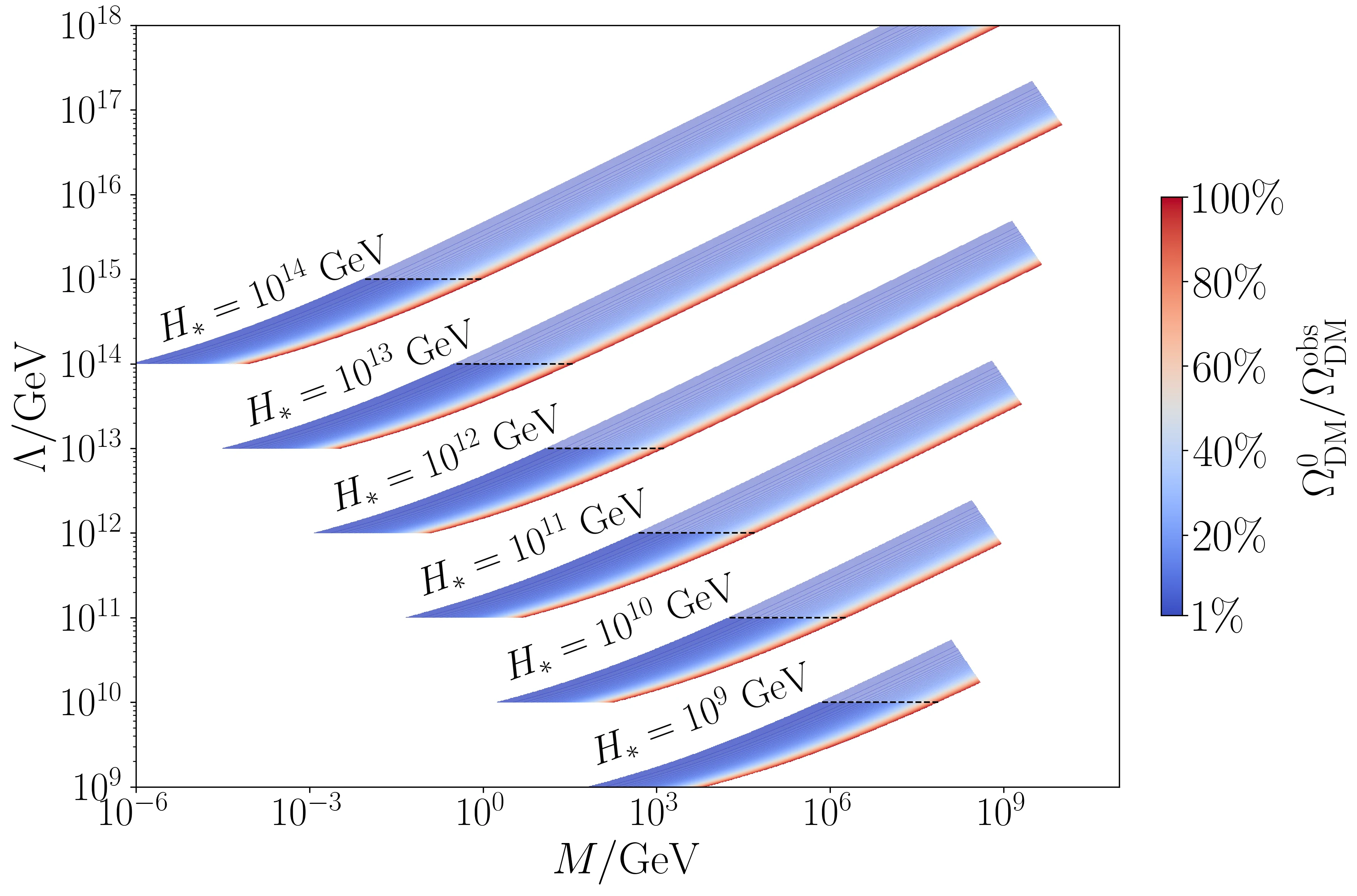
Modeling confirms that this purely gravitational mechanism yields exactly the amount of dark matter that astronomers observe. Moreover, scientists derived a simple formula to calculate its density without supercomputers. Perhaps the key to the mystery lies not in the depths of the microworld, but in the grand bends of the cosmos.
Original abstract
as written by the authors arXiv:2601.07670v2
We propose a novel gravitational mechanism for the non-thermal production of dark matter driven by curvature-induced tachyonic instabilities after inflation. Departing from the commonly studied non-minimal couplings to gravity, our framework considers a real spectator scalar field coupled quadratically to spacetime curvature invariants. We show that the rapid reorganization of spacetime curvature at the end of inflation can dynamically render the dark matter field tachyonic, triggering a short-lived phase of spontaneous symmetry breaking and explosive particle production. As a concrete and theoretically controlled example, we focus on the Gauss-Bonnet topological invariant. By combining analytical estimates with $$3+1$$ classical lattice simulations in the spectator field approximation, we track the out-of-equilibrium evolution of the system and compute the resulting dark matter abundance. We find that this purely gravitational mechanism can robustly reproduce the observed dark matter relic density over a wide range of masses and inflationary scales, providing also a simple fitting function that enables a lattice-independent application of our results.
In quantum field theory, 'tachyonic instability' does not imply faster-than-light motion — it's just a sign that the system has gone out of equilibrium and is ready for a dramatic restructuring.