The Mystery of Cosmic Dust: Weighing a Galaxy express
Astronomers pointed the James Webb at three galaxies whose light traveled 12 billion years. Early data pointed to incredibly fast growth — like an infant reaching adult height in just a year, clashing with the expansion of the Universe.
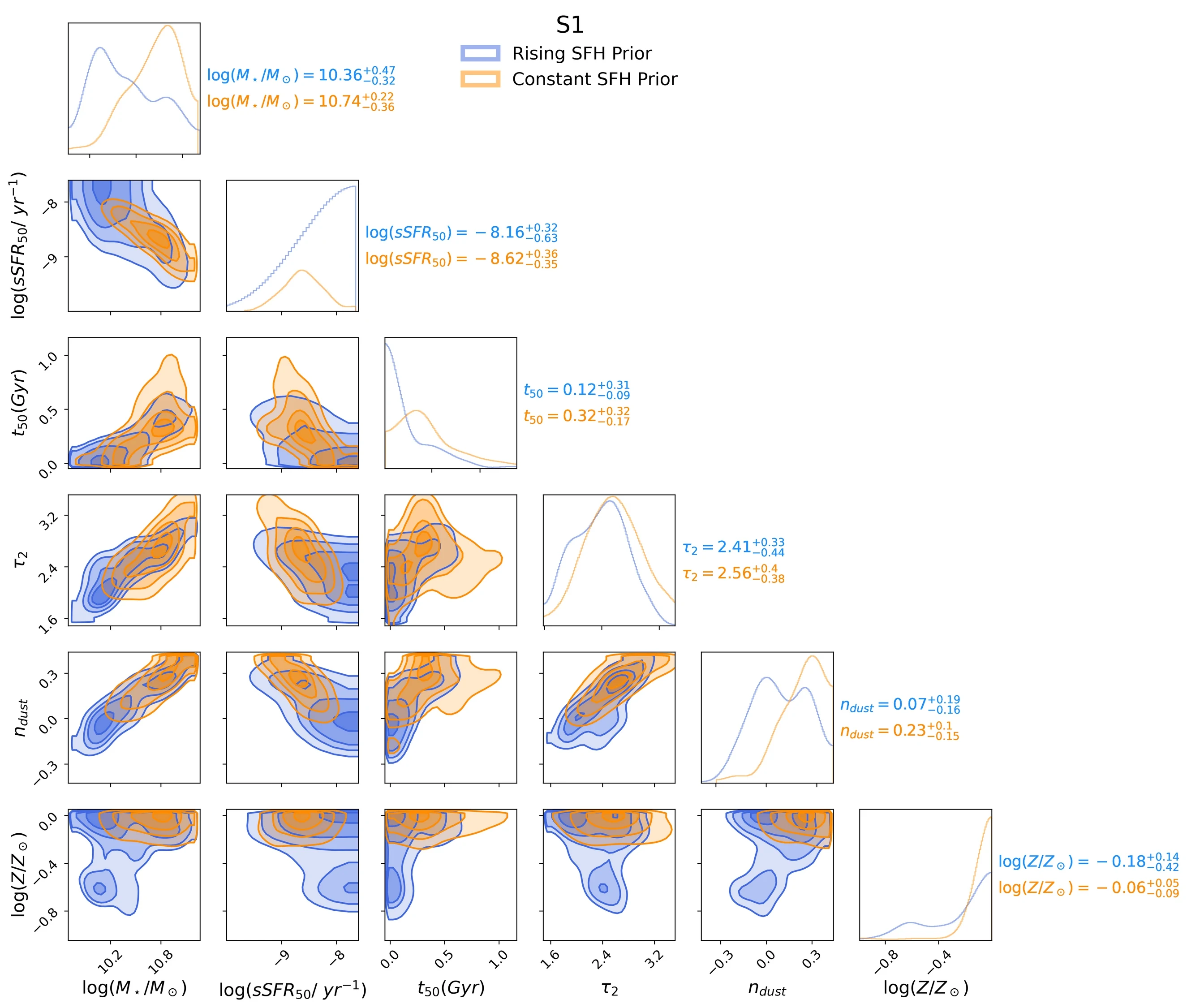
Fresh analysis of light (spectroscopy) revealed that one of the galaxies is closer, and recalculations accounting for cosmic dust (microscopic particles that hinder observations) yielded new numbers. The mass estimate depends on how much dust dims the light — as if you were weighing a statue behind glass of varying fog levels. The slightest change in opacity shifts the result. After correction, all three giants 'shed weight'; in one case, the mass was halved. Still, two remain too massive for their age, defying cosmology.
Original abstract
as written by the authors arXiv:2601.08693v2
JWST observations have suggested that some high-redshift galaxies may be ultra-massive, thereby challenging standard models of early galaxy formation and cosmology. We analyse the stellar masses using different modelling assumptions and with new data of three galaxies (S1, S2 and S3), whose NIRCam/grism redshifts were consistent with $$z>5$$. These three optically dark galaxies have previously been reported to host exceptionally high stellar masses and star-formation rates, implying extremely high star-formation efficiencies. Recent NIRSpec/IFU observations for S1 indicate a spectroscopic redshift of $$z_{\rm spec}=3.2439\pm0.0002$$, which is lower than previously reported. Using the Bayesian spectral energy distribution (SED) modelling tool \texttt{Prospector}, we investigate the impact of key model assumptions on stellar mass estimates, such as the choice of star-formation history (SFH) priors (constant versus rising SFH base for the non-parametric prior), the dust attenuation law, and the treatment of emission line fluxes. Our analysis yields revised stellar masses of $$\log(M_{\star}/M_{\odot}) \approx 10.36^{+0.47}_{-0.32}, 10.95^{+0.11}_{-0.10}$$ and $$10.31^{+0.24}_{-0.19}$$ for S1, S2, and S3, respectively. We find that adopting a rising SFH base prior results in lower inferred stellar masses compared to a constant SFH base prior. We identify a significant degeneracy between the dust attenuation curve slope, the amount of dust attenuation, and stellar mass. Our results highlight various systematics in SED modelling due to SFH priors and dust attenuation that can influence stellar mass estimates of heavily dust obscured sources. Nevertheless, even with these revised stellar mass estimates, two of the three galaxies remain among the most massive and actively star-forming systems at their respective redshifts, implying high star-formation efficiencies.
Cosmic dust grains are solid microparticles (mostly carbon and silicates) the size of a virus, born in the shells of old stars; together they create a translucent veil capable of masking whole armies of luminaries.